Rest and Recovery After 40: When to Ease Up
Soreness after a demanding workout can be temporary, but worsening symptoms or repeated drops in performance are reasons to change course.
After a hard or unfamiliar workout, muscle soreness and a temporary dip in strength can occur over the next 24 to 72 hours. 5 If you're improving, consider an easier session. If fatigue, disrupted sleep, and declining performance keep showing up together, reduce the effort or rest rather than pushing through. Seek medical advice if dizziness persists or returns, or breathlessness worsens during your usual activities. 2 1
Read the pattern, not just the soreness
A tough or unfamiliar workout, especially one with lowering movements that challenge the muscle, can be followed by soreness and temporarily reduced strength. These effects commonly show up over the next 24 to 72 hours. In a small trial of healthy adults averaging 22 years old, strength fell after a muscle-damaging exercise protocol and gradually recovered during that period. 5
That gives you a useful distinction: some post-workout soreness can be part of a short-lived response, but it isn't a reason to force another hard session. If you feel generally well and symptoms are easing, you might choose a less demanding activity. If soreness or weakness makes ordinary movement uncomfortable, skip strenuous work for now. These are practical adjustments, not a validated test or a fixed recovery timetable.
Fatigue and disrupted sleep add context. For example, one tiring workout followed by a better day is different from feeling drained across several sessions, sleeping poorly, and finding familiar workouts harder each time. No single sign proves that you're under-recovered. When several changes keep appearing together, easing the training demand and seeing whether the pattern improves is more useful than judging yourself by one sore muscle or one bad night.
Recovery questions after 40
Being over 40 does not automatically mean you need a fixed number of extra rest days. A small study comparing 12 men and 10 women found broadly similar soreness and muscle-recovery patterns after one specific high-effort isometric exercise. It also found that men had a greater drop in average power 15 minutes after exercise. Because participants were about 25, those results can't tell you how recovery changes during midlife or menopause. 4
If you notice changes in sleep, fatigue, or workout performance across menstrual-cycle phases or during perimenopause or postmenopause, compare how you feel after similar sessions and ease up if the pattern keeps recurring. A personal pattern doesn't prove that hormones are the cause or dictate a fixed number of rest days. Pay attention to what has changed for you: how demanding the session was, whether symptoms are improving, and whether your usual activities or performance feel harder repeatedly.
Choose your next move
Keep it easy or continue: If you're comfortable moving and soreness is mild and improving, choose activity that feels manageable instead of repeating a hard effort. Regular physical activity has broad health benefits, including supporting sleep, mood, and muscle strength. 3
Modify or rest: If you feel unusually drained, your performance has dipped, or soreness is affecting how you move, reduce the effort or take a break from strenuous training. Disrupted sleep alongside fatigue and repeated performance dips is another reason to ease up and reassess your training and recovery, rather than treating each sign separately or pushing through.
Get checked: Dizziness that doesn't go away or keeps coming back warrants medical advice; dizziness with fainting, changes in your pulse, weakness, or numbness also deserves attention. 2 Breathlessness that worsens during your usual activities should be assessed. Severe difficulty breathing or a tight or heavy chest requires immediate emergency help. 1 Don't assume these symptoms are caused by exercise or menopause.
A simple rule of thumb is to look for direction: after a hard workout, are symptoms easing, staying the same, or getting worse? Improving soreness may call for a lighter day. Fatigue, poor sleep, and declining performance that keep occurring together call for a change in training demands. The point isn't to meet a preset rest quota. It's to avoid treating every warning sign as a motivation problem.
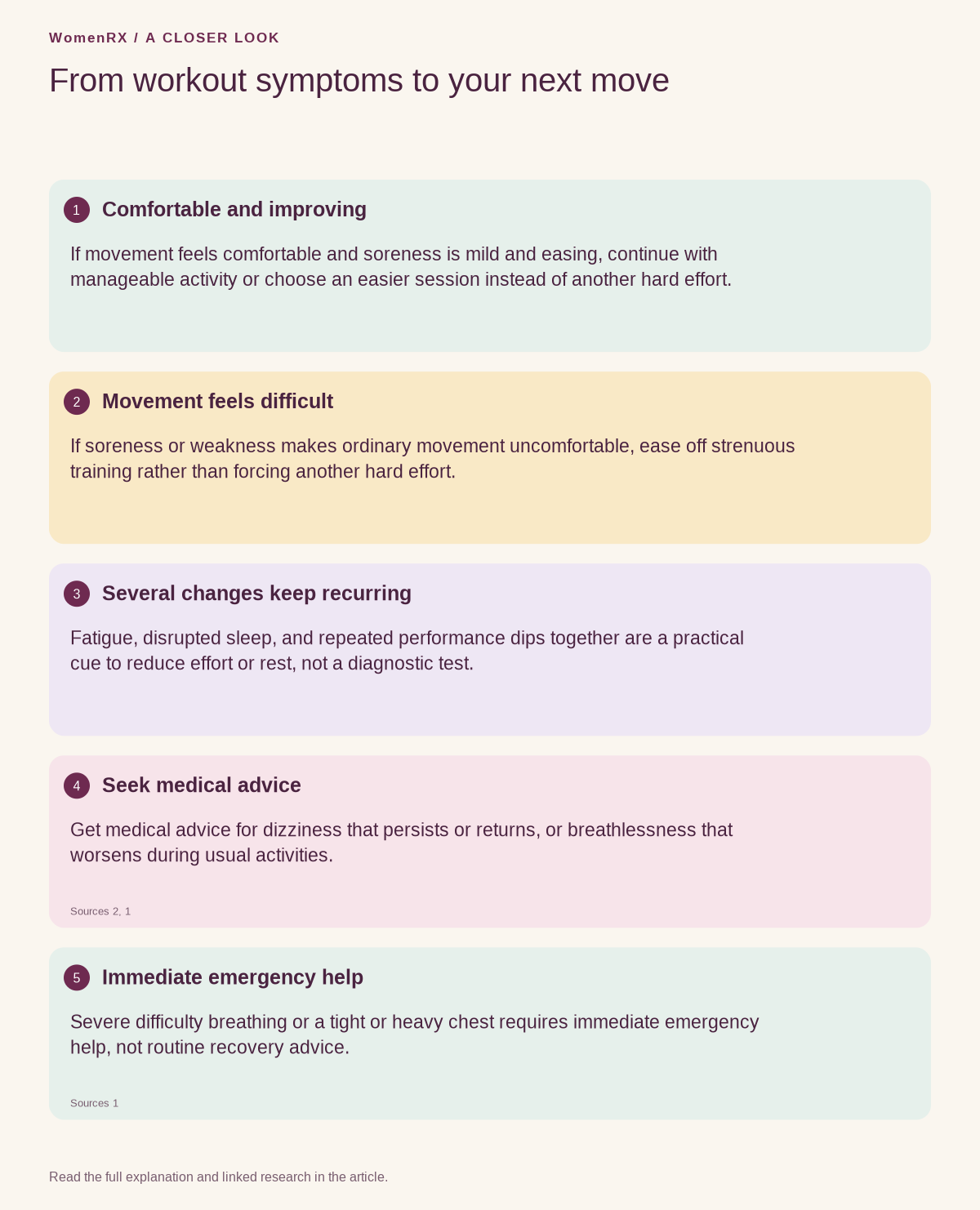
From workout symptoms to your next move
Comfortable and improving: If movement feels comfortable and soreness is mild and easing, continue with manageable activity or choose an easier session instead of another hard effort.
Movement feels difficult: If soreness or weakness makes ordinary movement uncomfortable, ease off strenuous training rather than forcing another hard effort.
Several changes keep recurring: Fatigue, disrupted sleep, and repeated performance dips together are a practical cue to reduce effort or rest, not a diagnostic test.
Seek medical advice: Get medical advice for dizziness that persists or returns, or breathlessness that worsens during usual activities.21
Immediate emergency help: Severe difficulty breathing or a tight or heavy chest requires immediate emergency help, not routine recovery advice.1
Read the figure as text
Use symptom direction and everyday function as practical cues. This is not a validated test or a prescribed recovery schedule.- Comfortable and improving: If movement feels comfortable and soreness is mild and easing, continue with manageable activity or choose an easier session instead of another hard effort.
- Movement feels difficult: If soreness or weakness makes ordinary movement uncomfortable, ease off strenuous training rather than forcing another hard effort.
- Several changes keep recurring: Fatigue, disrupted sleep, and repeated performance dips together are a practical cue to reduce effort or rest, not a diagnostic test.
- Seek medical advice: Get medical advice for dizziness that persists or returns, or breathlessness that worsens during usual activities.21
- Immediate emergency help: Severe difficulty breathing or a tight or heavy chest requires immediate emergency help, not routine recovery advice.1
More questions, answered
Does menopause automatically mean I need more rest days?
No. Notice whether soreness is easing and whether poor sleep, fatigue, or performance dips keep recurring. Menopause alone doesn't prescribe a number of rest days.
Sources you can check
- Shortness of breath - NHSAccessed 2026-09-25Return to first citation
- Dizziness - NHSAccessed 2026-09-25Return to first citation
- Benefits of Exercise: MedlinePlusAccessed 2026-09-25Return to first citation
- Influence of Sex on the Recovery Response Following Isometric Exercise Performed at Long Muscle Length.Rosaci G, Nigro F, Marcora SM, Bartolomei S. · Journal of strength and conditioning research · 2026Return to first citation
- Effects of Immediate and Delayed Repeated Cold Exposure After Physical Exertion: A Randomized Controlled Trial.Buehler C, Romitti R, Wellauer V, Clijsen R, Hohenauer E. · International journal of environmental research and public health · 2026Return to first citation