Thymosin Alpha-1: Evidence, Safety, and U.S. Status
Thymosin alpha-1 has been studied in specific illnesses, but those results don’t establish a general immune benefit or settle the safety of a product offered to you.
Thymosin alpha-1, also called thymalfasin, has human clinical research behind it, but the findings depend on the condition and what the treatment was compared with. A hepatitis B trial compared two doses; a small vaccine study measured antibody responses, not influenza prevention. Neither reported results separately for women. FDA also identifies potential risks with compounded thymosin alpha-1. Ask for the exact product and proposed use before weighing an offer. 234
If someone has offered you thymosin alpha-1 for “immune support,” start with a more precise question: support for what? The clinical findings most useful for judging this peptide come from people with particular medical conditions. They don’t show that it helps an otherwise healthy woman avoid infections, feel better, or recover faster. 23
What the human studies actually measured
In a randomized trial of 316 people in Japan with chronic hepatitis B, researchers compared two doses of thymalfasin over 24 weeks and followed participants through a 72-week observation period. The trial reported hepatitis B blood-test outcomes and found a similar incidence of adverse events in the two groups. Because both groups received thymalfasin, it cannot tell you whether the peptide works better than no treatment or a standard hepatitis B treatment. Its results also don’t transfer to an offer for general wellness. The abstract does not report outcomes separately for women. 3
A smaller pilot study tested thymosin alpha-1 alongside a pandemic influenza vaccine in people receiving hemodialysis. Among 94 participants in the intention-to-treat analysis, the vaccine-plus-peptide groups had better antibody-response measures at day 21 than the vaccine-only group. That’s a laboratory measure of vaccine response, not evidence that fewer people caught influenza. The study’s safety population included 99 people, and the investigators reported no adverse events they judged related to either thymosin alpha-1 or the vaccine. A short pilot in people receiving hemodialysis cannot establish safety for broader use. Its abstract does not give women’s results separately. 2
A 2024 review describes research across infections, cancer, and autoimmune conditions and reaches favorable conclusions about thymosin alpha-1. Its abstract does not provide condition-by-condition comparisons that would justify treating those uses as equally established. If your offer is for one of them, the evidence to examine is the study of that condition and that outcome, not the review’s overall verdict. 1
What safety information doesn’t settle
The trial reports are worth reading in context. In the hepatitis B study, reported adverse drug reactions were mild and mostly involved changes in liver-enzyme tests. In the vaccine pilot, investigators found no events they attributed to thymosin alpha-1. Neither finding rules out harms with a different population, a different product, or longer use. 23
Product type matters here. FDA identifies potential immune-reaction risks and difficulties characterizing peptide-related impurities in compounded drugs containing thymosin alpha-1. FDA also says the safety information is inadequate to fully understand the risks of the proposed compounded drug. Those concerns shouldn’t be erased by reassuring adverse-event reports from clinical trials. 4
The cited trial abstracts do not report results separately for women or address pregnancy, breastfeeding, periods, or menopause. That does not demonstrate that thymosin alpha-1 affects women differently. It means these reports cannot answer whether reproductive stage changes its benefits or risks. If pregnancy or breastfeeding is relevant to you, make that an explicit part of the product-specific discussion rather than assuming the general trial findings cover it. 23
What a U.S. offer does and doesn’t tell you
A prescription offer, a clinic webpage, or a reference to clinical trials is not, by itself, proof that the particular product is FDA-approved. U.S. rules for compounding drugs from bulk substances have several pathways and conditions. Thymosin alpha-1 is not among the six substances in the final federal list for one 503A bulk-substance pathway, but that list alone does not determine whether every proposed supply arrangement is lawful. Nor does a compounding category mean that a finished product is FDA-approved. 56
To assess the offer, get the product’s exact name, formulation, route, and source. Ask whether the finished product is FDA-approved or compounded, who would prepare and supply it, and what basis they’re using for that supply. Then ask what condition it’s meant to treat, what meaningful outcome the supporting study measured, and what it was compared with. These distinctions prevent a hepatitis B blood-test result or a vaccine antibody result from being presented as proof of a broad “immune boost.” 2356
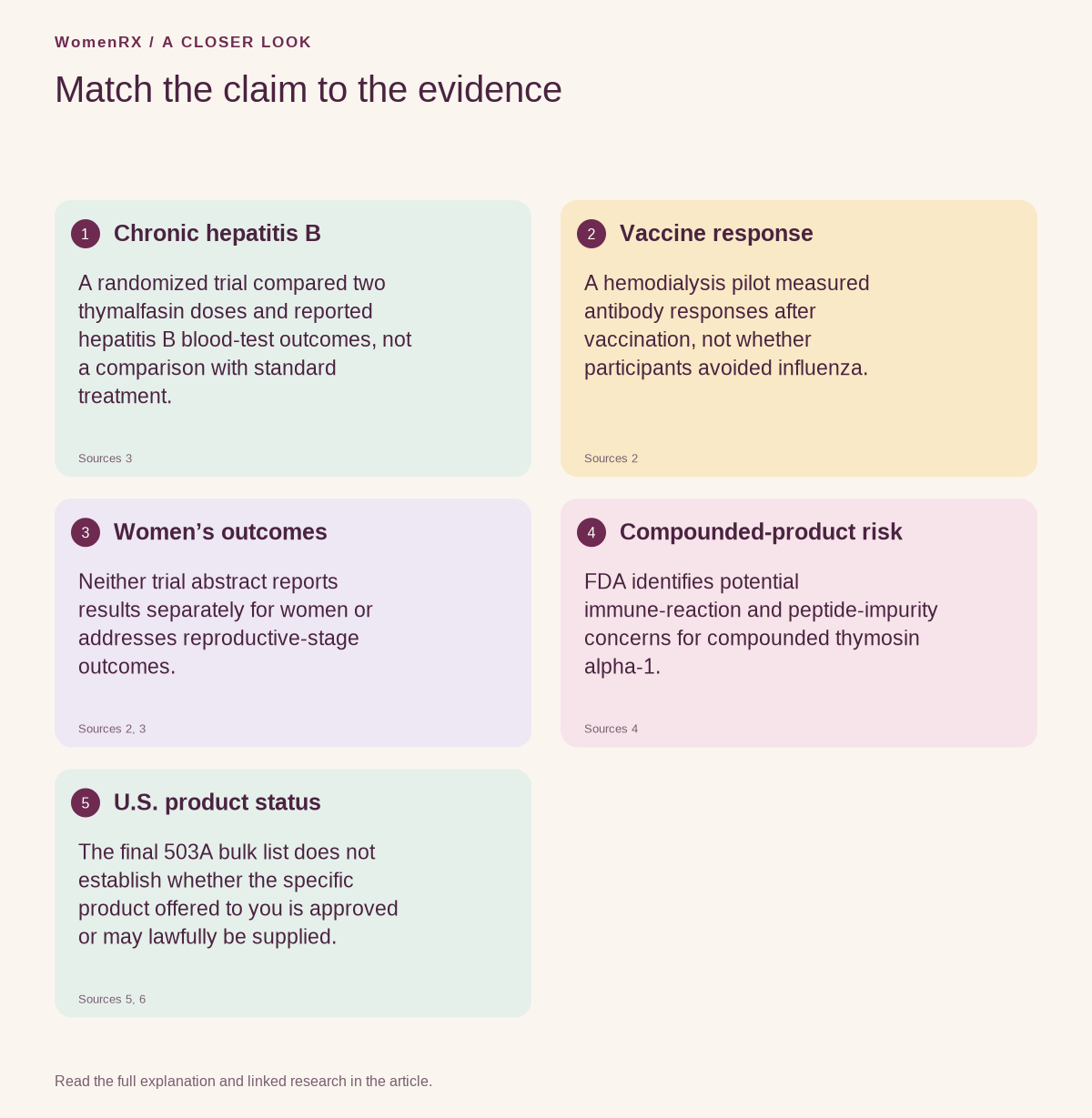
Match the claim to the evidence
Chronic hepatitis B: A randomized trial compared two thymalfasin doses and reported hepatitis B blood-test outcomes, not a comparison with standard treatment.3
Vaccine response: A hemodialysis pilot measured antibody responses after vaccination, not whether participants avoided influenza.2
Women’s outcomes: Neither trial abstract reports results separately for women or addresses reproductive-stage outcomes.23
Compounded-product risk: FDA identifies potential immune-reaction and peptide-impurity concerns for compounded thymosin alpha-1.4
U.S. product status: The final 503A bulk list does not establish whether the specific product offered to you is approved or may lawfully be supplied.56
Read the figure as text
Each finding answers a narrower question than a general claim about boosting immunity in women.- Chronic hepatitis B: A randomized trial compared two thymalfasin doses and reported hepatitis B blood-test outcomes, not a comparison with standard treatment.3
- Vaccine response: A hemodialysis pilot measured antibody responses after vaccination, not whether participants avoided influenza.2
- Women’s outcomes: Neither trial abstract reports results separately for women or addresses reproductive-stage outcomes.23
- Compounded-product risk: FDA identifies potential immune-reaction and peptide-impurity concerns for compounded thymosin alpha-1.4
- U.S. product status: The final 503A bulk list does not establish whether the specific product offered to you is approved or may lawfully be supplied.56
More questions, answered
Does a stronger vaccine antibody response mean thymosin alpha-1 prevents infection?
Not on the evidence from the hemodialysis pilot. It measured antibody responses after vaccination, not whether participants later developed influenza. 2
Does its absence from the final 503A list make every U.S. offer illegal?
No. The final list addresses one bulk-substance compounding pathway, not every possible product or supply arrangement. It also does not establish whether the product being offered to you is FDA-approved. The exact product and how it would be supplied need to be identified. 56
Sources you can check
- Comprehensive Review of the Safety and Efficacy of Thymosin Alpha 1 in Human Clinical Trials.Dinetz E, Lee E. · Alternative therapies in health and medicine · 2024Return to first citation
- Thymosin-alpha 1 (Zadaxin) enhances the immunogenicity of an adjuvated pandemic H1N1v influenza vaccine (Focetria) in hemodialyzed patients: a pilot study.Carraro G, Naso A, Montomoli E, Gasparini R, Camerini R, Panatto D, Tineo MC, De Giorgi L, Piccirella S, Khadang B, Ceracchi M, De Rosa A. · Vaccine · 2012Return to first citation
- The efficacy and safety of thymosin alpha-1 in Japanese patients with chronic hepatitis B; results from a randomized clinical trial.Iino S, Toyota J, Kumada H, Kiyosawa K, Kakumu S, Sata M, Suzuki H, Martins EB. · Journal of viral hepatitis · 2005Return to first citation
- Certain Bulk Drug Substances for Use in Compounding that May Present Significant Safety Risks | FDAAccessed 2026-09-26Return to first citation
- Bulk Drug Substances Used in Compounding Under Section 503A of the FD&C Act | FDAAccessed 2026-09-26Return to first citation
- 21CFR216.23, displayed current through September24,2026Accessed 2026-09-26Return to first citation