Retatrutide: What the Research Shows and How to Check Its Status
Retatrutide has shown weight-loss effects in clinical trials, but trial results and drug approval answer different questions.
Retatrutide is being studied for obesity and related conditions.1 Early randomized trials found greater weight loss than placebo, along with more non-severe gastrointestinal and hypersensitivity adverse events.2 Those findings don’t tell you whether a product is authorized where you live. For a current answer, ask your medicines regulator or a pharmacist to verify its status for your intended use.
What retatrutide is being studied to do
Retatrutide acts on three receptors involved in metabolic signaling: GIP, GLP-1 and glucagon receptors. Researchers are studying whether that combination can help treat obesity and conditions associated with it. The TRIUMPH phase 3 program was designed to test weight management, obstructive sleep apnea and knee osteoarthritis outcomes in separate analyses. Its design paper describes what the trials intend to measure, not their results.1
There is earlier human evidence. A 2024 systematic review pooled three placebo-controlled randomized trials involving 640 adults with overweight, obesity and/or type 2 diabetes. Retatrutide reduced body weight more than placebo, while non-severe gastrointestinal and hypersensitivity adverse events were more frequent. Those findings are promising, but the review called for phase 3 evidence on longer-term effectiveness and safety. It did not report a women-specific result in its summary.2
That leaves two separate questions: Does it work well enough, with an acceptable safety profile, for a particular use? And has a regulator authorized it for that use where you live? A trial result cannot answer the second question. Likewise, a phase 3 trial being planned or conducted isn’t an approval decision.12
How to check status without relying on a sales page
A 2026 review describes retatrutide as undergoing clinical trials for obesity and diabetes.4 That tells you what was being studied when the review was written, not whether a product is authorized where you live now. For a current answer, ask your medicines regulator or a pharmacist to verify the status of a product named retatrutide for the use you’re considering. Don’t treat a research article or a seller’s description as confirmation.
Research participation is a different question. The published TRIUMPH design describes randomized studies with defined populations and outcomes; it does not establish that any particular site is currently enrolling.1 If you’re interested in a study, ask its team whether it is enrolling and whether you might meet its eligibility criteria.
What an online offer cannot tell you
Be especially careful with an offer that skips the approval question and goes straight to selling an injectable product. A 2026 review identifies investigational retatrutide among substances appearing in the unregulated injectable market and describes potential problems with such products, including contamination, manufacturing impurities and inaccurate dosing. It does not test every product or establish that a particular seller’s vial has any one of those problems.3
A published trial can tell you what researchers found in the people they studied. It cannot verify the contents or quality of a vial offered online. The TRIUMPH design paper describes research, while the review of unregulated injectables describes potential product-quality risks; neither verifies a seller’s claims.13
Questions worth settling before considering a study
If you’re considering research participation, ask the study team which trial you’re discussing, whether it is enrolling, what condition it studies, and what follow-up it requires. Ask what is known about side effects and what the study will monitor. These questions matter because the early trials found increased non-severe gastrointestinal and hypersensitivity adverse events, while longer-term evidence was still needed when the 2024 review was published.2
If you could become pregnant, bring up pregnancy plans before deciding whether a study is right for you. Ask the study team how its protocol handles pregnancy and what reproductive-safety information is known. The trial summaries discussed here do not establish retatrutide’s safety during pregnancy; a weight-loss result in adults cannot fill that gap.12
The most useful next move depends on your question. For authorization, ask your medicines regulator or a pharmacist to verify the current status for your intended use. For research participation, ask a study team about enrollment and eligibility. For whether the evidence fits your health situation, focus on the condition studied, the comparison group, side effects and the unanswered longer-term questions, rather than the largest weight-loss figure you’ve seen quoted.12
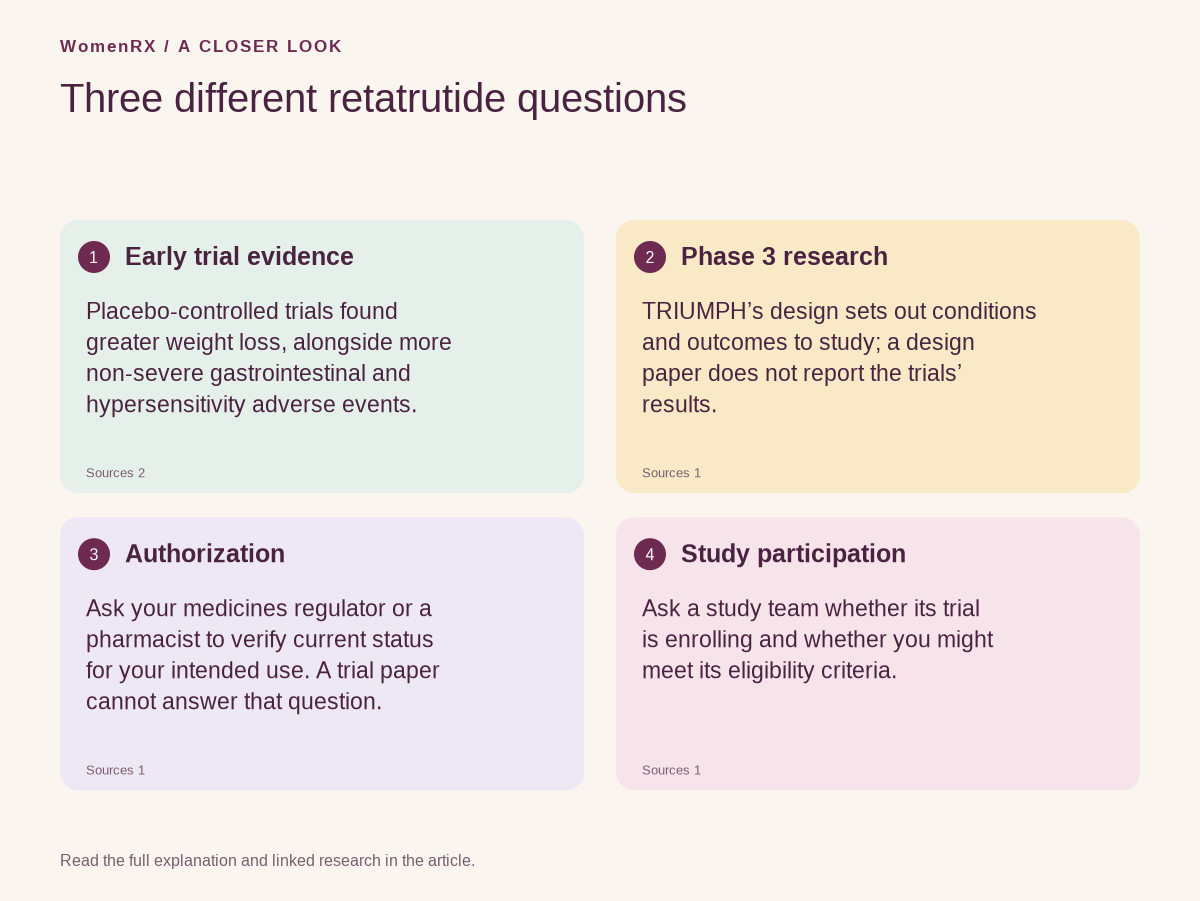
Three different retatrutide questions
Early trial evidence: Placebo-controlled trials found greater weight loss, alongside more non-severe gastrointestinal and hypersensitivity adverse events.2
Phase 3 research: TRIUMPH’s design sets out conditions and outcomes to study; a design paper does not report the trials’ results.1
Authorization: Ask your medicines regulator or a pharmacist to verify current status for your intended use. A trial paper cannot answer that question.1
Study participation: Ask a study team whether its trial is enrolling and whether you might meet its eligibility criteria.1
Read the figure as text
Research findings, authorization and study participation answer different questions.- Early trial evidence: Placebo-controlled trials found greater weight loss, alongside more non-severe gastrointestinal and hypersensitivity adverse events.2
- Phase 3 research: TRIUMPH’s design sets out conditions and outcomes to study; a design paper does not report the trials’ results.1
- Authorization: Ask your medicines regulator or a pharmacist to verify current status for your intended use. A trial paper cannot answer that question.1
- Study participation: Ask a study team whether its trial is enrolling and whether you might meet its eligibility criteria.1
More questions, answered
Does a phase 3 trial mean retatrutide is approved?
No. The TRIUMPH phase 3 design describes research intended to assess outcomes and safety, not an authorization decision. Ask your medicines regulator or a pharmacist to verify the current status where you live.1
Sources you can check
- Retatrutide for the treatment of obesity, obstructive sleep apnea and knee osteoarthritis: Rationale and design of the TRIUMPH registrational clinical trials.Giblin K, Kaplan LM, Somers VK, Le Roux CW, Hunter DJ, Wu Q, Lalonde A, Ahmad N, Bethel MA. · Diabetes, obesity & metabolism · 2026Return to first citation
- Effects of once-weekly subcutaneous retatrutide on weight and metabolic markers: A systematic review and meta-analysis of randomized controlled trials.Pasqualotto E, Ferreira ROM, Chavez MP, Hohl A, Ronsoni MF, Pasqualotto T, Moraes FCA, Hespanhol L, Figueiredo Watanabe JM, Lütkemeyer C, van de Sande-Lee S. · Metabolism open · 2024Return to first citation
- Dangers of Injectable Peptides and Other Unregulated "Biohacking" Drugs.Moiz A, O'Keefe EL, O'Keefe JH. · Missouri medicine · 2026Return to first citation
- The role of GLP-1 and GIP receptor agonists in the treatment of diabetes and obesity.Roskoski R. · Pharmacological research · 2026Return to first citation