Supplements for Hormone-Related Symptoms: Match Claims to Evidence
A supplement studied for one symptom or life stage isn’t automatically useful for another, and “hormone balance” is too vague to tell you what it might do.
There isn’t one supplement shown to balance women’s hormones generally. Evidence needs to match the concern: studies of premenstrual symptoms don’t establish benefits for PCOS or fertility, and menopause research focuses on outcomes such as hot flashes. For menopausal hot flashes, a major evidence review does not recommend supplements or herbal remedies; evidence for some PMS supplements is limited and mixed. 3 5 6
Start with the symptom, not “hormone balance”
“Hormone balance” can sound like a clear health goal, but it doesn’t name a symptom, diagnosis, or outcome a supplement has been shown to change. A more useful question is: Has this specific product been studied for the problem I have, in people like me, and did it improve the outcome I care about?
That distinction matters because menstrual symptoms, PCOS, fertility concerns, and menopause aren’t interchangeable. A result for one group or symptom can’t be assumed to apply to another.
PMS: some suggestions, but limited certainty
For premenstrual syndrome (PMS), a 2010 review reported that calcium supplements and chasteberry (also called Vitex agnus-castus) had evidence of benefit. But a later review of botanicals and women’s health said rigorous clinical trials for PMS botanicals had not been done. Taken together, these reviews don’t support treating chasteberry as a sure or broadly proven fix. 5 6
If you’re considering a PMS product, look for evidence tied to PMS symptoms rather than a general promise to “regulate hormones.” Also check whether the product and the outcome studied match what you’re considering: botanical preparations can differ, so a study of one preparation may not tell you much about another. 5
PCOS and fertility are separate questions
This evidence does not establish a supplement benefit for PCOS or fertility. That isn’t proof that no research exists; it means PMS or menopause findings shouldn’t be used as a substitute for condition-specific evidence. If a product promises to support ovulation, improve fertility, or treat PCOS, look for research on that exact outcome and population, not just claims about hormone levels or women’s health generally.
Menopause: hot-flash evidence doesn’t support herbal remedies
For bothersome hot flashes and night sweats, the North American Menopause Society’s 2023 evidence review did not recommend supplements or herbal remedies. This is a finding about the evidence for menopausal vasomotor symptoms, not proof that every supplement has been tested for every menopause concern. 3
Black cohosh is a useful example of why the details matter. A review of 16 randomized trials involving 2,027 women found the studies varied substantially in their design, duration, preparations, and results; the reviewers concluded that evidence was insufficient to support or oppose its use for menopausal symptoms. Products also vary in composition, and the compounds that might account for relief are not known. 1
A separate randomized trial helps put another popular category in perspective. Among 252 recently postmenopausal women with frequent hot flashes, red-clover supplements did not produce a clinically important benefit compared with placebo over 12 weeks. That result applies to the studied products and participants, not every supplement or every menopause symptom. 4
If hot flashes are disrupting your life, supplements aren’t the only option to discuss. The 2023 position statement identifies several evidence-supported nonhormone treatments, and the Menopause Society’s 2022 statement describes hormone therapy as the most effective treatment for vasomotor symptoms. Which options fit depends on your health and preferences. 2 3
A practical check before buying
Use this short screen to make a product claim more specific:
- Name the outcome. Is the promise about PMS symptoms, hot flashes, fertility, or something else?
- Match the population. Was the product studied in people with that symptom or diagnosis, rather than in a different group?
- Check the exact preparation. For botanicals, the plant name and preparation matter; different products may not be equivalent. 1
- Read the full ingredient list. Botanicals aren’t automatically free of risk. They may have medication interactions, and potential toxic effects and interactions haven’t been rigorously tested for many botanicals. Bring the ingredient list to a pharmacist or clinician if you take medication or have a health condition. 5
- Be wary of broad promises. “Balances hormones” doesn’t tell you which symptom was studied or what changed.
The aim isn’t to reject every supplement. It’s to avoid paying for a broad promise when the useful evidence, if any, is tied to a much narrower symptom, population, and product.
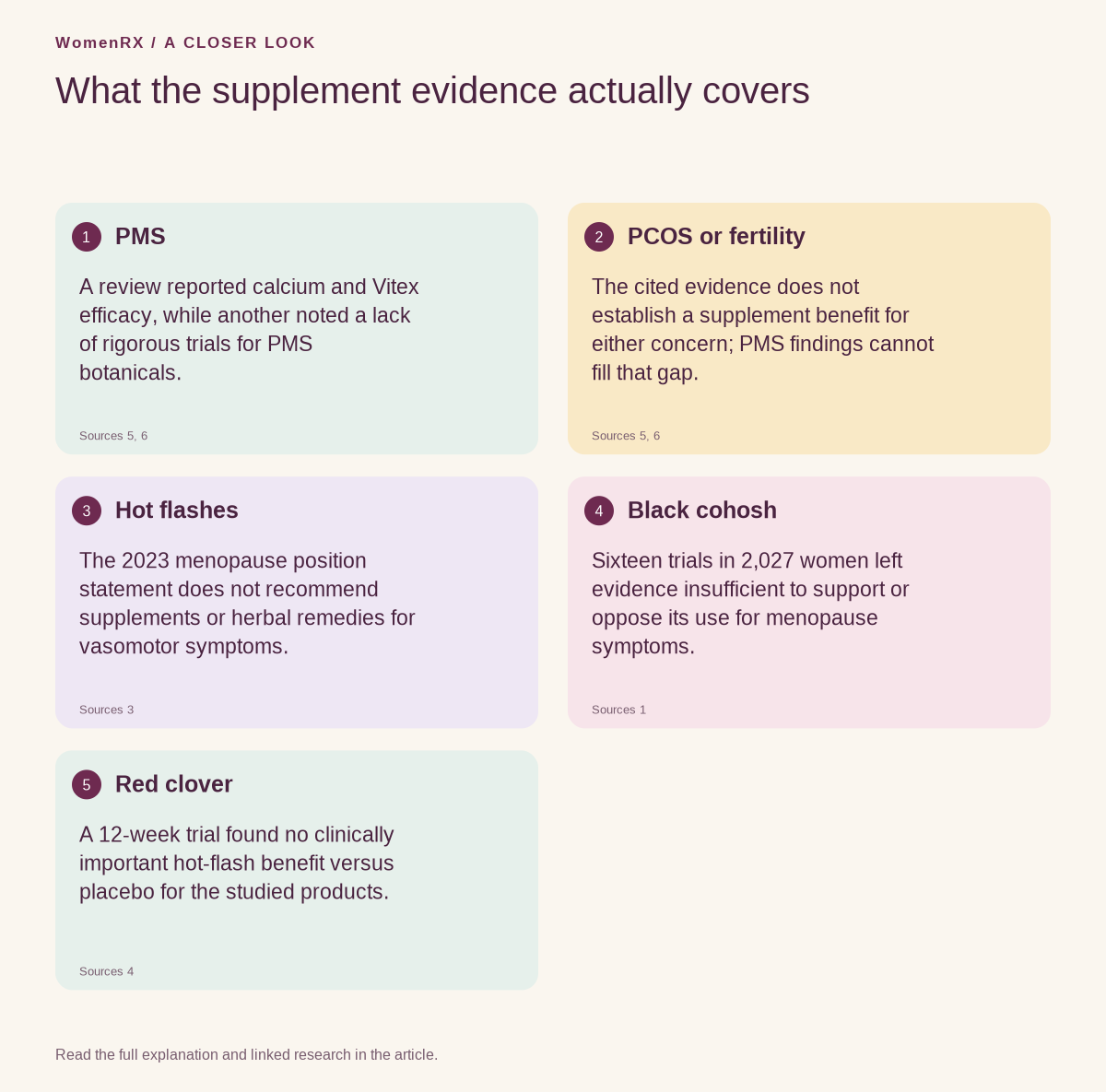
What the supplement evidence actually covers
PMS: A review reported calcium and Vitex efficacy, while another noted a lack of rigorous trials for PMS botanicals.56
PCOS or fertility: The cited evidence does not establish a supplement benefit for either concern; PMS findings cannot fill that gap.56
Hot flashes: The 2023 menopause position statement does not recommend supplements or herbal remedies for vasomotor symptoms.3
Black cohosh: Sixteen trials in 2,027 women left evidence insufficient to support or oppose its use for menopause symptoms.1
Red clover: A 12-week trial found no clinically important hot-flash benefit versus placebo for the studied products.4
Read the figure as text
Compare the symptom or condition studied with what the cited evidence can and cannot say.- PMS: A review reported calcium and Vitex efficacy, while another noted a lack of rigorous trials for PMS botanicals.56
- PCOS or fertility: The cited evidence does not establish a supplement benefit for either concern; PMS findings cannot fill that gap.56
- Hot flashes: The 2023 menopause position statement does not recommend supplements or herbal remedies for vasomotor symptoms.3
- Black cohosh: Sixteen trials in 2,027 women left evidence insufficient to support or oppose its use for menopause symptoms.1
- Red clover: A 12-week trial found no clinically important hot-flash benefit versus placebo for the studied products.4
More questions, answered
Does “natural” mean a supplement is safe to combine with medication?
No. Botanicals may interact with medicines, and potential interactions haven’t been rigorously tested for many of them. Check the complete ingredient list with a pharmacist or clinician rather than assuming a product is safe because it’s plant-based. 5
Is black cohosh proven to relieve hot flashes?
No. A review of 16 trials involving 2,027 women found substantial differences among studies and concluded that the evidence was insufficient to support or oppose black cohosh for menopausal symptoms. 1
Sources you can check
- Black Cohosh - Health Professional Fact SheetAccessed 2026-09-25Return to first citation
- The 2022 hormone therapy position statement of The North American Menopause Society.“The 2022 Hormone Therapy Position Statement of The North American Menopause Society” Advisory Panel. · Menopause (New York, N.Y.) · 2022Return to first citation
- The 2023 nonhormone therapy position statement of The North American Menopause Society.Menopause (New York, N.Y.) · 2023Return to first citation
- Phytoestrogen supplements for the treatment of hot flashes: the Isoflavone Clover Extract (ICE) Study: a randomized controlled trial.Tice JA, Ettinger B, Ensrud K, Wallace R, Blackwell T, Cummings SR. · JAMA · 2003Return to first citation
- Botanicals and Their Bioactive Phytochemicals for Women's Health.Dietz BM, Hajirahimkhan A, Dunlap TL, Bolton JL. · Pharmacological reviews · 2016Return to first citation
- Therapeutic management of premenstrual syndrome.Freeman EW. · Expert opinion on pharmacotherapy · 2010Return to first citation