Stress and Digestive Symptoms: How the Gut-Brain Link Works
Stress can change how your gut moves and how strongly you feel its signals, without explaining away every digestive symptom.
Your brain and gut communicate in both directions. Stress-related signals can affect gut movement and sensitivity, while signals from the gut shape what you feel as discomfort or pain. This can help explain an IBS flare during a stressful week, but it can’t tell you whether stress caused your particular symptoms or rule out another cause. 851
How stress fits into an IBS pattern
Stress is a whole-body response to a challenge, not just a feeling in your head. It includes the release of hormones that help your body respond to a demand. Your gut and brain also exchange signals. In IBS, stress-related changes in those signals may affect how quickly the gut moves and how sensitive it is. Signals traveling back from the gut can make ordinary digestive activity feel painful or uncomfortable. That’s one explanation for why symptoms can intensify during stress, not evidence that the pain is imaginary or that stress is the only cause. 385
The characteristic IBS pattern includes recurring abdominal discomfort or pain that changes with a bowel movement, along with a change in stool pattern. Food and mental stress can both worsen symptoms for some people. If your stomach hurts before a demanding meeting, then settles afterward, stress may be part of the picture. If the same pain also follows meals or changes when you have a bowel movement, those details matter too. Neither pattern, on its own, diagnoses IBS. 56
Look for a pattern without deciding on a cause too soon
A short, simple record can help separate things that tend to happen together. Note where you feel discomfort, whether you have diarrhea or constipation, and whether the discomfort changes after a bowel movement. Alongside that, jot down meals, unusually stressful events, and, if you have periods, where you are in your cycle. This is a way to describe your experience clearly, not a test that can prove stress caused it. 547
For example, cramps that reliably begin just before a period and spread toward the back or thighs may deserve a different conversation from abdominal discomfort that comes with a change in stool. Period pain can also have causes that need assessment, particularly when periods become more painful, heavier, or irregular, or pain occurs with sex, urination, or bowel movements. 4
Which steps address stress, and which address gut symptoms?
There’s a difference between helping yourself through a stressful day and treating a recurring digestive condition:
- For stress in general: Regular activity, enough sleep, and relaxing activities such as breathing or muscle relaxation are reasonable ways to manage stress. They may be worth trying for how you feel overall, but that general advice doesn’t establish that they’ll resolve your digestive symptoms. 3
- For persistent IBS symptoms: Cognitive behavioral therapy (CBT) is a gut-brain-focused option discussed in IBS research. The IBS reviews include psychological therapies among possible treatments, particularly when symptoms remain difficult to manage; they don’t predict whether CBT will help you individually. Considering it doesn’t mean the symptoms are made up. 58
- For supplements marketed for stress: Ashwagandha has been studied for perceived stress, not established as an IBS treatment. It can itself cause stomach upset, nausea, or loose stools, which makes it a poor way to sort out unexplained digestive symptoms. Its safety is also uncertain in pregnancy and breastfeeding. 2
The useful question is not “Is this stress or is this real?” It’s “What pattern am I seeing, and does it call for symptom-specific care?” Managing stress and checking for another cause can happen at the same time. There’s no single test for IBS, and depending on your symptoms, a clinician may use tests to check for conditions such as celiac disease, infection, or inflammatory bowel disease. 7
When not to wait for the pattern to become clear
Contact a healthcare provider if mild abdominal pain lasts a week or more, or if pain comes with other symptoms. Get medical help immediately for sudden, sharp abdominal pain; vomiting blood or blood in your stool; a stiff, hard, tender abdomen; or an inability to move your bowels, especially with vomiting. These signs need attention even if you’re under a lot of stress. 1
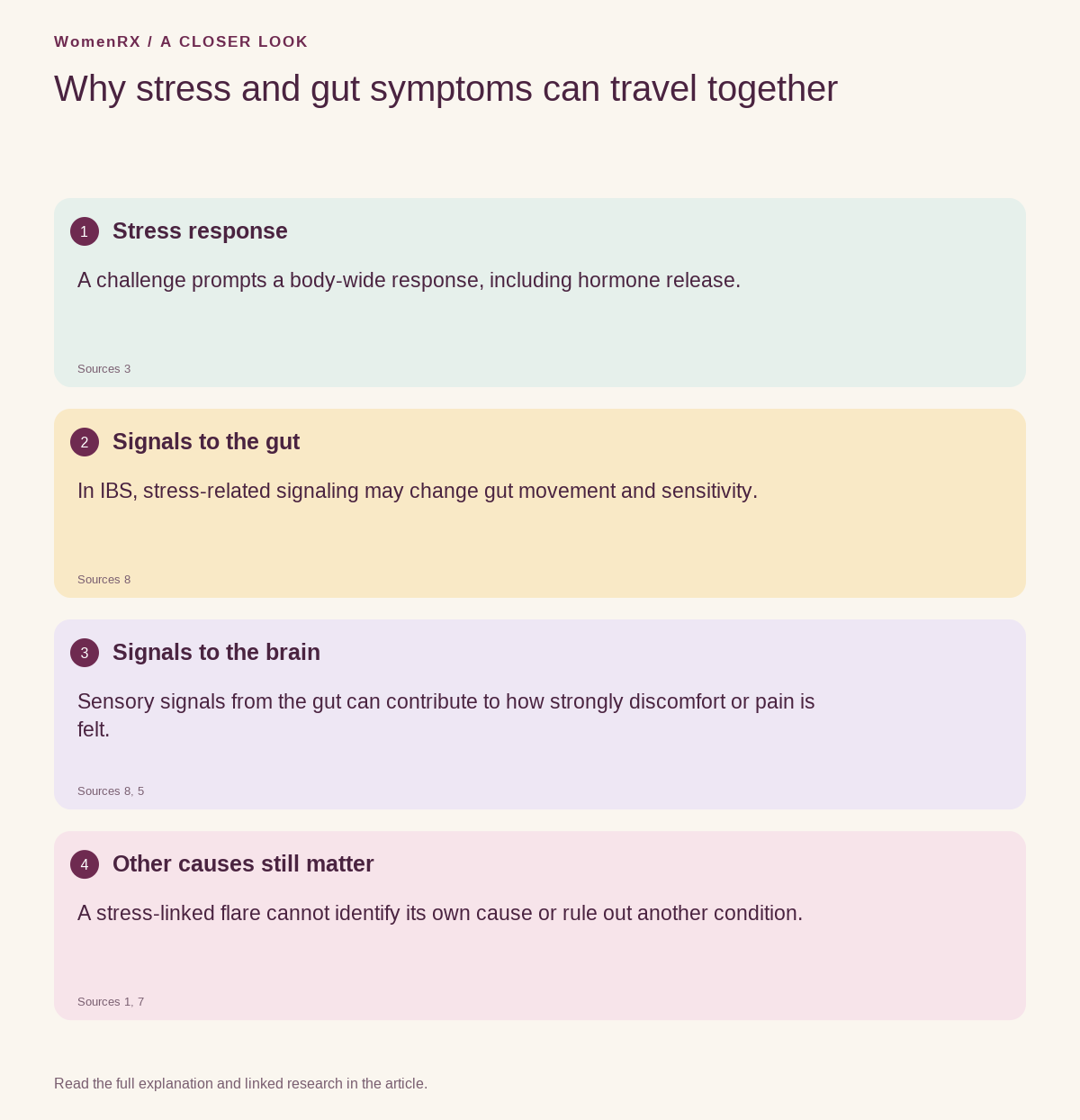
Why stress and gut symptoms can travel together
Stress response: A challenge prompts a body-wide response, including hormone release.3
Signals to the gut: In IBS, stress-related signaling may change gut movement and sensitivity.8
Signals to the brain: Sensory signals from the gut can contribute to how strongly discomfort or pain is felt.85
Other causes still matter: A stress-linked flare cannot identify its own cause or rule out another condition.17
Read the figure as text
The arrows run both ways. This explains a possible IBS flare, not the cause of every abdominal symptom.- Stress response: A challenge prompts a body-wide response, including hormone release.3
- Signals to the gut: In IBS, stress-related signaling may change gut movement and sensitivity.8
- Signals to the brain: Sensory signals from the gut can contribute to how strongly discomfort or pain is felt.85
- Other causes still matter: A stress-linked flare cannot identify its own cause or rule out another condition.17
More questions, answered
Can stress cause IBS?
Stress can worsen IBS symptoms, but IBS has a complex set of contributing factors. A stressful period followed by digestive trouble does not, by itself, show that stress caused IBS or rule out another explanation. 56
Sources you can check
- Abdominal Pain | MedlinePlusAccessed 2026-09-25Return to first citation
- Ashwagandha: Is it helpful for stress, anxiety, or sleep? - Health Professional Fact SheetAccessed 2026-09-25Return to first citation
- Stress: MedlinePlusAccessed 2026-09-25Return to first citation
- Period pain - NHSAccessed 2026-09-25Return to first citation
- Causative Factors, Clinical Manifestations, and Therapeutic Strategies for Irritable Bowel Syndrome.Anand K, Khatib MN. · Cureus · 2024Return to first citation
- What is IBS (irritable bowel syndrome) - NHSAccessed 2026-09-25Return to first citation
- Getting diagnosed with IBS (irritable bowel syndrome) - NHSAccessed 2026-09-25Return to first citation
- Pathophysiological and Therapeutic Association between Brain-Gut Axis and Irritable Bowel Syndrome: A Systematic Review.Farooq U, Sadiqa A, Arshad Jarral S. · Pakistan journal of medical sciences · 2026Return to first citation