Spinach, Iron, and What Your Body Absorbs
Spinach contains iron, but the amount on the nutrition label isn’t the amount your body absorbs.
A half-cup of boiled, drained spinach contains about 3 mg of iron. That iron is nonheme iron, the plant form, which is less readily absorbed than heme iron from meat and seafood. Spinach also contains compounds that can limit iron absorption. Eating it with a vitamin C source can help absorption, but spinach alone can’t confirm or treat iron deficiency. 1
Spinach can contribute iron to a meal, but its listed iron content and the amount your body absorbs are different things. A half-cup of boiled, drained spinach provides about 3 mg of iron. That’s a useful food contribution, not a measure of how much iron reaches your bloodstream. 1
The iron number is only part of the story
Iron in plant foods is called nonheme iron. It’s generally less bioavailable than heme iron, the form found in meat and seafood. The NIH Office of Dietary Supplements notes that spinach contains compounds, including polyphenols, that can inhibit iron absorption. So a serving’s nutrient figure shouldn’t be read as a promise that all of that iron will be absorbed. 1
The serving figure also describes a specific preparation: boiled and drained spinach. It doesn’t tell you the iron in an equal-volume portion of raw spinach. If you’re comparing portions, check whether each figure refers to raw or cooked spinach and to what serving size.
Spinach also contributes other nutrients, including fiber and several vitamins and minerals. But if you’re choosing it specifically for iron, the amount and the form of iron matter alongside the rest of the meal. 3
What you eat with spinach can matter
Vitamin C, also called ascorbic acid, can improve absorption of nonheme iron. Meat, poultry, and seafood can also enhance nonheme iron absorption when eaten in the same meal. In contrast, some plant compounds can inhibit absorption; the NIH reference specifically notes polyphenols in spinach. These effects aren’t a guarantee of how much iron you’ll absorb from any one meal. 1
A practical approach is to include spinach in a meal with a vitamin C source. If you eat meat, poultry, or seafood, those foods can also support absorption of the meal’s nonheme iron. You don’t need to turn every spinach serving into an absorption calculation: the overall diet matters, and the NIH notes that the effects of enhancers and inhibitors are generally less pronounced in a typical Western diet. 1
Needs can change with life stage
For women ages 19 to 50, the recommended dietary allowance for iron is 18 mg per day; during pregnancy, it’s 27 mg per day. Menstrual blood loss is one reason iron needs and deficiency risk can be relevant before menopause, and heavy menstrual bleeding increases the risk of iron deficiency. Pregnancy also increases iron needs as the body supports expanded blood volume and red blood cell production. 1
Those reference amounts are for total daily intake, not a target to meet with spinach alone. A half-cup of cooked spinach’s 3 mg can contribute, but it doesn’t show whether your overall intake is adequate or whether you’re absorbing enough. 1
When iron deficiency is a concern
Fatigue, shortness of breath, and difficulty concentrating can occur with iron-deficiency anemia, but symptoms alone don’t establish the cause. Iron deficiency can develop before anemia, and checking iron status may involve more than a hemoglobin test: clinicians may use ferritin, which reflects iron stores, along with other measurements. Ferritin can also be affected by inflammation. 12
If you’re concerned about low iron, especially with heavy periods or during pregnancy, eating more spinach can be part of a varied diet, but it isn’t a way to diagnose or reliably treat deficiency. Assessment matters because low iron can have causes such as blood loss or difficulty absorbing iron, and different kinds of anemia can have different causes. 12
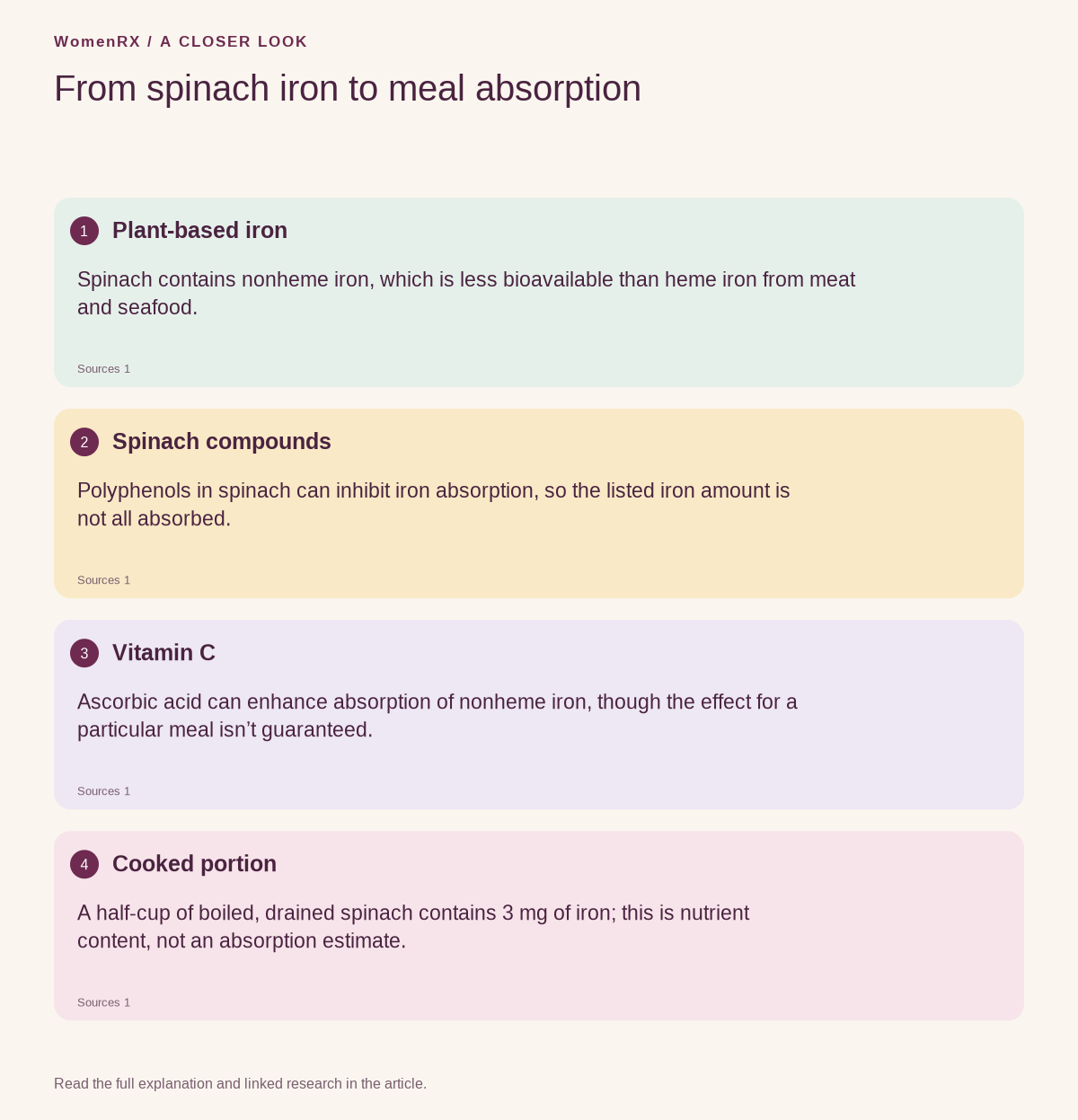
From spinach iron to meal absorption
Plant-based iron: Spinach contains nonheme iron, which is less bioavailable than heme iron from meat and seafood.1
Spinach compounds: Polyphenols in spinach can inhibit iron absorption, so the listed iron amount is not all absorbed.1
Vitamin C: Ascorbic acid can enhance absorption of nonheme iron, though the effect for a particular meal isn’t guaranteed.1
Cooked portion: A half-cup of boiled, drained spinach contains 3 mg of iron; this is nutrient content, not an absorption estimate.1
Read the figure as text
The amount of iron in a serving is not the same as the amount absorbed. Meal components can influence absorption of spinach’s plant-based iron.- Plant-based iron: Spinach contains nonheme iron, which is less bioavailable than heme iron from meat and seafood.1
- Spinach compounds: Polyphenols in spinach can inhibit iron absorption, so the listed iron amount is not all absorbed.1
- Vitamin C: Ascorbic acid can enhance absorption of nonheme iron, though the effect for a particular meal isn’t guaranteed.1
- Cooked portion: A half-cup of boiled, drained spinach contains 3 mg of iron; this is nutrient content, not an absorption estimate.1
More questions, answered
Does spinach provide heme iron?
No. Spinach contains nonheme iron, the form found in plants. Heme iron is found in meat and seafood and is generally more bioavailable. 1
Can spinach tell me whether I’m iron deficient?
No. A food’s iron content doesn’t measure your iron stores. Assessment may include ferritin and other blood measurements; hemoglobin alone isn’t a sensitive or specific measure of iron deficiency. 1
Sources you can check
- Iron - Health Professional Fact SheetAccessed 2026-09-25Return to first citation
- Iron: MedlinePlusAccessed 2026-09-25Return to first citation
- Nutrient Composition, Physical Characteristics and Sensory Quality of Spinach-Enriched Wheat Bread.Prasad RV, Dhital S, Williamson G, Barber E. · Foods (Basel, Switzerland) · 2024Return to first citation