Skin and Hair Questions: Where to Start
A breakout, an itchy patch, and thinning hair call for different explanations, even when they happen at the same time.
Start with what has changed: clogged pores and pimples, an itchy rash, hair shedding or thinning, or a changing spot on your skin. Those distinctions lead to more useful questions than assuming hormones explain everything. Acne can be influenced by hormonal changes, while hair loss and rashes have many possible causes. A mole or spot that changes in size, shape, color, or feel deserves medical attention. 1235
If it’s a breakout, look at the kind of spot
Acne begins when hair follicles clog. It can show up as blackheads, whiteheads, pimples, or deeper, painful lumps. Hormonal changes during adolescence and pregnancy may play a role, but acne isn’t caused by dirty skin. Scrubbing harder won’t clear the blockage and may irritate your skin. 37
For a few spots, gentle cleansing and an acne treatment may be enough to explore. Deeper nodules or cysts are a different situation: they carry a greater risk of scarring and are worth getting assessed rather than repeatedly squeezed or covered with new products. Acne that’s making you feel miserable also merits care, regardless of how many spots you have. 378
Sometimes the combination of symptoms changes the question. Acne alongside persistent irregular periods or increased coarse facial hair can be a reason to ask about androgen excess and other possible causes. Acne alone doesn’t establish polycystic ovary syndrome (PCOS), particularly in adolescence, when breakouts are common and menstrual patterns may still be changing. 9
If your question is whether spironolactone belongs among your acne options, the acne treatment route below starts there. It also includes a guide to reading personal treatment reviews without treating one person’s result as a prediction for you.
If it’s hair loss, notice the pattern before choosing a product
Hair can be lost for different reasons, including family history, illness, medicines, stress, and poor nutrition. Some loss is temporary; female pattern hair loss tends to be persistent. That difference matters because treatment depends on the cause. Hair thinning with age isn’t automatically explained by menopause, and a product advertised for “women’s hair loss” won’t identify what’s happening on your scalp. 26
For example, if you’re noticing more hair coming out after an illness, the useful first question is different from the one you’d ask about gradual thinning that runs in your family. If the change worries you, a medical assessment can help establish the cause before you spend money on a commercial hair-loss treatment. 26
The hair reading route focuses on three easy-to-confuse claims: whether treating a flaky scalp means hair will regrow, and what studies of microneedling do or don’t tell you about a home dermaroller. It’s a place to start if those treatments have caught your eye, not a substitute for finding the cause of hair loss.
If it’s itchy or irritated, think beyond acne
An itchy, dry rash may fit eczema or another form of dermatitis rather than acne. Eczema can affect adults as well as children, and scratching may make the itch and swelling worse. Soaps, fabrics, and lotions can irritate some people’s skin. Gentle washing, moisturizer, and paying attention to products that sting or aggravate a rash are more relevant starting points than an acne routine. 14
This is also why adding several strong products at once can make a skin question harder to sort out. If your main symptom is itching or a rash, focus on that concern rather than assuming every bump is a pimple. 14
If it’s a dark patch or a changing spot, separate the questions
Sunlight can contribute to skin spots and longer-term skin damage. Protecting skin from UV exposure is useful whether or not a cosmetic treatment interests you. But a new or changing spot isn’t simply a question of fading discoloration: changes in a mole or spot’s size, shape, color, or feel should be checked. 5
If you’re trying to understand facial patches you suspect might be melasma, the pigmentation reading route helps you consider both hormonal context and sunlight without treating appearance alone as proof of a cause. You don’t need to pursue a cosmetic treatment to take a skin change seriously.
Start with what changed
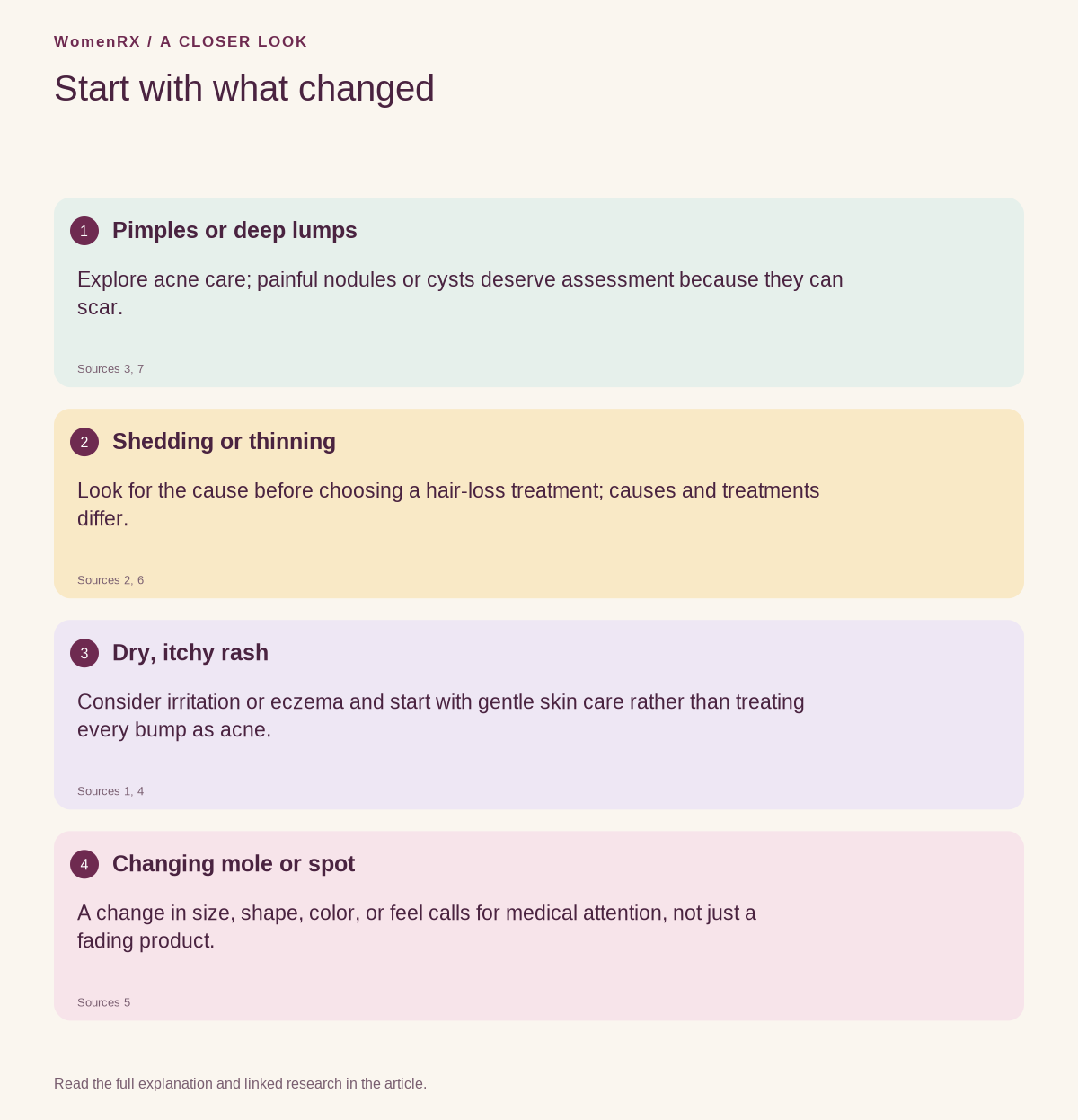
Pimples or deep lumps: Explore acne care; painful nodules or cysts deserve assessment because they can scar.37
Shedding or thinning: Look for the cause before choosing a hair-loss treatment; causes and treatments differ.26
Dry, itchy rash: Consider irritation or eczema and start with gentle skin care rather than treating every bump as acne.14
Changing mole or spot: A change in size, shape, color, or feel calls for medical attention, not just a fading product.5
Read the figure as text
Choose the concern that best matches what you’re seeing; each points to a different question.- Pimples or deep lumps: Explore acne care; painful nodules or cysts deserve assessment because they can scar.37
- Shedding or thinning: Look for the cause before choosing a hair-loss treatment; causes and treatments differ.26
- Dry, itchy rash: Consider irritation or eczema and start with gentle skin care rather than treating every bump as acne.14
- Changing mole or spot: A change in size, shape, color, or feel calls for medical attention, not just a fading product.5
More questions, answered
Does acne mean my hormones are out of balance?
No. Hormonal changes can contribute to acne, but a breakout by itself doesn’t establish a hormone disorder. Persistent irregular periods or increased coarse facial hair alongside acne make the broader picture more relevant, especially if you’re wondering about PCOS. 39
Should I switch to a hair-growth treatment if my scalp is flaky?
First separate the flaky-scalp question from the hair-loss question. Dandruff is a scalp condition, while hair loss has several possible causes; an improvement in flakes alone doesn’t identify the cause of thinning. The hair reading route includes a closer look at claims about dandruff shampoo and regrowth. 12
Sources you can check
- Skin Conditions | Hives | Acne | MedlinePlusAccessed 2026-09-25Return to first citation
- Hair Loss | Alopecia | Alopecia Areata | MedlinePlusAccessed 2026-09-25Return to first citation
- Acne | Blackheads | Pimple | Zits | MedlinePlusAccessed 2026-09-25Return to first citation
- Eczema | Dermatitis | Atopic Dermatitis | MedlinePlusAccessed 2026-09-25Return to first citation
- Sun Exposure | Sunburn | UV rays | MedlinePlusAccessed 2026-09-25Return to first citation
- Hair loss - NHSAccessed 2026-09-25Return to first citation
- Acne - NHSAccessed 2026-09-25Return to first citation
- Acne - Treatment - NHSAccessed 2026-09-25Return to first citation
- Diagnosis and treatment of polycystic ovary syndrome: an Endocrine Society clinical practice guideline.Legro RS, Arslanian SA, Ehrmann DA, Hoeger KM, Murad MH, Pasquali R, Welt CK, Endocrine Society. · The Journal of clinical endocrinology and metabolism · 2013Return to first citation