Sjögren Disease: What Persistent Dryness Can Mean
Dry eyes or mouth can have several causes, and a Sjögren evaluation looks beyond how dry you feel.
Persistent dry eyes or mouth are worth assessing, but dryness alone doesn’t mean you have Sjögren disease. Medicines and common eye or mouth conditions can cause similar symptoms. An evaluation may combine your history with eye and saliva measurements, blood tests for anti-SSA antibodies, and sometimes a small salivary-gland biopsy. Relief for dryness and assessment of symptoms elsewhere in the body are separate parts of care.1345
Start with the pattern, not the label
A mouth that feels sticky when you talk, or eyes that bother you through a workday, can make ordinary things surprisingly hard. Sjögren disease is one possible explanation: it’s an autoimmune condition that can affect the glands that make saliva and tears. It can also affect parts of the body beyond those glands.145
But the same symptoms can arise for other reasons. Some medicines, including certain antidepressants and blood pressure medicines, can contribute to dry eyes or mouth. Mouth breathing at night and dehydration can cause a dry mouth. Dry eyes can happen when tears evaporate too quickly, including with an eyelid condition called blepharitis. That’s why an evaluation begins with what you’re experiencing and what else might explain it, rather than assuming dryness is autoimmune.123
Sjögren is seen predominantly in women: women made up 93.4% of one retrospective cohort of 411 people diagnosed at a Turkish center. That finding describes people who already had the disease, not the likelihood that any woman with dryness has it.6
How the pieces of an evaluation fit together
The first step is usually a conversation and an examination. Which feels dry, your eyes, your mouth, or both? Does mouth dryness interfere with eating or speaking? Have you had trouble with your teeth or symptoms elsewhere, such as joint pain? A clinician or dentist can examine your mouth and review your medicines and medical history; an eye clinician can assess persistent eye symptoms and other possible causes.135
When Sjögren remains a possibility, tests look for different kinds of evidence:
- Eye tests can measure tear production and look for changes on the eye’s surface. The Schirmer test and ocular staining are among the measures used in adult Sjögren classification criteria.4
- A saliva-flow test measures how much saliva you produce. The sensation of a dry mouth and a measured reduction in saliva are related questions, but they aren’t the same measurement.14
- Blood testing may look for anti-SSA, also called anti-Ro, antibodies. This result contributes to the overall assessment; it isn’t a stand-alone answer to what’s causing your dryness.45
- A small biopsy of a salivary gland in the lip may be considered when further evidence is needed. It looks for a characteristic pattern of inflammation, and the quality and interpretation of the sample matter.4
These tests aren’t necessarily done in a fixed order or all at once. Adult classification criteria combine objective findings from the eyes, mouth, antibodies, and sometimes biopsy. They also account for conditions that can produce a similar picture. Classification criteria help define groups consistently; a clinician still has to interpret the results alongside your symptoms and other possible causes.45
Relief for dryness is one job; checking the rest of you is another
You don’t have to wait for a diagnosis to discuss relief. For dry eyes, options include eye drops or gels, attention to eyelid care, and breaks from prolonged screen use. For dry mouth, regular water sips, sugar-free gum or candy, and products that moisten the mouth may help. A dentist matters here, too: too little saliva raises the risk of tooth decay and mouth infections.13
Those measures address the discomfort and consequences of dryness. They don’t, by themselves, assess disease elsewhere in the body. Sjögren can be associated with fatigue and pain and, in some people, inflammatory problems involving other organs or nerves. If you have symptoms beyond your eyes and mouth, mention them rather than assuming they’re all part of dryness. The question then becomes whether they need a separate assessment and a different kind of care.45
If a medicine seems to be contributing, bring it up rather than stopping it on your own. A clinician can weigh whether changing it is appropriate while still investigating persistent symptoms.123
When to move the conversation forward
Arrange an assessment if dry mouth is making it hard to eat or speak, if dryness persists despite measures that usually help, or if dry eyes and dry mouth are occurring together. Persistent dry eyes also deserve an eye assessment, since Sjögren is only one possible cause.23
A very dark red eye, or a red eye with a severe headache and nausea, is different from routine dryness and needs urgent assessment.3
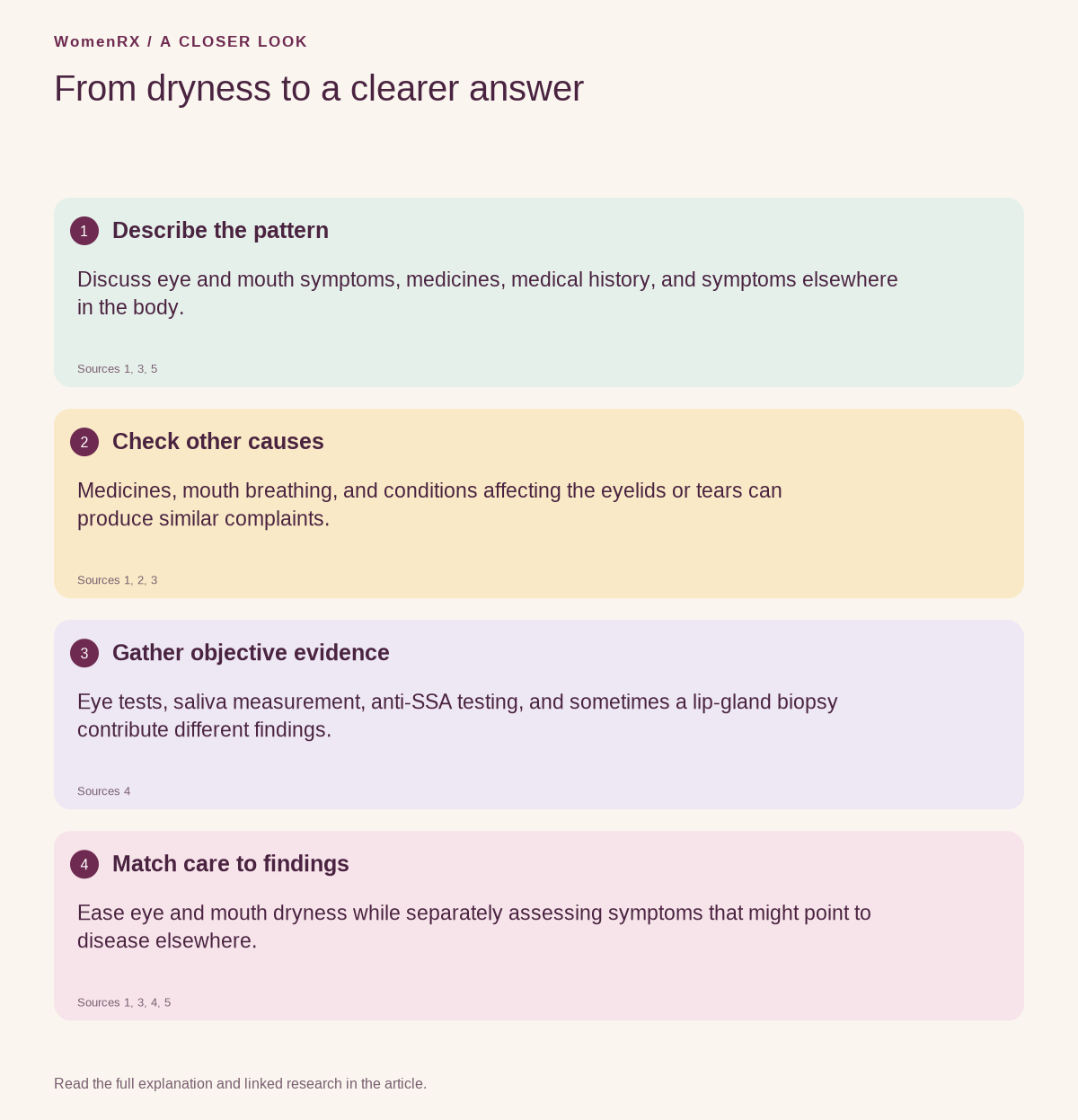
From dryness to a clearer answer
Describe the pattern: Discuss eye and mouth symptoms, medicines, medical history, and symptoms elsewhere in the body.135
Check other causes: Medicines, mouth breathing, and conditions affecting the eyelids or tears can produce similar complaints.123
Gather objective evidence: Eye tests, saliva measurement, anti-SSA testing, and sometimes a lip-gland biopsy contribute different findings.4
Match care to findings: Ease eye and mouth dryness while separately assessing symptoms that might point to disease elsewhere.1345
Read the figure as text
The steps answer different questions; not everyone needs every test.- Describe the pattern: Discuss eye and mouth symptoms, medicines, medical history, and symptoms elsewhere in the body.135
- Check other causes: Medicines, mouth breathing, and conditions affecting the eyelids or tears can produce similar complaints.123
- Gather objective evidence: Eye tests, saliva measurement, anti-SSA testing, and sometimes a lip-gland biopsy contribute different findings.4
- Match care to findings: Ease eye and mouth dryness while separately assessing symptoms that might point to disease elsewhere.1345
More questions, answered
Can Sjögren cause symptoms besides dry eyes and mouth?
Yes. Fatigue and pain can occur, and some people have inflammatory involvement beyond the tear and salivary glands. New symptoms elsewhere deserve their own assessment rather than being attributed automatically to dryness.45
Does a positive anti-SSA blood test settle the diagnosis?
No. Anti-SSA is an important piece of evidence, but adult classification combines it with clinical context and, where appropriate, objective eye, saliva, or biopsy findings. Other causes also need consideration.45
Sources you can check
- Dry Mouth: MedlinePlusAccessed 2026-09-25Return to first citation
- Dry mouth - NHSAccessed 2026-09-25Return to first citation
- Dry eyes - NHSAccessed 2026-09-25Return to first citation
- Clinical features and pathogenesis of Sjogrens disease related peripheral neuropathy and their relevance to clinical trials.Pucino V, Nayar S, Fehmi J, Baldini C, Bowman SJ, Fisher BA. · Communications medicine · 2026Return to first citation
- Chemosensory dysfunction in primary Sjögren's syndrome: a topical review.Foguem C, Seror R, Gosset M. · Clinical rheumatology · 2023Return to first citation
- Late-Onset Sjögren disease: A different clinical entity?Cengiz CB, Kahraman Denizhan T, Kaplan H, Oğuz Kökoğlu E, Kızıltepe M, Eren Cengiz B, Oğuz H, Şenel AS. · Sarcoidosis, vasculitis, and diffuse lung diseases : official journal of WASOG · 2026Return to first citation