Seeking Menopause HRT in Puerto Rico: Questions About Care and Access
Separate the medical decision from the local logistics by confirming what a clinician recommends, then checking appointment, pharmacy, language, and coverage details directly.
In Puerto Rico, confirm local provider, appointment, pharmacy, and insurance details directly; don’t assume a listing or a plan’s general benefits answer your specific questions. In the medical discussion, describe the symptoms you want help with and ask how your health history, age, and time since menopause affect the balance of benefits and risks. Hormone therapy is individualized, and nonhormonal options may also be worth discussing. 12
Treat access and suitability as two separate questions
Finding someone who offers menopause care doesn’t tell you whether hormone therapy is a good fit for you. And a treatment discussion doesn’t confirm that a particular prescription is available at your pharmacy or covered by your plan. Work through both parts, and verify local details with the clinic, pharmacy, and insurer rather than relying on an unconfirmed directory entry.
When contacting a clinic, ask who would provide the care, what menopause-related experience they have, whether they’re accepting patients, and what appointment formats are available. If you prefer care in Spanish or English, ask what language support is available for the appointment and follow-up. You can ask the clinic for the clinician’s credentials and verify them through the relevant official Puerto Rico licensing source. These are questions to ask, not assumptions about what a clinic or plan offers.
Make the treatment conversation specific to you
Bring a short description of what is bothering you most, such as hot flashes, night sweats, sleep disruption, or vaginal or urinary symptoms. Note what you’ve tried and what you hope treatment will change. Share your health history and current medications so the clinician can consider your individual circumstances.
Ask what kind of treatment is being discussed and what symptom it is meant to address. Hormone therapy can help with bothersome vasomotor symptoms, such as hot flashes, and genitourinary symptoms; the benefits and risks vary with factors including the type of therapy, dose, route, duration, timing, and whether a progestogen is used. The North American Menopause Society describes the benefit-risk balance as generally favorable for appropriately selected women younger than 60 or within 10 years of menopause onset who have no contraindications, while it may be less favorable when starting later. Those are population-level findings, not a personal eligibility test. 1
If symptoms are mainly vaginal or urinary, ask whether local treatment is relevant or whether systemic therapy is being considered, and why. For bothersome genitourinary symptoms not relieved by over-the-counter therapies, the Society identifies low-dose vaginal estrogen and certain other therapies as options for women without an indication for systemic hormone therapy. 1
Useful questions include:
- Which symptoms are we aiming to treat, and what options fit them?
- What benefits and risks matter most given my age, timing, and health history?
- What does the proposed treatment contain, and how is it taken or used?
- How will we tell whether it’s helping, and when will we revisit the decision?
- If hormone therapy isn’t a fit or isn’t my preference, what evidence-based alternatives could address my symptoms?
Hormone therapy is the most effective treatment for vasomotor symptoms, but it isn’t the only option. The 2023 position statement on nonhormonal therapy lists several evidence-supported approaches, including cognitive behavioral therapy, clinical hypnosis, and certain prescription medicines. Ask which, if any, match your symptoms and health circumstances rather than assuming that one alternative suits everyone. 2
Verify the practical details before you depend on a plan
Ask the clinic what appointment options it offers, what information to bring, and how follow-up works. If a prescription is discussed, ask the prescriber what exact product and formulation they intend to prescribe. Then contact your chosen pharmacy to check whether it can fill that specific prescription; availability should be confirmed rather than inferred from a general listing.
For coverage, ask your insurer about the specific visit and prescribed product, including any requirements that apply to your plan. A general statement that a plan covers menopause care or a medicine category may not settle whether your particular appointment or prescription is covered. Write down whom you spoke with and any reference number the insurer provides. If the proposed treatment is unavailable or not covered, ask the clinician whether there are medically appropriate alternatives before making a change.
A clear next step is to leave the conversation knowing the proposed treatment and its purpose, what local details still need confirmation, and who will follow up. That keeps a logistical barrier from being mistaken for a medical recommendation, or vice versa.
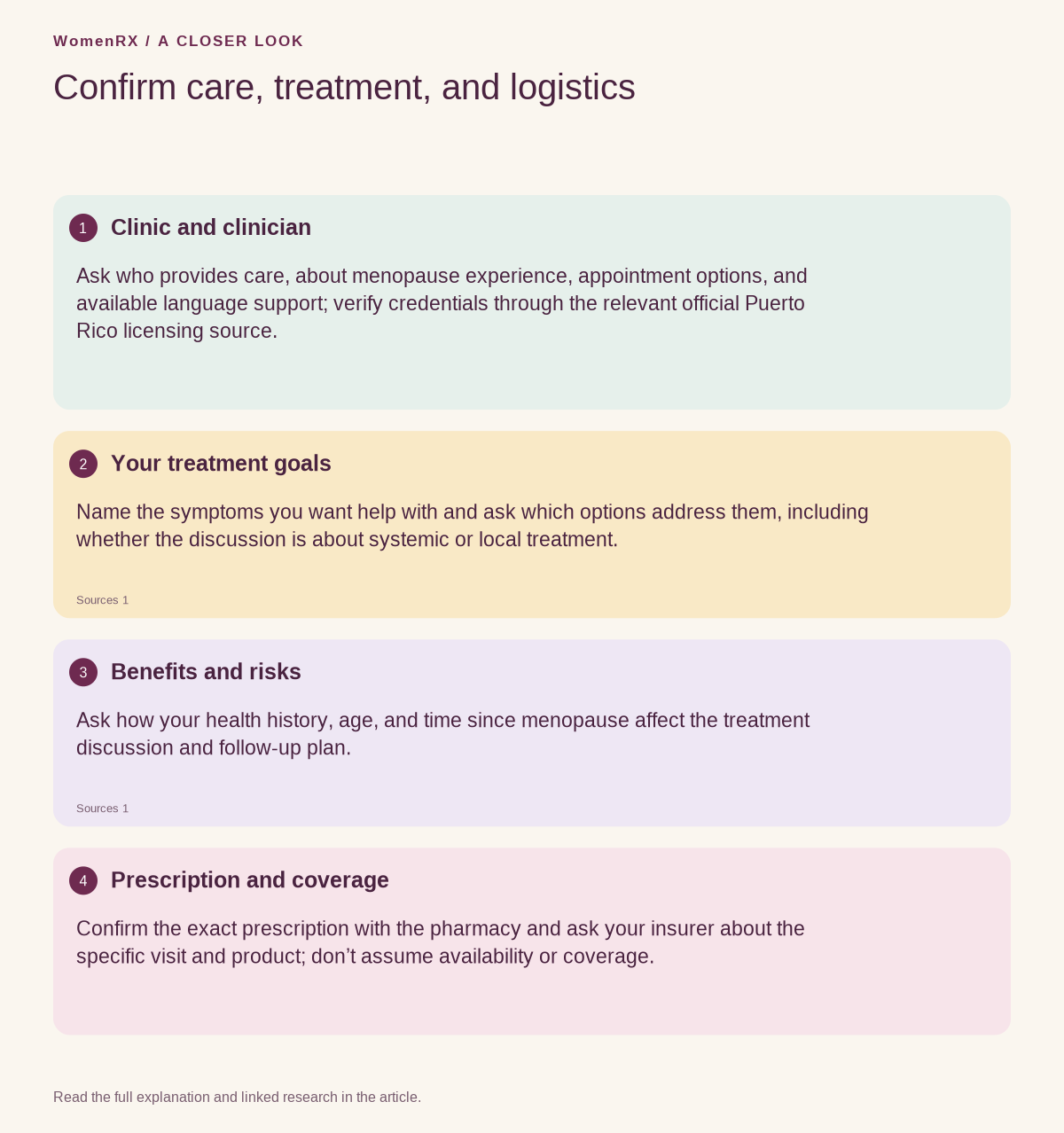
Confirm care, treatment, and logistics
Clinic and clinician: Ask who provides care, about menopause experience, appointment options, and available language support; verify credentials through the relevant official Puerto Rico licensing source.
Your treatment goals: Name the symptoms you want help with and ask which options address them, including whether the discussion is about systemic or local treatment.1
Benefits and risks: Ask how your health history, age, and time since menopause affect the treatment discussion and follow-up plan.1
Prescription and coverage: Confirm the exact prescription with the pharmacy and ask your insurer about the specific visit and product; don’t assume availability or coverage.
Read the figure as text
Keep the medical discussion separate from the local details you need to verify with the clinic, pharmacy, and insurer.- Clinic and clinician: Ask who provides care, about menopause experience, appointment options, and available language support; verify credentials through the relevant official Puerto Rico licensing source.
- Your treatment goals: Name the symptoms you want help with and ask which options address them, including whether the discussion is about systemic or local treatment.1
- Benefits and risks: Ask how your health history, age, and time since menopause affect the treatment discussion and follow-up plan.1
- Prescription and coverage: Confirm the exact prescription with the pharmacy and ask your insurer about the specific visit and product; don’t assume availability or coverage.
More questions, answered
If hormone therapy isn’t right for me, does that mean I have no treatment options?
No. The North American Menopause Society lists evidence-supported nonhormonal options for vasomotor symptoms, including cognitive behavioral therapy, clinical hypnosis, and certain prescription medicines. Which option fits depends on your symptoms and health circumstances. 2
Should I ask about the same kind of hormone therapy for every menopause symptom?
Not necessarily. Ask the clinician to connect the treatment to the symptom. For bothersome genitourinary symptoms, low-dose vaginal estrogen is among the options identified for some women; systemic therapy is a separate discussion. 1
Sources you can check
- The 2022 hormone therapy position statement of The North American Menopause Society.“The 2022 Hormone Therapy Position Statement of The North American Menopause Society” Advisory Panel. · Menopause (New York, N.Y.) · 2022Return to first citation
- The 2023 nonhormone therapy position statement of The North American Menopause Society.Menopause (New York, N.Y.) · 2023Return to first citation