Seborrheic Dermatitis Care for Scalp and Face
Scalp shampoo and facial cream have different directions; don’t borrow either approach for an uncertain ear patch.
Ketoconazole shampoo is commonly used for scalp seborrheic dermatitis, while cream may be used on smaller areas of skin. Maintenance can help when scalp symptoms return. The ketoconazole directions describe scalp and skin use, not an ear-specific or ear-canal approach. 12 Other skin conditions can look similar. 4
Match the treatment to the area
Seborrheic dermatitis can cause recurring scaly patches on the scalp or face. Ketoconazole is an antifungal used to treat it and comes in shampoo and cream forms. In a small randomized trial of people with mild-to-moderate facial seborrheic dermatitis, ketoconazole cream reduced disease severity compared with placebo. 16
That doesn’t mean every flaky patch needs the same product. Where the scaling sits matters, both for choosing a treatment and for deciding whether seborrheic dermatitis is the right diagnosis.
On the scalp: treat the flare, then consider maintenance
A common ketoconazole shampoo approach for seborrheic dermatitis is twice-weekly use for two to four weeks, followed by use every one to two weeks to help keep symptoms from returning. Follow the directions for your particular product or the plan you’ve been given rather than using it more often to chase stubborn flakes. 2
How a shampoo feels on your hair matters if you’ll need to keep using it. In a six-week randomized study of 87 men and women with moderate-to-severe dandruff, a selenium disulfide shampoo and a ketoconazole shampoo produced similar improvements on the measured scalp symptoms; participants rated some hair-feel qualities more favorably with selenium disulfide. The study did not report separate results for women, and it doesn’t establish that every shampoo with either ingredient performs alike. 5
On the face: use a treatment suited to skin
For smaller affected areas, ketoconazole cream is an option. Medicine guidance describes a short treatment course for seborrheic dermatitis, while the facial trial found improvement with ketoconazole cream compared with placebo. 26 If ketoconazole cream causes itching, burning, or redness that doesn’t improve after a few days or gets worse, stop using it and speak with a pharmacist or clinician. 3
Antifungal treatment doesn’t always settle the inflammation by itself. A clinician may consider an anti-inflammatory treatment alongside it, but long-term topical corticosteroid use has known side effects. That’s why a steroid shouldn’t become an open-ended, unsupervised answer to facial scaling. 6
The scalp and facial studies discussed here don’t establish whether these treatments are suitable during pregnancy or breastfeeding. 56
If you have an ear patch
These ketoconazole directions do not give an ear-specific or ear-canal regimen. If you’re unsure what is causing the patch, have the diagnosis checked rather than borrowing scalp or facial directions. 124
When to reconsider the diagnosis
Flaking alone doesn’t confirm seborrheic dermatitis. Atopic dermatitis, psoriasis, and allergic or irritant contact dermatitis can have overlapping appearances. A clinician uses the rash’s history, location, and appearance to help tell them apart. 4
If a rash you’re treating as seborrheic dermatitis does not respond as expected, ask a clinician to check the diagnosis.
Care depends on the location
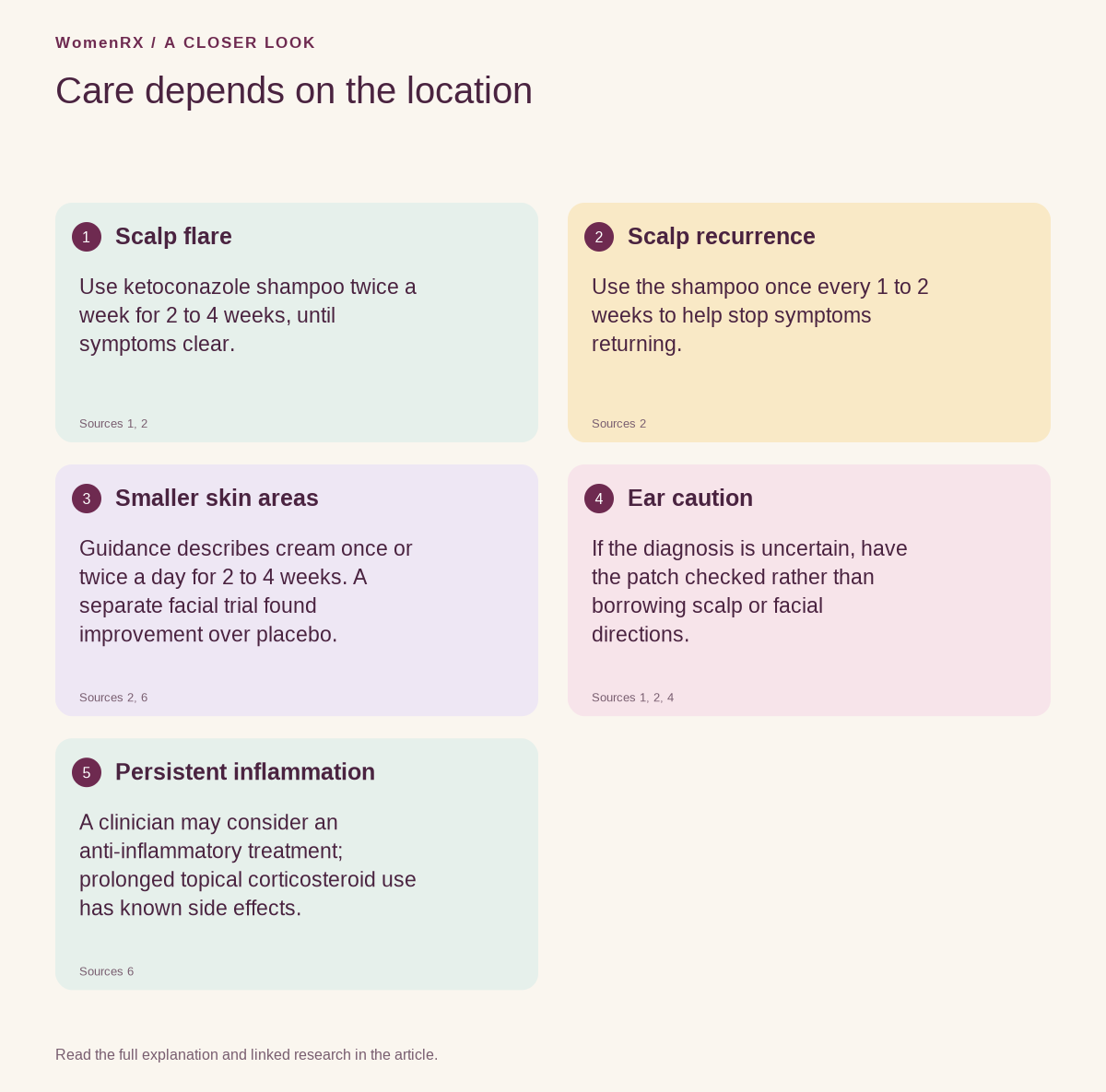
Scalp flare: Use ketoconazole shampoo twice a week for 2 to 4 weeks, until symptoms clear.12
Scalp recurrence: Use the shampoo once every 1 to 2 weeks to help stop symptoms returning.2
Smaller skin areas: Guidance describes cream once or twice a day for 2 to 4 weeks. A separate facial trial found improvement over placebo.26
Ear caution: If the diagnosis is uncertain, have the patch checked rather than borrowing scalp or facial directions.124
Persistent inflammation: A clinician may consider an anti-inflammatory treatment; prolonged topical corticosteroid use has known side effects.6
Read the figure as text
Ketoconazole shampoo has a scalp treatment and maintenance schedule. Cream has separate directions for smaller affected skin areas; these directions do not establish an ear-specific regimen.- Scalp flare: Use ketoconazole shampoo twice a week for 2 to 4 weeks, until symptoms clear.12
- Scalp recurrence: Use the shampoo once every 1 to 2 weeks to help stop symptoms returning.2
- Smaller skin areas: Guidance describes cream once or twice a day for 2 to 4 weeks. A separate facial trial found improvement over placebo.26
- Ear caution: If the diagnosis is uncertain, have the patch checked rather than borrowing scalp or facial directions.124
- Persistent inflammation: A clinician may consider an anti-inflammatory treatment; prolonged topical corticosteroid use has known side effects.6
Sources you can check
- About ketoconazole - NHSAccessed 2026-09-25Return to first citation
- How and when to use ketoconazole - NHSAccessed 2026-09-25Return to first citation
- Side effects of ketoconazole - NHSAccessed 2026-09-25Return to first citation
- Atopic dermatitis reconsidered: Clinical mimics and diagnostic pearls.Lawrence CN, Karagounis TK, Cohen DE. · Journal of the American Academy of Dermatology · 2026Return to first citation
- Beyond Efficacy: 0.6% Selenium Disulfide Shampoo Matches 2% Ketoconazole for Seborrheic Dermatitis with Superior Cosmesis.Farris PK, Barbosa V, Houshmand EB, Kovylkina N. · Journal of drugs in dermatology : JDD · 2026Return to first citation
- Treatment with the Topical Antimicrobial Peptide Omiganan in Mild-to-Moderate Facial Seborrheic Dermatitis versus Ketoconazole and Placebo: Results of a Randomized Controlled Proof-of-Concept Trial.Rousel J, Saghari M, Pagan L, Nădăban A, Gambrah T, Theelen B, de Kam ML, Haakman J, van der Wall HEC, Feiss GL, Niemeyer-van der Kolk T, Burggraaf J, Bouwstra JA, Rissmann R, van ... · International journal of molecular sciences · 2023Return to first citation