Ketoconazole Shampoo for Hair Loss: What It Treats
Ketoconazole shampoo treats dandruff and seborrheic dermatitis, but clearer scalp skin doesn’t prove hair regrowth.
Ketoconazole shampoo has an established role in treating dandruff and seborrheic dermatitis, scalp conditions associated with yeast. Its possible benefit for pattern hair loss is a separate, less settled question. Reviews describe the hair-loss evidence as preliminary and do not establish a regrowth benefit for women. If thinning is your main concern, treating flakes isn’t a substitute for finding its cause. 3 5 8 1
A calmer scalp and fuller hair are different outcomes
Ketoconazole is an antifungal medicine. Its shampoo is used for dandruff and seborrheic dermatitis, which can leave the scalp flaky, dry or greasy. A systematic review found topical ketoconazole effective for conditions associated with Malassezia yeast, including seborrheic dermatitis. If your flakes improve, that’s a useful result. It doesn’t, by itself, show that your hair is growing back. 3 5
The distinction matters when you’re using the shampoo because your hair looks thinner. Female pattern hair loss involves gradual changes to hair follicles and reduced hair density. Hair loss can have other causes, too, including illness, medicines and nutritional problems. Treatment depends on the cause, so a dandruff shampoo can’t tell you what’s behind the thinning. 6 1
Why ketoconazole comes up in hair-loss discussions
Researchers are studying whether scalp microbes and inflammation influence pattern hair loss. That offers a reason to investigate ketoconazole, but a plausible mechanism isn’t proof that an antifungal shampoo increases hair density. A review of scalp microbiome research describes microbiome-targeted treatments for androgenetic alopecia as investigational rather than established routine care. 6
The evidence is stronger for treating the scalp condition than for regrowing hair. A systematic review that found effectiveness for Malassezia-related conditions called for further research on ketoconazole for hair loss. Another review described topical treatments including ketoconazole as promising for male pattern hair loss, while emphasizing that the evidence was preliminary and that more women need to be included in studies. Those findings don’t establish a hair-regrowth benefit for women. 5 8
There’s a nuance: a Canadian expert consensus gave ketoconazole shampoo near-consensus support as part of a regimen for androgenetic alopecia. That is not a finding that the shampoo, on its own, regrows hair. The consensus recommendation does not establish how much regrowth to expect or whether women benefit. 7 8
What to watch if you’re already using it
If dandruff or seborrheic dermatitis is the reason you’re using ketoconazole shampoo, judge it by whether those scalp symptoms improve. Follow your product’s directions or your clinician’s instructions. The shampoo can irritate skin, and allergic contact dermatitis is possible. 3 4 5
If thinning is your main concern, keep that question separate. For example, flakes may settle while your part continues to look wider. That’s a reason to have the hair loss assessed, rather than assuming the shampoo has addressed it. Minoxidil can be used for female pattern hair loss, but whether that’s a relevant option depends on identifying the type of loss. 1 2
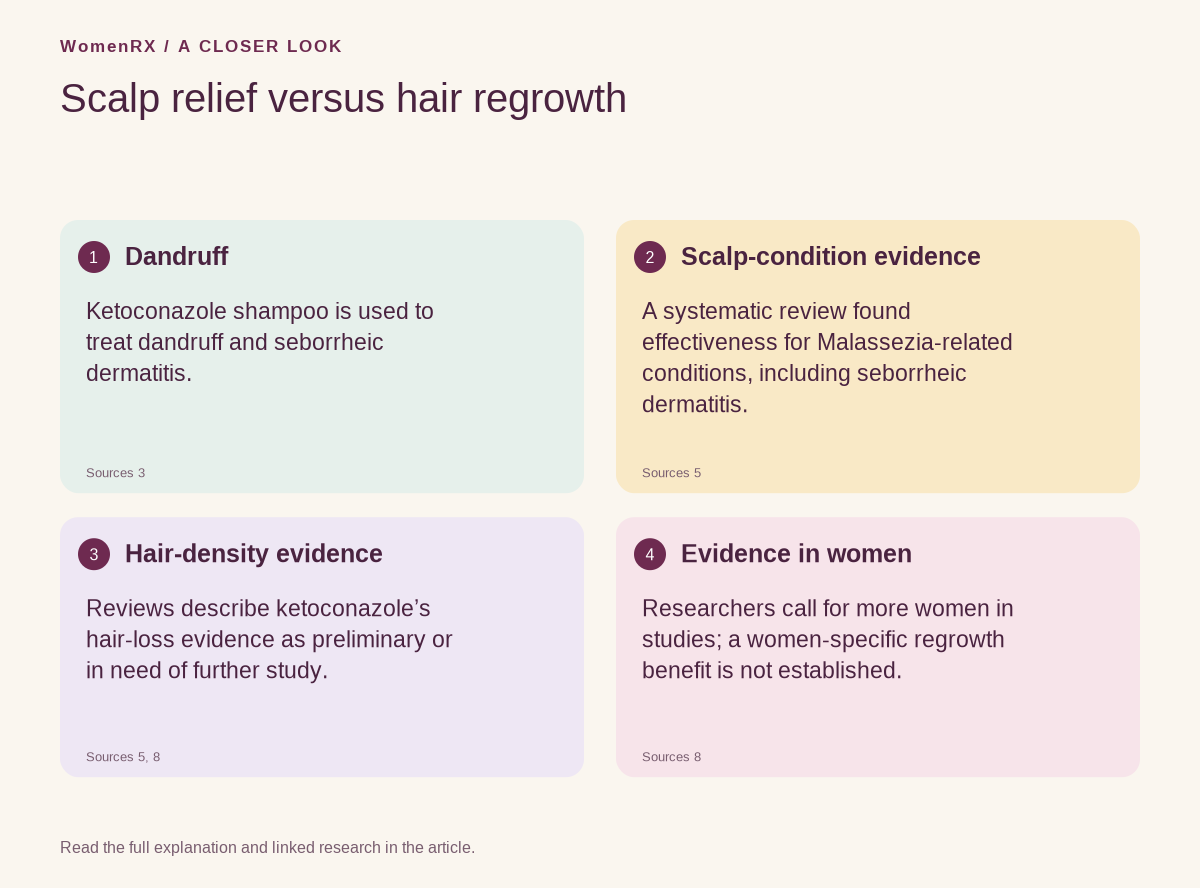
Scalp relief versus hair regrowth
Dandruff: Ketoconazole shampoo is used to treat dandruff and seborrheic dermatitis.3
Scalp-condition evidence: A systematic review found effectiveness for Malassezia-related conditions, including seborrheic dermatitis.5
Hair-density evidence: Reviews describe ketoconazole’s hair-loss evidence as preliminary or in need of further study.58
Evidence in women: Researchers call for more women in studies; a women-specific regrowth benefit is not established.8
Read the figure as text
Ketoconazole has different levels of support depending on the outcome you’re looking for.- Dandruff: Ketoconazole shampoo is used to treat dandruff and seborrheic dermatitis.3
- Scalp-condition evidence: A systematic review found effectiveness for Malassezia-related conditions, including seborrheic dermatitis.5
- Hair-density evidence: Reviews describe ketoconazole’s hair-loss evidence as preliminary or in need of further study.58
- Evidence in women: Researchers call for more women in studies; a women-specific regrowth benefit is not established.8
Sources you can check
- Hair Loss | Alopecia | Alopecia Areata | MedlinePlusAccessed 2026-09-25Return to first citation
- Hair loss - NHSAccessed 2026-09-25Return to first citation
- About ketoconazole - NHSAccessed 2026-09-25Return to first citation
- How and when to use ketoconazole - NHSAccessed 2026-09-25Return to first citation
- Topical ketoconazole: a systematic review of current dermatological applications and future developments.Choi FD, Juhasz MLW, Atanaskova Mesinkovska N. · The Journal of dermatological treatment · 2019Return to first citation
- Scalp Microbiome Alterations in Androgenetic Alopecia: Patterns and Emerging Mechanistic Insights.Gupta AK, Teasell EM, Liddy A, Economopoulos V. · International journal of dermatology · 2026Return to first citation
- A Canadian Consensus on Androgenetic Alopecia: Approach and Management.Landells I, Chow E, Gupta AK, Jasso Olivares JC, Thuraisingam T, Ahluwalia R, Tan JKL, Pratt M, Yadav G, Chivers Q, Vezina N, Laforest T, Raad E, Owen J, Dayeh NR. · Journal of cutaneous medicine and surgery · 2025Return to first citation
- Topical Antiandrogen Therapies for Androgenetic Alopecia and Acne Vulgaris.Marks DH, Prasad S, De Souza B, Burns LJ, Senna MM. · American journal of clinical dermatology · 2020Return to first citation