Could This Rash Around Your Mouth Be Perioral Dermatitis?
Small, recurring bumps around the chin or nose fit the pattern, but several look-alikes make the details worth checking before you change treatment.
It could be. Perioral dermatitis often causes small bumps or pustules around the chin and folds beside the nose, sometimes with fine scale, that recur over weeks or months. Acne, contact dermatitis, rosacea-related eruptions, and other conditions can look similar. The pattern is a clue, not a diagnosis, especially if you’re considering a new treatment or changing a prescribed cream. 35
What the pattern can tell you
Despite its name, perioral dermatitis isn’t limited to the skin immediately beside your lips. A typical pattern includes small raised bumps or pustules on the chin and in the folds running from the nose toward the mouth. Fine scale can appear too, and the eruption may come and go over weeks or months. 35
That’s a useful starting point, not a way to identify it from a photo. Reviews of perioral dermatitis include acne, contact dermatitis, seborrheic dermatitis, and steroid-induced rosacea among its possible look-alikes. Small facial pustules alone don’t settle the question: acne and rosacea can cause them too. 357
Where the look-alikes overlap
Acne or rosacea-related eruptions: Look first at the full pattern, not just one bump. A recurring cluster on the chin and in the folds beside the nose fits the described perioral dermatitis pattern. Pustules elsewhere on the face leave acne and rosacea among the possibilities, but location alone can’t confirm or rule out any of them. If you’ve been treating the bumps as acne without a clear answer, an assessment is more useful than adding another treatment by guesswork. 357
Contact or seborrheic dermatitis: Both belong on the comparison list. Fine scale occurs with perioral dermatitis too, so flakes alone won’t separate them. Timing may give an assessor another clue: mention a recent change in something applied to your face, especially if irritation followed it. For example, metronidazole skin cream or gel can itself cause irritation. That sequence doesn’t establish contact dermatitis or identify the original rash. A dermatology report describes fine yellowish scale and a particular vessel pattern visible with dermoscopy in seborrheic dermatitis. Those are examination findings, not a bathroom-mirror checklist. 2356
Demodicidosis, a mite-associated eruption: This can also produce facial redness, roughness, bumps or pustules, sometimes with itching or burning. In one published report, a man with changes on his cheeks and forehead had used topical corticosteroids and aloe vera for a long time; the authors suggested the steroid treatment may have reflected a presumed diagnosis of seborrheic dermatitis. The report doesn’t establish what he was initially told he had, or how often this kind of mix-up happens in women. It does show why a recurring, hard-to-classify rash may need a closer skin examination rather than another guess at treatment. 6
Check what’s already touching the rash
Topical corticosteroid use often precedes perioral dermatitis, although that history doesn’t prove the cream caused any individual rash. If you’ve been applying a topical steroid to your face, bring its name and where you’ve used it into the assessment. Don’t take a brief improvement after applying a cream as proof that the diagnosis is right. If the cream was prescribed, check with its prescriber before changing how you use it. 34
A treatment can also complicate what you see. Topical metronidazole is used for rosacea and is described as an option for perioral dermatitis, yet its cream or gel can cause dryness, itching, discomfort, irritation, or redness. If your skin became more irritated after starting it, that change is worth discussing; it doesn’t, by itself, identify the original rash. 125
When an assessment is the better next move
Get the rash assessed if it keeps returning over weeks or months, doesn’t fit the usual chin-and-nose-fold pattern, or seems to worsen while you’re using a facial treatment. Those are situations where the overlap between conditions matters to what you do next. A clinician can consider the distribution, examine the skin, and review products and medicines you’re actually using. When a mite-associated eruption is suspected, dermoscopy and microscopic examination may help distinguish it from similar-looking rashes. 356
Perioral dermatitis is described as affecting women predominantly, but that observation doesn’t make it a women-only condition or establish a different diagnostic pattern by life stage. The useful question remains the same: does this particular rash and treatment history fit, or does a look-alike need attention first? 34
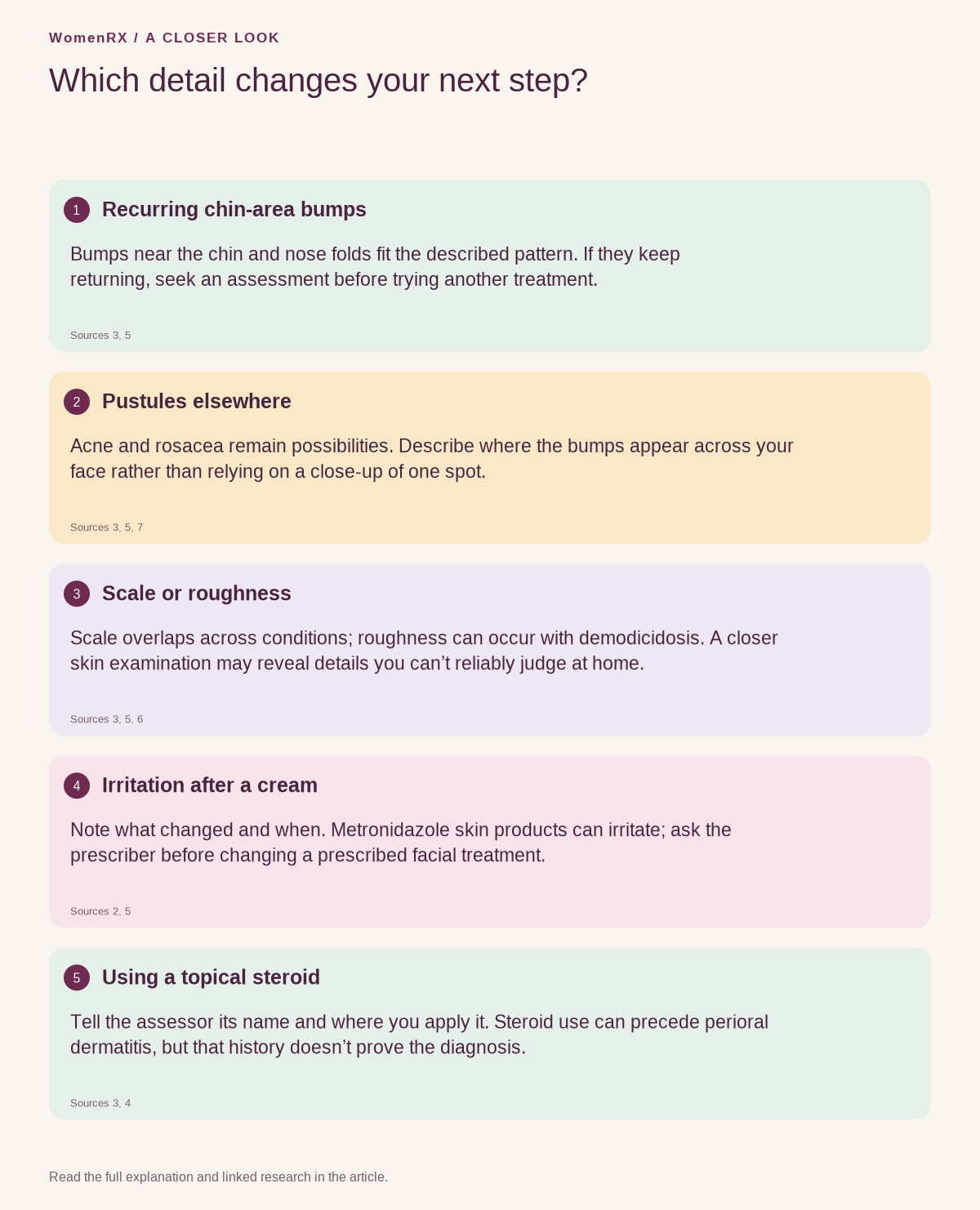
Which detail changes your next step?
Recurring chin-area bumps: Bumps near the chin and nose folds fit the described pattern. If they keep returning, seek an assessment before trying another treatment.35
Pustules elsewhere: Acne and rosacea remain possibilities. Describe where the bumps appear across your face rather than relying on a close-up of one spot.357
Scale or roughness: Scale overlaps across conditions; roughness can occur with demodicidosis. A closer skin examination may reveal details you can’t reliably judge at home.356
Irritation after a cream: Note what changed and when. Metronidazole skin products can irritate; ask the prescriber before changing a prescribed facial treatment.25
Using a topical steroid: Tell the assessor its name and where you apply it. Steroid use can precede perioral dermatitis, but that history doesn’t prove the diagnosis.34
Read the figure as text
Start with the feature you’ve noticed. These paths organize what to describe and whom to ask; none identifies the rash on its own.- Recurring chin-area bumps: Bumps near the chin and nose folds fit the described pattern. If they keep returning, seek an assessment before trying another treatment.35
- Pustules elsewhere: Acne and rosacea remain possibilities. Describe where the bumps appear across your face rather than relying on a close-up of one spot.357
- Scale or roughness: Scale overlaps across conditions; roughness can occur with demodicidosis. A closer skin examination may reveal details you can’t reliably judge at home.356
- Irritation after a cream: Note what changed and when. Metronidazole skin products can irritate; ask the prescriber before changing a prescribed facial treatment.25
- Using a topical steroid: Tell the assessor its name and where you apply it. Steroid use can precede perioral dermatitis, but that history doesn’t prove the diagnosis.34
Sources you can check
- About metronidazole - NHSAccessed 2026-09-25Return to first citation
- Side effects of metronidazole - NHSAccessed 2026-09-25Return to first citation
- Perioral dermatitis.Lipozenčić J, Hadžavdić SL. · Clinics in dermatology · 2014Return to first citation
- Perioral dermatitis.Ljubojević S, Lipozencić J, Turcić P. · Acta dermatovenerologica Croatica : ADC · 2008Return to first citation
- Perioral dermatitis.Lipozencic J, Ljubojevic S. · Clinics in dermatology · 2011Return to first citation
- Usefulness of dermoscopy in the diagnosis and monitoring treatment of demodicidosis.Friedman P, Sabban EC, Cabo H. · Dermatology practical & conceptual · 2017Return to first citation
- Pustular skin disorders: diagnosis and treatment.Mengesha YM, Bennett ML. · American journal of clinical dermatology · 2002Return to first citation