Sensitive Skin, Irritation, or Allergy? Clues That Help
Stinging without a visible rash can differ from contact dermatitis, but irritation and allergy may look alike and often need an exposure history or patch testing to tell apart.
“Sensitive skin” describes discomfort such as stinging, burning, or itching; it isn’t a diagnosis. If a product seems to trigger symptoms, simplify by pausing nonessential recent additions and write down what touched the area, where, and how often. A rash that keeps returning or is hard to explain deserves an assessment. Irritant and allergic contact dermatitis can look alike, so ask whether patch testing could help clarify an allergy. 2 3
Start with what you notice
Skin can sting, burn, or itch after a product even when there’s no visible change. That kind of discomfort is often described as sensitive skin, but the term doesn’t identify a cause. A visible rash, redness, or scaling may point toward dermatitis, though appearance alone can’t reliably separate irritant contact dermatitis from allergic contact dermatitis. 3 2
Irritant dermatitis happens when an exposure damages the skin barrier and triggers inflammation. Allergic contact dermatitis is another possibility, and the two can be difficult to distinguish by appearance. A clinician may consider the location and your pattern of exposure as well as the skin itself. 2
What the pattern can, and can’t, tell you
Where a reaction appears can offer a clue. Irritant dermatitis starts where the irritant contacts the skin and generally doesn’t spread; the hands and face are common sites. But that’s a clue, not a home diagnostic test. 2
Timing isn’t a dependable shortcut either. Some irritant reactions can be delayed: the review describes certain exposures causing inflammation that may not show up until 8-24 hours later. So a reaction that appears later isn’t automatically an allergy. And irritation and allergy can look so similar that a clinician may need testing to sort them out. 2
A pattern of discomfort without visible skin changes is different from a clear rash, but it still doesn’t reveal which product or ingredient is responsible. Avoid assuming that every sensation means you have an allergy, or that every rash is just “sensitive skin.” 3 2
Simplify without cutting out everything
If symptoms began after adding a nonessential product, pausing that product is a reasonable first step. Avoiding irritants and protecting the skin barrier are central approaches to irritant contact dermatitis. Broadly eliminating product categories or ingredients without a clear reason can make it harder to spot a relevant exposure. 2
Keep a short record while you simplify. The useful details are the product or exposure, the area it touched, how often and how long you used it, and what the skin did. Include everyday exposures such as frequent water contact or work-related products, especially if your hands are affected. These are the kinds of details clinicians use when assessing possible contact dermatitis. 2
For example, a record might say: “New face cream; cheeks; used each evening; stinging and redness noticed after use.” Note when symptoms first appeared and whether they ease after you stop using the product. This record can help organize the history; it cannot confirm an allergy by itself.
When to ask about patch testing
If a rash keeps recurring, the cause isn’t clear, or simplifying hasn’t resolved the problem, arrange an assessment rather than continuing to guess. Contact dermatitis can have several causes, and chronic hand eczema, for example, may involve irritants, allergy, atopic dermatitis, or another cause. 1 2
Chronic hand eczema has a higher reported incidence in women, according to a European contact-dermatitis task-force review. The review also identifies environmental exposures, particularly frequent water contact at work, as key contributors. If your symptoms began during pregnancy or around menopause, include that timing in your record, but don’t assume it identifies a hormonal cause or tells you whether the reaction is irritation or allergy. 1 2
Patch testing is used to investigate allergic contact dermatitis. Irritant dermatitis has no confirmatory test and is often assessed from the history and examination after allergy has been considered; the review recommends patch testing to help exclude allergic contact dermatitis when the distinction matters. Ask the clinician assessing your skin whether patch testing fits your symptoms and exposures. 2
This is most useful when you suspect a particular contact exposure but can’t identify it confidently, or when a recurring rash would change what products or exposures you avoid.
A practical next-step map
- Discomfort, no visible change: Note the product and area, pause a nonessential recent addition, and watch whether symptoms settle. This pattern describes a sensation, not a confirmed diagnosis. 3
- Rash where an exposure touched: Record the location and exposure details. Irritant dermatitis often starts at the contact site, but appearance and location don’t rule out allergy. 2
- Recurring or unclear rash: Arrange an assessment and bring your exposure record. Ask whether patch testing could help evaluate allergic contact dermatitis. 2
- Hands affected repeatedly: Include water, cleaning, and work exposures in your notes; chronic hand eczema can have more than one cause. 1
The aim isn’t to identify an allergen by trial and error. It’s to narrow down relevant exposures and get the right assessment if symptoms persist or recur.
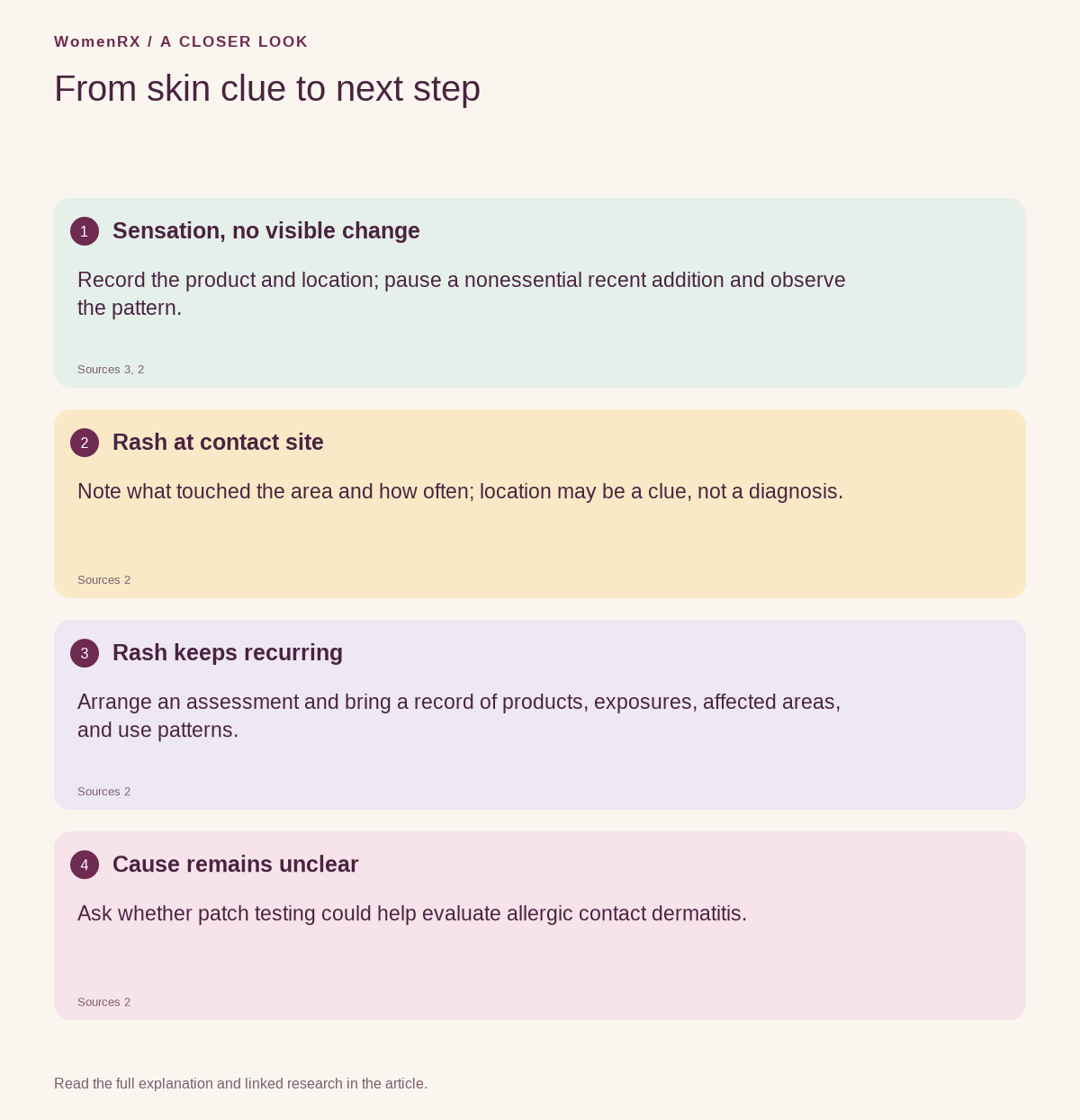
From skin clue to next step
Sensation, no visible change: Record the product and location; pause a nonessential recent addition and observe the pattern.32
Rash at contact site: Note what touched the area and how often; location may be a clue, not a diagnosis.2
Rash keeps recurring: Arrange an assessment and bring a record of products, exposures, affected areas, and use patterns.2
Cause remains unclear: Ask whether patch testing could help evaluate allergic contact dermatitis.2
Read the figure as text
These patterns can help organize what to do next, but they do not diagnose the cause. Irritation and allergy can overlap in appearance.- Sensation, no visible change: Record the product and location; pause a nonessential recent addition and observe the pattern.32
- Rash at contact site: Note what touched the area and how often; location may be a clue, not a diagnosis.2
- Rash keeps recurring: Arrange an assessment and bring a record of products, exposures, affected areas, and use patterns.2
- Cause remains unclear: Ask whether patch testing could help evaluate allergic contact dermatitis.2
More questions, answered
Does a delayed reaction mean I’m allergic?
No. Some irritant reactions can also be delayed, with certain exposures causing inflammation 8-24 hours later. Timing alone can’t distinguish irritation from allergy. 2
Can I diagnose an allergy by stopping a product?
Stopping a suspected nonessential product may help you notice whether symptoms change, but it does not confirm an allergy. Irritant and allergic contact dermatitis can look alike; a clinician may consider patch testing. 2
Sources you can check
- Chronic hand eczema: Common questions and practical recommendations from the EADV Contact Dermatitis Task Force.Balato A, Tancredi V, Aerts O, Crépy MN, Dugonik A, Gonçalo M, Krecisz B, Ljubojevic Hadzavdic S, Malinauskienė L, Özkaya E, Simon D, Giménez-Arnau AM. · Journal of the European Academy of Dermatology and Venereology : JEADV · 2026Return to first citation
- Irritant Contact Dermatitis - a Review.Patel K, Nixon R. · Current dermatology reports · 2022Return to first citation
- Cutaneous acceptability of a moisturizing cream in subjects with sensitive skin.Snatchfold J. · Journal of cosmetic dermatology · 2019Return to first citation