How to Care for Skin That Stings After Products
A simpler routine can give irritated skin a break while helping you notice which products may be causing trouble.
Pause recently added or nonessential products that sting, keep washing gentle, and use a moisturizer your skin tolerates. Repeated exposure to soaps and detergents can irritate skin, while moisturizer can help protect it from further irritation. 2 4 If the problem worsens, doesn’t ease with a simpler routine, or keeps returning, getting it assessed is more useful than trying more products.
First, reduce what’s touching your skin
When skin feels tight, dry, or suddenly stings, you don’t need to add a complicated “barrier repair” routine. Start by setting aside recently added or nonessential products that seem to make it worse. Also think beyond skincare: repeated contact with soap, detergent, and water can disrupt the skin’s outer layer and contribute to irritant dermatitis, especially on the hands. 4
Keep necessary washing, but make it gentler. Use lukewarm water, avoid scrubbing, and rinse without rubbing the irritated area. For hands, a review of washing-related dermatitis recommends moisturizing after cleansing rather than cutting back on needed hand hygiene. 4
Make moisturizer the steady part of the reset
Choose a fragrance-free moisturizer that feels comfortable on the affected skin. If a light lotion isn’t doing enough for dryness, consider a cream or ointment instead. Thicker products can offer more protection against dryness, though the best-feeling option is the one you can use without adding discomfort. 4
There’s a reason to keep this step simple and consistent. In a two-week randomized study of 132 healthy adults, hand-skin scores worsened in the group repeatedly washing with soap alone, but not in the groups using moisturizer after washing. This was a hand-washing experiment, not a test of facial products or a treatment for every rash. 2
Moisturizers aren’t interchangeable, either. In a small experiment involving 36 healthy volunteers, six moisturizers helped skin recover after a controlled irritant exposure compared with leaving the irritated area untreated. In a separate four-week study of 49 adults with atopic dermatitis, one specific urea-and-glycerol cream reduced the skin’s response to a tested irritant more than the comparison creams or no treatment. Those results show why a formula can matter; they don’t establish one ingredient or product as the answer for your skin. 1 3
Bring extras back only when skin feels settled
Once the irritation has eased, consider bringing back nonessential products one at a time rather than restarting everything together. That’s a practical way to notice whether discomfort returns with a particular product, not a test that can tell you whether you have an allergy. If something repeatedly seems to set off the same reaction, stop trying it on irritated skin.
Irritation isn’t the only possible explanation for a rash. Allergic contact dermatitis is a delayed reaction that can be triggered by an ingredient in a product, and a routine reset can’t tell the two conditions apart. 4 If the area is worsening, isn’t easing after you simplify, or keeps flaring again, getting it assessed is a sensible next move instead of cycling through more products.
Does your life stage change the reset?
Pregnancy, the postpartum period, and menopause can all raise questions about skin changes. The moisturizer experiments discussed here didn’t compare reset routines across those life stages, so they don’t establish a different set of steps for each one. Keep the routine conservative, and don’t assume a new or persistent rash is simply due to hormones. 1 2 3
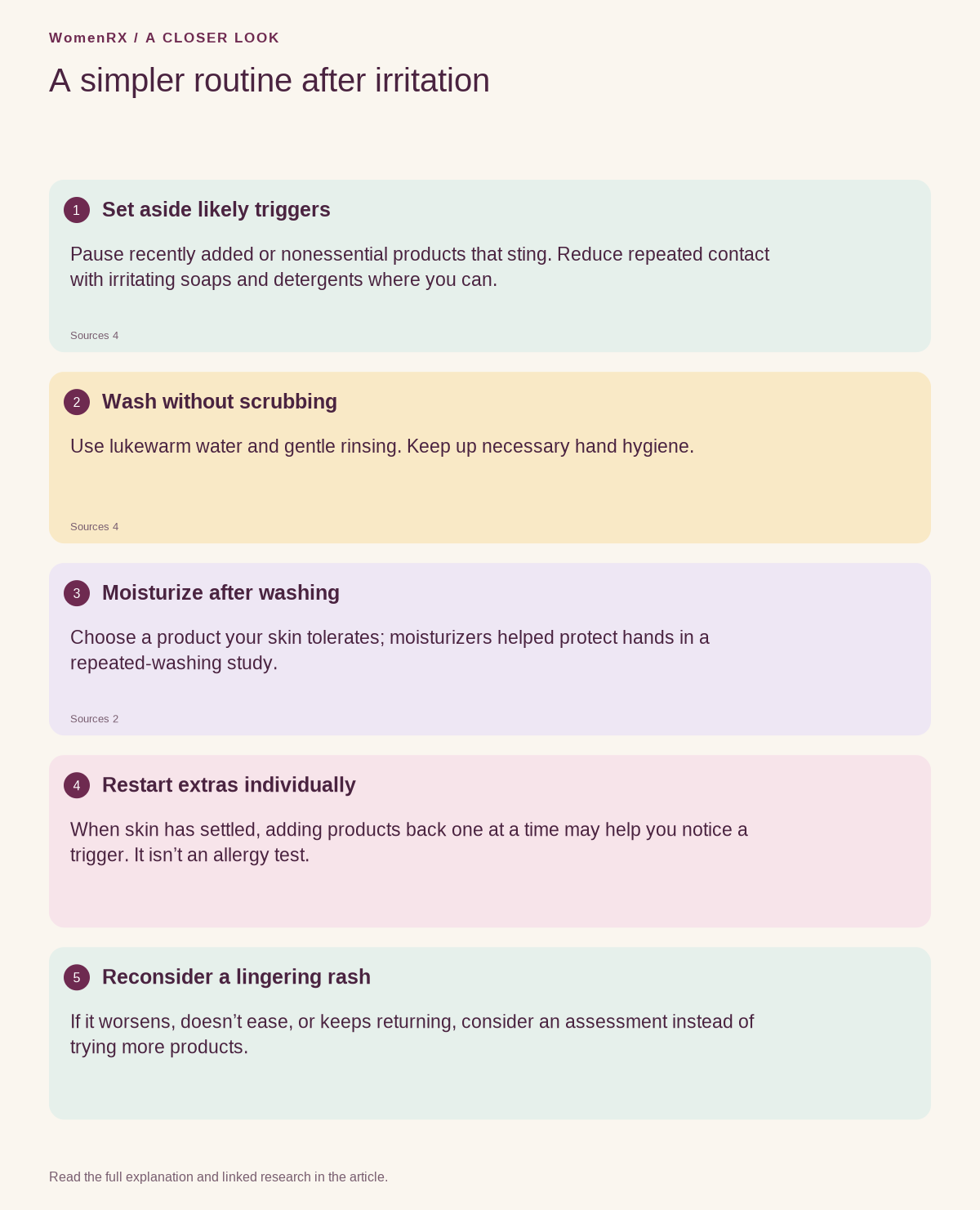
A simpler routine after irritation
Set aside likely triggers: Pause recently added or nonessential products that sting. Reduce repeated contact with irritating soaps and detergents where you can.4
Wash without scrubbing: Use lukewarm water and gentle rinsing. Keep up necessary hand hygiene.4
Moisturize after washing: Choose a product your skin tolerates; moisturizers helped protect hands in a repeated-washing study.2
Restart extras individually: When skin has settled, adding products back one at a time may help you notice a trigger. It isn’t an allergy test.
Reconsider a lingering rash: If it worsens, doesn’t ease, or keeps returning, consider an assessment instead of trying more products.
Read the figure as text
Use this sequence to reduce possible irritant exposure without treating it as a diagnosis or a timed repair plan.- Set aside likely triggers: Pause recently added or nonessential products that sting. Reduce repeated contact with irritating soaps and detergents where you can.4
- Wash without scrubbing: Use lukewarm water and gentle rinsing. Keep up necessary hand hygiene.4
- Moisturize after washing: Choose a product your skin tolerates; moisturizers helped protect hands in a repeated-washing study.2
- Restart extras individually: When skin has settled, adding products back one at a time may help you notice a trigger. It isn’t an allergy test.
- Reconsider a lingering rash: If it worsens, doesn’t ease, or keeps returning, consider an assessment instead of trying more products.
Sources you can check
- Different types of emollient cream exhibit diverse physiological effects on the skin barrier in adults with atopic dermatitis.Danby SG, Andrew PV, Taylor RN, Kay LJ, Chittock J, Pinnock A, Ulhaq I, Fasth A, Carlander K, Holm T, Cork MJ. · Clinical and experimental dermatology · 2022Return to first citation
- A double-blind, randomized study to assess the effectiveness of different moisturizers in preventing dermatitis induced by hand washing to simulate healthcare use.Williams C, Wilkinson SM, McShane P, Lewis J, Pennington D, Pierce S, Fernandez C. · The British journal of dermatology · 2010Return to first citation
- Effect of different moisturizers on SLS-irritated human skin.Held E, Lund H, Agner T. · Contact dermatitis · 2001Return to first citation
- Frequent Hand Washing for COVID-19 Prevention Can Cause Hand Dermatitis: Management Tips.Beiu C, Mihai M, Popa L, Cima L, Popescu MN. · Cureus · 2020Return to first citation