Psyllium Side Effects: What’s Expected and What’s Not
Mild gas or bloating can happen when you add fiber, but trouble swallowing or worsening abdominal swelling calls for a different response.
A little gas, bloating, or cramping can occur when you increase fiber, especially quickly. Psyllium needs enough liquid: swallowing it dry or with too little fluid has been linked to blockage in the throat or intestines. Stop taking it and seek prompt medical advice if swallowing becomes difficult or constipation worsens with increasing abdominal swelling. 1 2 3
What may be a temporary adjustment
Gas, bloating, and cramps can follow a quick increase in fiber. These symptoms don’t prove psyllium is the cause, though: constipation and other digestive problems can feel similar. If discomfort is mild and you otherwise feel well, note whether it began after starting psyllium or increasing fiber, and avoid increasing fiber further until you know how you’re responding. Guidance on constipation recommends increasing fiber gradually to reduce side effects. 1 4
A clinical review of trials in adults with high cholesterol described psyllium as well tolerated, but it doesn’t give a detailed list or frequency of digestive side effects. That finding is reassuring only in context; it can’t predict how a particular person will feel. 5
Why liquid and swallowing matter
Psyllium absorbs water and expands. If it is swallowed without enough liquid, it may swell before passing safely. The FDA reported cases of esophageal obstruction associated with psyllium laxatives in granular form. A published case report also described intestinal obstruction after a man took psyllium husks without adequate fluid; one case shows a possible risk, not how often it happens. 2 3
Follow the directions for your exact product and mix or take it as directed. Don’t swallow psyllium dry. Because esophageal obstruction has been reported, if you have trouble swallowing or are unsure whether a digestive condition affects whether psyllium is suitable for you, ask a pharmacist or clinician before starting.
A practical stop-and-seek-advice pathway
- Mild gas, bloating, or cramps: If symptoms are manageable, don’t increase your fiber further for now. If they persist, worsen, or concern you, stop psyllium and ask a clinician or pharmacist what to do next. Fiber increases are generally recommended gradually. 1 4
- Difficulty swallowing: Stop taking psyllium and seek prompt medical assessment. Psyllium-related esophageal blockage has been reported, including with granular laxatives. 2
- Worsening constipation with a growing, swollen abdomen: Don’t take more psyllium while waiting to see if it passes. Seek prompt medical assessment, since intestinal obstruction has been reported after psyllium use and can involve worsening constipation and abdominal distension. 3
These symptoms don’t confirm that psyllium caused a blockage. They are reasons not to treat the problem by taking more fiber at home.
Pregnancy, postpartum, and medicines
The safety findings described here don’t establish a different general risk for women, or a specific risk during pregnancy or postpartum recovery. They also don’t answer whether psyllium is appropriate for your recovery or alongside your medicines. If you’re pregnant, recently gave birth, or taking prescribed medicines and are considering psyllium, ask your maternity care team or pharmacist about your particular situation rather than assuming a general constipation recommendation applies.
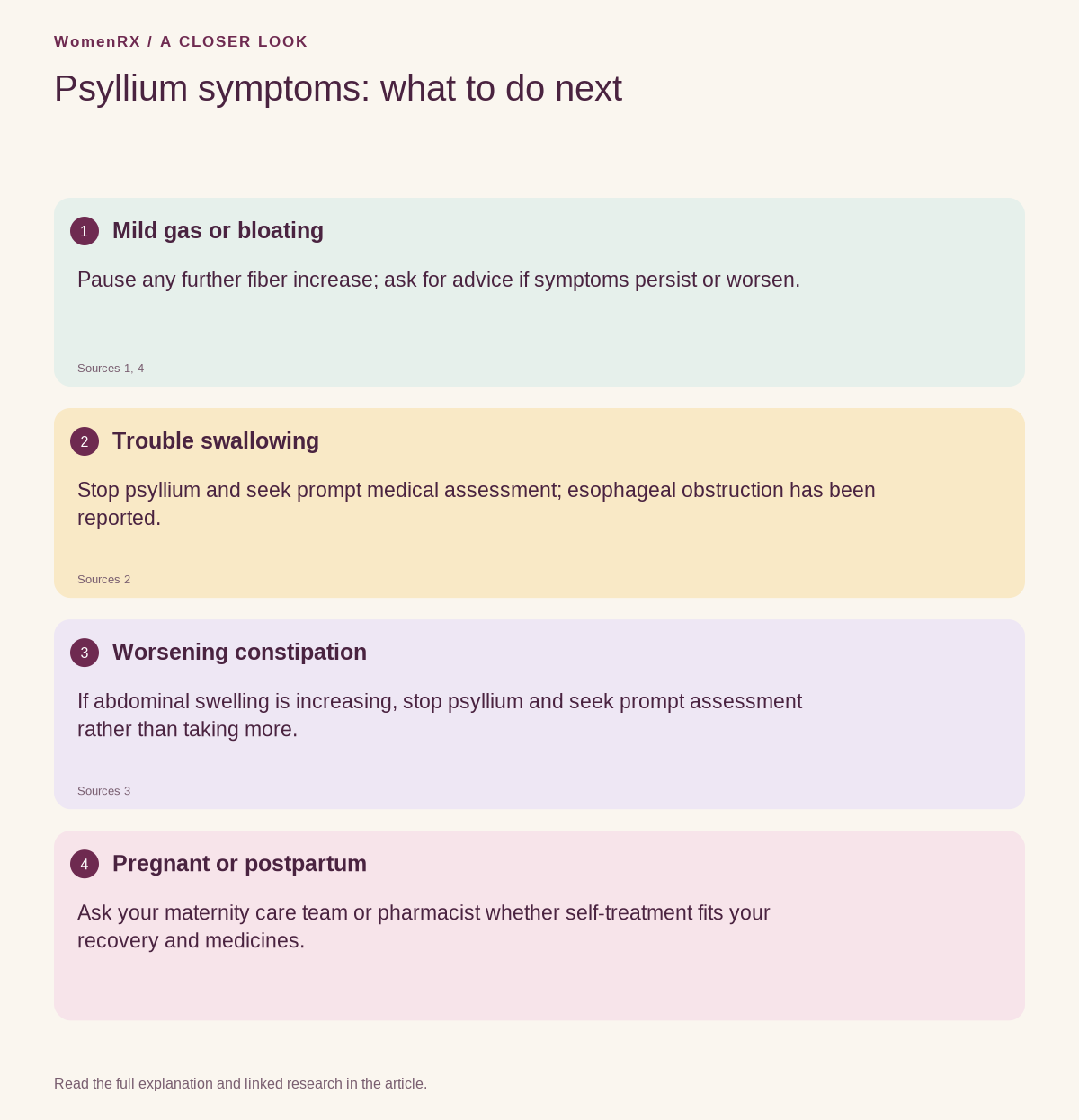
Psyllium symptoms: what to do next
Mild gas or bloating: Pause any further fiber increase; ask for advice if symptoms persist or worsen.14
Trouble swallowing: Stop psyllium and seek prompt medical assessment; esophageal obstruction has been reported.2
Worsening constipation: If abdominal swelling is increasing, stop psyllium and seek prompt assessment rather than taking more.3
Pregnant or postpartum: Ask your maternity care team or pharmacist whether self-treatment fits your recovery and medicines.
Read the figure as text
Use the symptom pattern to distinguish mild effects to monitor from signs that call for stopping psyllium and getting assessed.- Mild gas or bloating: Pause any further fiber increase; ask for advice if symptoms persist or worsen.14
- Trouble swallowing: Stop psyllium and seek prompt medical assessment; esophageal obstruction has been reported.2
- Worsening constipation: If abdominal swelling is increasing, stop psyllium and seek prompt assessment rather than taking more.3
- Pregnant or postpartum: Ask your maternity care team or pharmacist whether self-treatment fits your recovery and medicines.
More questions, answered
Can psyllium make constipation worse?
It can. A case report linked worsening constipation and abdominal distension to psyllium taken without adequate fluid. If constipation is getting worse, especially with increasing abdominal swelling, stop taking it and seek prompt medical assessment rather than adding more. 3
Do these findings show that psyllium is riskier for women?
No sex-specific difference is established by these findings. One safety analysis included men and women with high cholesterol, but it does not report a separate women-only safety result or answer questions about pregnancy and postpartum recovery. 5
Sources you can check
- Dietary Fiber: MedlinePlusAccessed 2026-09-25Return to first citation
- Laxative drug products for over-the-counter human use; psyllium ingredients in granular dosage forms. Final rule.Food and Drug Administration, HHS. · Federal register · 2007Return to first citation
- Intestinal obstruction caused by a laxative drug (Psyllium): A case report and review of the literature.Hefny AF, Ayad AZ, Matev N, Bashir MO. · International journal of surgery case reports · 2018Return to first citation
- Management of Constipation in Older Adults.Mounsey A, Raleigh M, Wilson A. · American family physician · 2015Return to first citation
- Cholesterol-lowering effects of psyllium intake adjunctive to diet therapy in men and women with hypercholesterolemia: meta-analysis of 8 controlled trials.Anderson JW, Allgood LD, Lawrence A, Altringer LA, Jerdack GR, Hengehold DA, Morel JG. · The American journal of clinical nutrition · 2000Return to first citation