Protein With Age: A Practical Way to Assess Your Meals
Look at what you eat across a typical day before deciding whether to change your protein intake.
There isn’t one protein target that fits every older woman: needs vary with health, activity, and age. 1 Listing foods you eat on a few typical days can help you see your usual pattern. Research on older women’s strength and performance is mixed, and evenly spreading protein across meals is a strategy under study, not a guarantee of stronger muscles. 3 4 6
Start with your usual day, not a target
Protein is found in foods such as meat, dairy products, nuts, beans, and some grains. To get a useful picture of your intake, write down what you eat and drink over a few typical days, including amounts. Add the protein grams shown on package labels or in a reliable food database. Looking at more than one day can help you avoid mistaking an unusually protein-heavy or protein-light day for your normal pattern.
This is an estimate, not a test of whether your diet is “good” or “bad.” The amount that makes sense for you depends on factors including age, health, and physical activity. A single number borrowed from an online article may not fit your circumstances. 1
Also look at the rest of the plate. A protein tally doesn’t tell you whether you’re eating enough overall, or whether your meals include a range of foods. In a study of older adults, age, physical activity, and chronic disease were associated with physical performance; after adjustment, no nutrient was associated with grip strength in both sexes. Nutrition matters, but protein alone doesn’t explain how well someone moves or maintains strength. 3
What studies in older women can, and can’t, tell you
Some findings are encouraging, but they don’t point to one proven amount. In a cross-sectional study of 309 Japanese women aged 65 to 92, more frequent intake of protein-rich foods was associated with better muscle mass, strength, and performance on several physical tests. It wasn’t associated with muscle-specific strength, and the study cannot show that eating those foods more often caused the differences. 5
Other research gives a less clear picture. In a study of 620 older adults, higher intake of several nutrients was associated with better grip strength in men, but not women; after adjustment, no nutrient remained associated with grip strength in both sexes. A separate Norwegian study found no adjusted longitudinal association between protein intake in middle age and grip strength in older age, in either sex. These studies differ in design and population, but together they’re a reason not to treat a protein number as a promise of stronger muscles. 3 4
A small randomized trial offers a more direct, but very specific, comparison. Thirty adults aged 60 to 80 with type 2 diabetes and sarcopenia-related deficits, including 15 women, followed one of two diets for 12 weeks. Knee muscle performance was maintained in the higher-protein group and declined in the comparison group, while fat-free mass did not change. That result may matter for people with a similar health profile, but it does not establish a general target for healthy older women. 2
Meal distribution is a question, not a rule
Researchers are interested in whether protein is better spread across meals rather than concentrated in one. A 2025 review describes research proposing roughly 25 to 30 grams per meal for older adults to support muscle protein synthesis. That is a proposed meal pattern, not proof that a particular amount at each meal improves strength or prevents disability in older women. 6
If you notice that most of your day’s protein comes at dinner, you could use that as a prompt to consider whether another meal could include a protein-containing food. For example, a breakfast with dairy or beans, or a lunch with nuts or another protein source, may make your day’s pattern less concentrated. These are food examples, not prescribed portions or a requirement to eat specific foods. 1
When a general estimate may not fit
If you’re pregnant, have kidney disease, or are eating very little because of poor appetite or another barrier, don’t assume a general older-adult estimate applies to you. Protein needs vary with health, and poor appetite can make it harder to eat enough. 1 6 Bring a short food record and your health concerns to a clinician or registered dietitian, and ask how a protein change would fit with your overall food intake and care plan.
A practical next step is to review a few days of meals: which foods contribute protein, whether the pattern changes from day to day, and whether appetite or health makes eating enough difficult. That gives a clinician or dietitian something concrete to work with, without assuming a supplement or a higher target is automatically needed.
A useful protein check-in
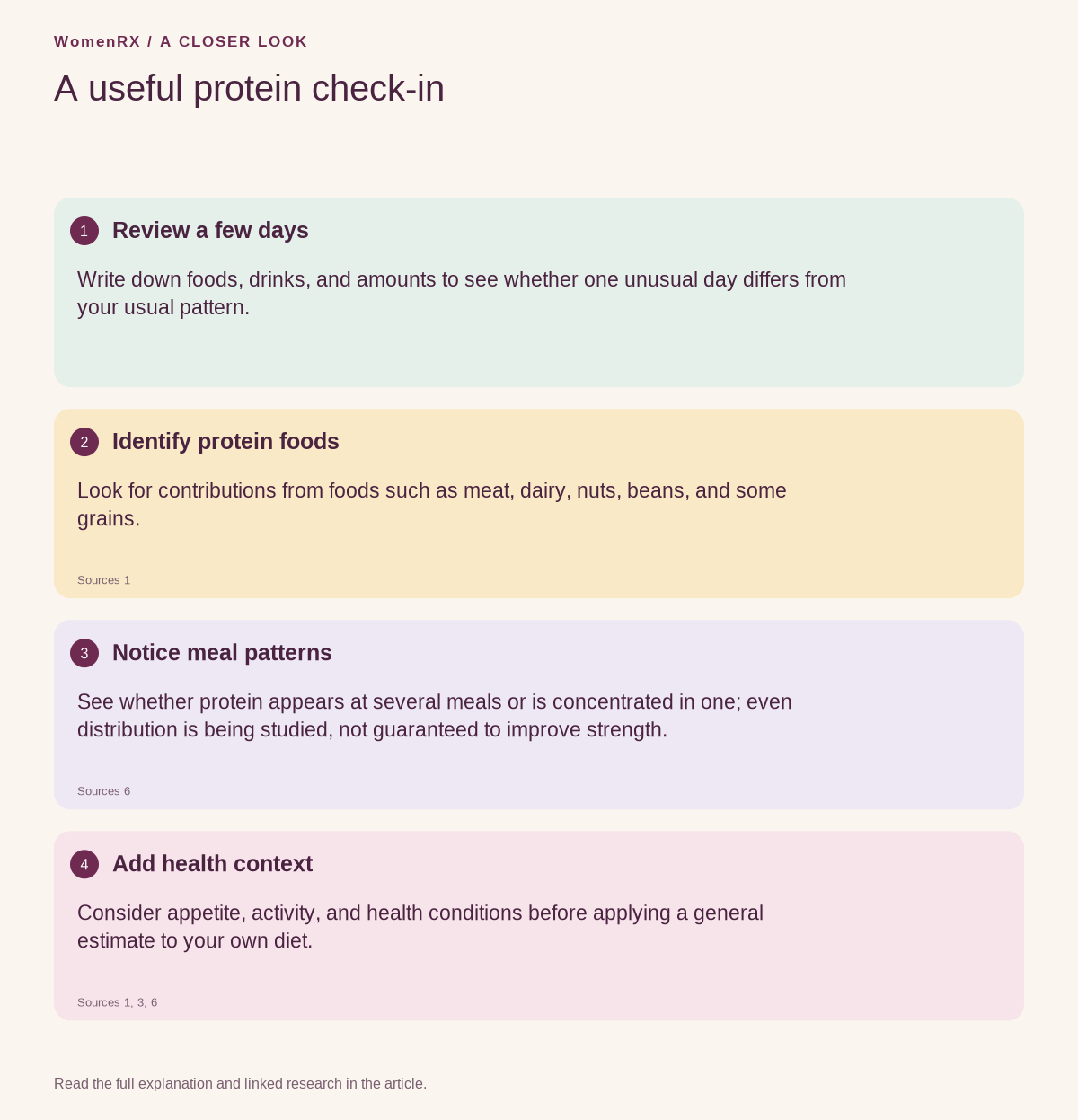
Review a few days: Write down foods, drinks, and amounts to see whether one unusual day differs from your usual pattern.
Identify protein foods: Look for contributions from foods such as meat, dairy, nuts, beans, and some grains.1
Notice meal patterns: See whether protein appears at several meals or is concentrated in one; even distribution is being studied, not guaranteed to improve strength.6
Add health context: Consider appetite, activity, and health conditions before applying a general estimate to your own diet.136
Read the figure as text
Use these prompts to review your usual meals and decide what questions to bring to a clinician or dietitian.- Review a few days: Write down foods, drinks, and amounts to see whether one unusual day differs from your usual pattern.
- Identify protein foods: Look for contributions from foods such as meat, dairy, nuts, beans, and some grains.1
- Notice meal patterns: See whether protein appears at several meals or is concentrated in one; even distribution is being studied, not guaranteed to improve strength.6
- Add health context: Consider appetite, activity, and health conditions before applying a general estimate to your own diet.136
More questions, answered
Do I need a protein powder to support healthy aging?
No, a protein powder isn’t automatically required. Protein comes from foods such as meat, dairy, nuts, beans, and some grains, and what makes sense for you depends on factors including your health and activity. 1
Sources you can check
- Dietary Proteins: MedlinePlusAccessed 2026-09-25Return to first citation
- Effects of Higher Dietary Protein Intake on Isokinetic Muscle Performance in Older Adults with Type 2 Diabetes Mellitus.Kalyva S, Argyropoulou D, Koulouvaris P, Tsolakis C, Terzis G, Nomikos T, Geladas ND, Theodorou AA, Paschalis V. · Journal of functional morphology and kinesiology · 2026Return to first citation
- Muscle Strength and Physical Performance in Relation to Dietary Intake Among Older Men and Women.Pigłowska MK, Sołtysik BK, Kostka J, Kostka T, Guligowska A. · Nutrients · 2026Return to first citation
- The Association of Isocaloric Substitution of Dietary Protein in Middle Age with Muscle Mass and Strength in Old Age: The Hordaland Health Study.Sabir Z, Hjartåker A, Dierkes J, Rosendahl-Riise H. · Current developments in nutrition · 2024Return to first citation
- Protein-rich food intake frequency score and muscle mass, strength, muscle-specific strength or physical performance in Japanese older women: a cross-sectional study.Nakayama Y, Yokoyama K, Moriyasu A, Kimura M, Yoshida T, Kobayashi H, Kimura M, Yamada Y. · BMC geriatrics · 2026Return to first citation
- Protein and Aging: Practicalities and Practice.Harris S, DePalma J, Barkoukis H. · Nutrients · 2025Return to first citation