Progesterone Without Estrogen: It Depends on the Goal
Progesterone can be prescribed without estrogen for specific reasons, but protecting the uterine lining during menopause hormone therapy is a different job.
Yes, for certain indications: oral micronized progesterone is labeled for secondary amenorrhea when low progesterone is the cause. 1 Progesterone is also studied as support in frozen embryo transfer, but those findings do not tell you whether estrogen is included in a particular protocol. 23 For menopause treatment, if you have a uterus and use systemic estrogen, an appropriate progestogen is generally used to reduce endometrial overgrowth risk. 1
Progesterone without estrogen isn’t automatically unusual. What matters is the job it’s meant to do. Treating a specific cause of absent periods, supporting a fertility-treatment cycle, and reducing a risk from systemic estrogen are different goals. A prescription for one doesn’t automatically serve the others.
When progesterone may be used on its own
One specific use of oral micronized progesterone is secondary amenorrhea: periods have stopped after previously occurring, and low progesterone has been identified as the cause. The US prescribing information for Prometrium lists this use. That doesn’t make progesterone a general fix for irregular periods; the reason your cycle changed matters. 1
Fertility treatment is another distinct setting. Progesterone may be used as support during some frozen embryo transfer protocols, but the findings depend on how the cycle was prepared. A review of modified natural-cycle transfers found no overall difference in live birth rates between progesterone support and no support. A separate review of additional progesterone in artificially prepared cycles examined observational studies of women with low progesterone measurements and found substantial differences across studies. These findings don’t establish whether estrogen is part of any particular protocol, and they don’t make progesterone a general fertility treatment. 23
Menopause symptoms and uterine protection are separate questions
For bothersome hot flashes and other vasomotor symptoms, the North American Menopause Society describes hormone therapy as the most effective treatment. Its position statement says benefits and risks vary with factors including age, timing, route, and whether a progestogen is used. That supports a discussion about menopause hormone therapy; it doesn’t establish progesterone alone as an equivalent replacement for estrogen. 4
The clearest menopause-related reason for adding a progestogen is to protect the uterine lining when systemic estrogen is used and the uterus is still present. Estrogen alone raises the risk of endometrial hyperplasia, an abnormal overgrowth of the lining. In a randomized trial described in Prometrium’s prescribing information, 358 postmenopausal women with intact uteri received estrogen plus progesterone, estrogen alone, or placebo for up to 36 months. Among those with an endometrial diagnosis reported in the trial table, hyperplasia occurred in 7 of 117 women (6%) in the combination group, compared with 74 of 115 (64%) in the estrogen-alone group. Those results concern the regimens studied, not every progesterone product or schedule. 1
Two details therefore change a menopause-treatment discussion: Are you using systemic estrogen, and do you have a uterus? When both are true, lining protection is a reason to include an appropriate progestogen. If your uterus has been removed, that particular reason doesn’t apply. The treatment choice still depends on the symptoms you’re trying to address and your health circumstances. 14
Make the treatment goal clear
If progesterone is offered without estrogen, ask what it’s intended to treat. Is the plan for secondary amenorrhea linked to low progesterone, support within a particular fertility protocol, or a menopause symptom? If the goal is relief from hot flashes, ask what evidence supports that plan rather than assuming progesterone alone does the same job as estrogen-containing menopause therapy. 1234
If you take systemic estrogen and still have a uterus, clarify which progestogen is included and whether the plan is intended to protect the lining. Don’t assume one regimen can be substituted for another. Oral micronized progesterone can also cause dizziness or drowsiness in some people, and its prescribing information notes possible fluid retention. 1
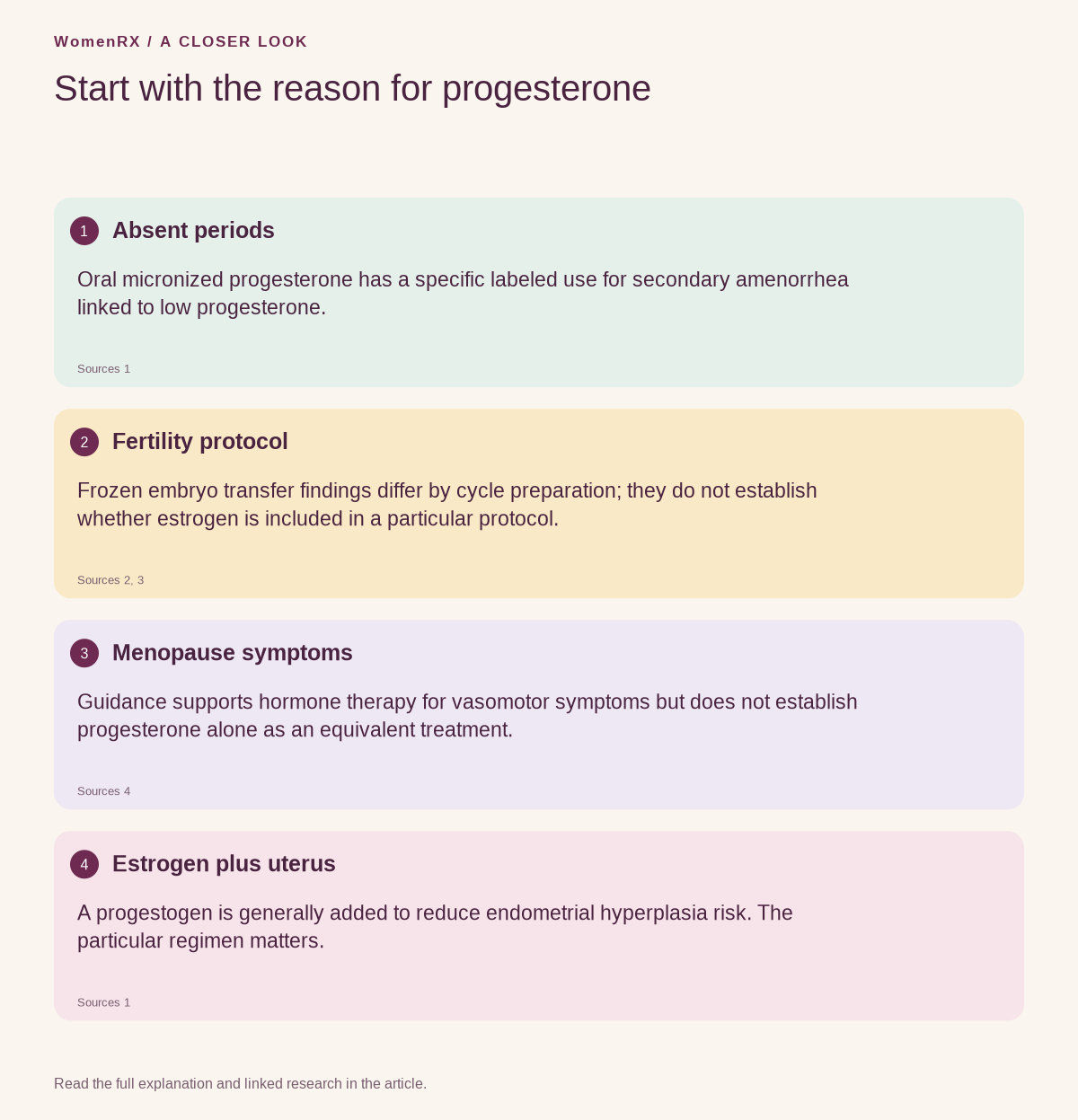
Start with the reason for progesterone
Absent periods: Oral micronized progesterone has a specific labeled use for secondary amenorrhea linked to low progesterone.1
Fertility protocol: Frozen embryo transfer findings differ by cycle preparation; they do not establish whether estrogen is included in a particular protocol.23
Menopause symptoms: Guidance supports hormone therapy for vasomotor symptoms but does not establish progesterone alone as an equivalent treatment.4
Estrogen plus uterus: A progestogen is generally added to reduce endometrial hyperplasia risk. The particular regimen matters.1
Read the figure as text
The treatment goal comes first. For menopause therapy, whether you use systemic estrogen and have a uterus changes progesterone’s role.- Absent periods: Oral micronized progesterone has a specific labeled use for secondary amenorrhea linked to low progesterone.1
- Fertility protocol: Frozen embryo transfer findings differ by cycle preparation; they do not establish whether estrogen is included in a particular protocol.23
- Menopause symptoms: Guidance supports hormone therapy for vasomotor symptoms but does not establish progesterone alone as an equivalent treatment.4
- Estrogen plus uterus: A progestogen is generally added to reduce endometrial hyperplasia risk. The particular regimen matters.1
More questions, answered
Does progesterone alone protect the uterine lining?
Don’t assume it does in every situation. The cited trial tested progesterone with estrogen in postmenopausal women with intact uteri. It supports the studied combination, not a blanket claim about progesterone alone or every treatment plan. 1
Is progesterone used in fertility treatment the same as menopause therapy?
No. Progesterone support in frozen embryo transfer is part of a specific fertility protocol; the findings don’t establish whether estrogen is included in a particular protocol. In menopause therapy, a progestogen may be included to protect the uterine lining when someone with a uterus uses systemic estrogen. Those uses aren’t interchangeable. 123
Sources you can check
- PROMETRIUM (PROGESTERONE) CAPSULE [ACERTIS PHARMACEUTICALS, LLC] | US prescribing information and patient instructionsAccessed 2026-09-25Return to first citation
- Reproductive outcomes after rescue luteal phase support for women with low serum progesterone in artificial cycles around frozen embryo transfer day: Systematic review and network meta-analysis of over 7500 patients.Etrusco A, Agrifoglio V, D'Amato A, Wyns C, Di Donna MC, Vitagliano A, Alviggi C, Conforti A, Laganà AS, Busnelli A, Levi Setti PE, Riemma G. · International journal of gynaecology and obstetrics: the official organ of the International Federation of Gynaecology and Obstetrics · 2026Return to first citation
- Luteal phase progesterone support in modified natural cycle frozen embryo transfer: a systematic review and meta-analysis.Engesgaard FM, Johansen AS, Saupstad M, Wang NF, Pinborg A, Løssl K. · Reproductive biomedicine online · 2026Return to first citation
- The 2022 hormone therapy position statement of The North American Menopause Society.“The 2022 Hormone Therapy Position Statement of The North American Menopause Society” Advisory Panel. · Menopause (New York, N.Y.) · 2022Return to first citation