Planning GLP-1 Treatment Around Caregiving
A workable plan covers more than the dose: it accounts for appointments, medication instructions, meals, and what to do if side effects disrupt the day.
Before starting or continuing a GLP-1 medicine, map out follow-ups, product-specific use and storage instructions, and backup if you feel unwell. Ask what to do if appetite or digestive symptoms affect eating or drinking, and whom to contact. Saxenda’s label directs discontinuing the medicine and starting appropriate medical management if pancreatitis is suspected. 1
Caregiving doesn’t create one standard schedule. You might have school pickup at a fixed time, unpredictable overnight care, or no reliable backup when a child is sick. The useful question isn’t whether treatment fits a perfect routine. It’s whether you and your prescriber can make a plan that still works when your day changes.
Use the prompts below to identify snags before they become urgent. They’re planning questions, not dosing instructions. Follow the directions for your specific medicine, and ask your prescriber or pharmacist to clarify anything you’re unsure about.
Start with the parts of your week that can’t move
Look at a typical week, including the less predictable parts. When can you take a call or attend a follow-up? Is there a time when another adult can step in if an appointment runs long? If you use a pharmacy delivery service or need to collect a prescription, what happens when a delivery is delayed or you can’t leave home?
Bring those details to the appointment. Ask which follow-ups need to happen in person, what options exist if you need to reschedule, and how to reach the care team with a question between visits. If cost, insurance, or refill timing could interrupt treatment, raise that early too. A US survey of clinicians who prescribe obesity medicines identified medication cost and insurance coverage as major treatment barriers, although it did not study caregiving routines specifically. 3
Make the medicine instructions fit your actual routine
Ask the prescriber or pharmacist to go over the instructions for the exact medicine you’re taking. Confirm when and how it is used, how it should be stored, and what to do if a dose is late, missed, or interrupted. Don’t assume that instructions for one GLP-1 medicine apply to another.
Then test the plan against real-life disruptions: travel, a child’s illness, a change in your work shift, or a day when you can’t get to the refrigerator or supplies. If you use reminders, choose one you’re likely to notice during a busy day. A calendar alert, medication app, or reminder tied to an existing routine may help organize the plan, but it can’t replace product-specific instructions.
Plan for meals and days you feel unwell
Ask what the prescriber wants you to do if you have little appetite, nausea, vomiting, or another digestive problem that makes meals or drinking difficult. It may help to decide in advance what food and drinks you can realistically keep available, and who could help with caregiving if you need time to rest. A registered-dietitian interview study emphasized proactive side-effect management and ongoing, individualized nutrition support; it describes care perspectives, not proof that one particular meal plan works for everyone. 4
GLP-1 medicines can be associated with gastrointestinal reactions, and some can be severe. 2 Ask whom to contact, how quickly to do so, and what symptoms should change your plans for the day. For example, Saxenda (liraglutide) prescribing information says persistent or severe abdominal pain, sometimes spreading to the back and sometimes accompanied by nausea or vomiting, can be a sign of pancreatitis. Ask your prescriber how to respond if these symptoms occur. If pancreatitis is suspected, the Saxenda label directs discontinuing Saxenda and initiating appropriate medical management. This direction is specific to Saxenda’s prescribing information, not a universal stop instruction for every GLP-1 medicine. 1
Decide who can cover one task
You may not need someone to take over everything. Think about one specific backup: an adult who can pick up a child, bring groceries, cover a short appointment, or help if you’re too unwell to manage your usual responsibilities. If no one is available, tell your prescriber. That information can shape a realistic plan for follow-up and for handling side effects.
Questions to take to your prescriber
- What are the instructions for my exact medicine, including storage and what to do about a missed or delayed dose?
- How can I reach you between appointments, and what symptoms should prompt a call?
- If appetite or digestive symptoms affect eating or drinking, what should I do?
- Which appointments can be remote, and what should I do if caregiving makes me miss one?
- If a refill, cost, or pharmacy delay becomes a problem, who can help me plan the next step?
The goal isn’t to prove you can manage every disruption alone. It’s to identify the weak points in your routine and agree on a next step before you’re trying to solve them while caring for someone else.
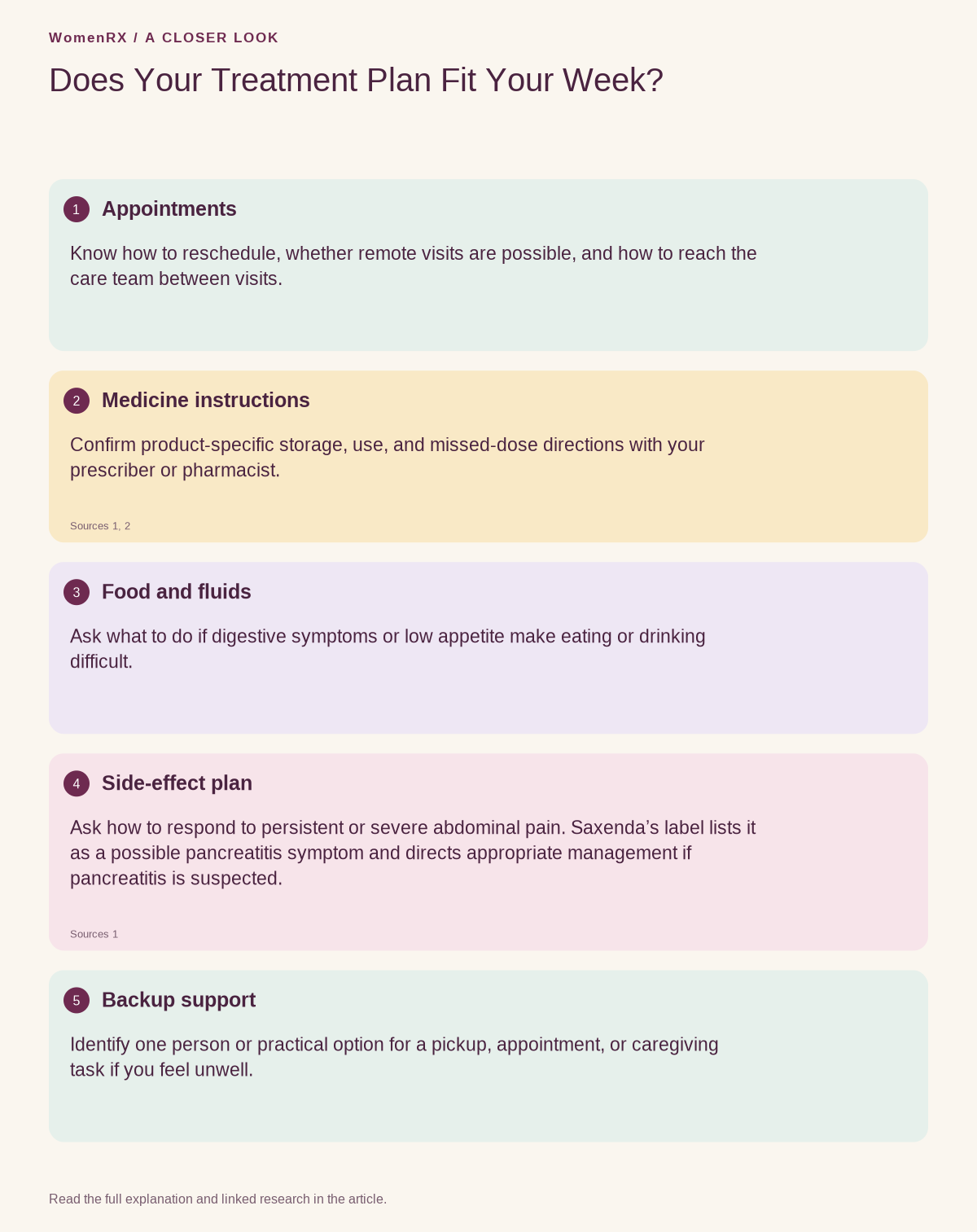
Does Your Treatment Plan Fit Your Week?
Appointments: Know how to reschedule, whether remote visits are possible, and how to reach the care team between visits.
Medicine instructions: Confirm product-specific storage, use, and missed-dose directions with your prescriber or pharmacist.12
Food and fluids: Ask what to do if digestive symptoms or low appetite make eating or drinking difficult.
Side-effect plan: Ask how to respond to persistent or severe abdominal pain. Saxenda’s label lists it as a possible pancreatitis symptom and directs appropriate management if pancreatitis is suspected.1
Backup support: Identify one person or practical option for a pickup, appointment, or caregiving task if you feel unwell.
Read the figure as text
Use these prompts to spot practical gaps and decide what to ask your prescriber. This is a planning aid, not a validated score.- Appointments: Know how to reschedule, whether remote visits are possible, and how to reach the care team between visits.
- Medicine instructions: Confirm product-specific storage, use, and missed-dose directions with your prescriber or pharmacist.12
- Food and fluids: Ask what to do if digestive symptoms or low appetite make eating or drinking difficult.
- Side-effect plan: Ask how to respond to persistent or severe abdominal pain. Saxenda’s label lists it as a possible pancreatitis symptom and directs appropriate management if pancreatitis is suspected.1
- Backup support: Identify one person or practical option for a pickup, appointment, or caregiving task if you feel unwell.
More questions, answered
Should I change my dose to fit a busy day?
Don’t change the timing or amount on your own. Ask your prescriber or pharmacist for instructions specific to your medicine, including what to do if a dose is missed or delayed.
What if caregiving makes me miss a follow-up?
Ask the clinic ahead of time how to reschedule and whether a remote appointment is an option. If you’re already having side effects or have a medication question, ask how to contact the care team rather than waiting for the next routine visit.
Sources you can check
- SAXENDA (LIRAGLUTIDE) INJECTION, SOLUTION [NOVO NORDISK PHARMACEUTICAL INDUSTRIES, LP] | US prescribing information and patient instructionsAccessed 2026-09-25Return to first citation
- VICTOZA (LIRAGLUTIDE) INJECTION [NOVO NORDISK] | US prescribing information and patient instructionsAccessed 2026-09-25Return to first citation
- Healthcare professionals' perceptions and management of obesity & knowledge of glucagon, GLP-1, GIP receptor agonists, and dual agonists.Garvey WT, Mahle CD, Bell T, Kushner RF. · Obesity science & practice · 2024Return to first citation
- Optimizing nutrition, diet, and lifestyle communication in GLP-1 medication therapy for weight management: A qualitative research study with registered dietitians.Despain D, Hoffman BL. · Obesity pillars · 2024Return to first citation