What Determines the Cost of Semaglutide Treatment?
Your total depends on more than the pharmacy price: check the exact medication, your plan’s rules, and the cost of care around it.
There’s no single reliable cost for semaglutide treatment. Your estimate depends on the product prescribed, your insurance plan’s terms, and any separate charges for visits or supplies. Insurance is a contract that pays part of covered expenses, while medication cost and coverage are also considerations in treatment choice. Get estimates for the medication and care separately, then add them for the timeframe you’re planning. 1 3
Build your estimate from separate pieces
A pharmacy quote is only one line of the budget. Make a list of the costs you may face, and mark each as one-time, recurring, or not yet confirmed. Your health plan is a contract that pays part of covered medical expenses under its terms, so ask what applies to your specific plan. 1
1. Medication
Ask the prescriber or pharmacy to confirm the exact semaglutide product prescribed. Then ask your insurer whether that product is covered for the reason it’s being prescribed, and what your estimated cost would be at your usual pharmacy. If you’ve seen coverage information for another product or use, ask whether it applies to your exact prescription. The treatment review literature identifies cost, insurance coverage, and personal preferences as factors in choosing a medication. 3
Write down:
- Pharmacy’s estimate for the exact product
- The plan terms used to calculate the estimate
- Any coverage requirements or limits to confirm
- Whether the estimate is for one fill or a longer period
Ask the pharmacy whether any supplies are included with the product or billed separately. Don’t add a supplies charge to your estimate until you know what the prescribed product requires and what is included.
2. Insurance terms
Check your plan’s current drug list and ask what you would owe, not just whether the medication is listed as covered. The plan’s terms determine what it pays toward covered expenses, but the details vary by plan. 1
A 2026 analysis compared Medicare Part D plans in January 2024 and January 2025. It found changes in coverage and cost-sharing structures in the plans studied, including higher deductibles and increased use of coinsurance in some plan categories. Those findings describe Medicare Part D plans in those years; they don’t establish the terms of employer or individual plans, Medicaid, or your current plan. 2
If your plan says coverage depends on a requirement, ask what it is, who submits any paperwork, and what happens if coverage is denied or changes. Don’t build your budget around a discount or savings offer unless you’ve confirmed that you qualify and know how it applies to your prescription.
3. Visits and other care charges
Ask the prescribing office which visits or other services you may be charged for, whether those charges are billed to insurance, and what your share might be. Separate an initial visit from follow-up visits, and record how often each is expected rather than assuming a set schedule or fee. A plan’s coverage of the medication doesn’t by itself tell you what a particular office visit will cost.
Use the same approach for any separately billed tests or services: ask whether they’re part of your care plan, whether insurance covers them, and what you would owe. The goal is to include only charges relevant to your own plan of care, not a generic list of possible fees.
4. Make a monthly and longer-term total
Use this worksheet, filling in estimates from your insurer, pharmacy, and care team:
| Cost | One-time or recurring? | Your estimate |
|---|---|---|
| Medication fills | Recurring; confirm the period | $___ |
| Initial visit | One-time or as billed | $___ |
| Follow-up visits | Confirm how often | $___ |
| Supplies, if separate | Confirm with pharmacy | $___ |
| Other planned services | Confirm what applies | $___ |
| Estimated total | Add the same timeframe | $___ |
Keep one-time costs separate from recurring ones. To make a longer-term estimate, add the recurring expenses for the number of months you’re planning and include one-time charges only once. Label the result an estimate: plan terms, care arrangements, and pharmacy quotes can change.
5. Plan for a change in coverage or timing
Before starting, ask when your plan’s coverage terms are reviewed and how you’ll learn about a change. If coverage ends or your cost rises, ask the insurer what options or appeal process apply, and ask the prescriber what alternatives are appropriate for your care. The Medicare Part D analysis comparing plans from 2024 and 2025 is one reason to recheck rather than treat an old estimate as permanent; it does not predict what another plan will do. 2
If pregnancy could affect the timing of treatment, ask the prescriber whether that would change your treatment plan. Then ask the insurer and pharmacy what an interruption could mean for coverage, refills, or a later restart. Those are planning questions, not a prediction that you will need extra visits or costs.
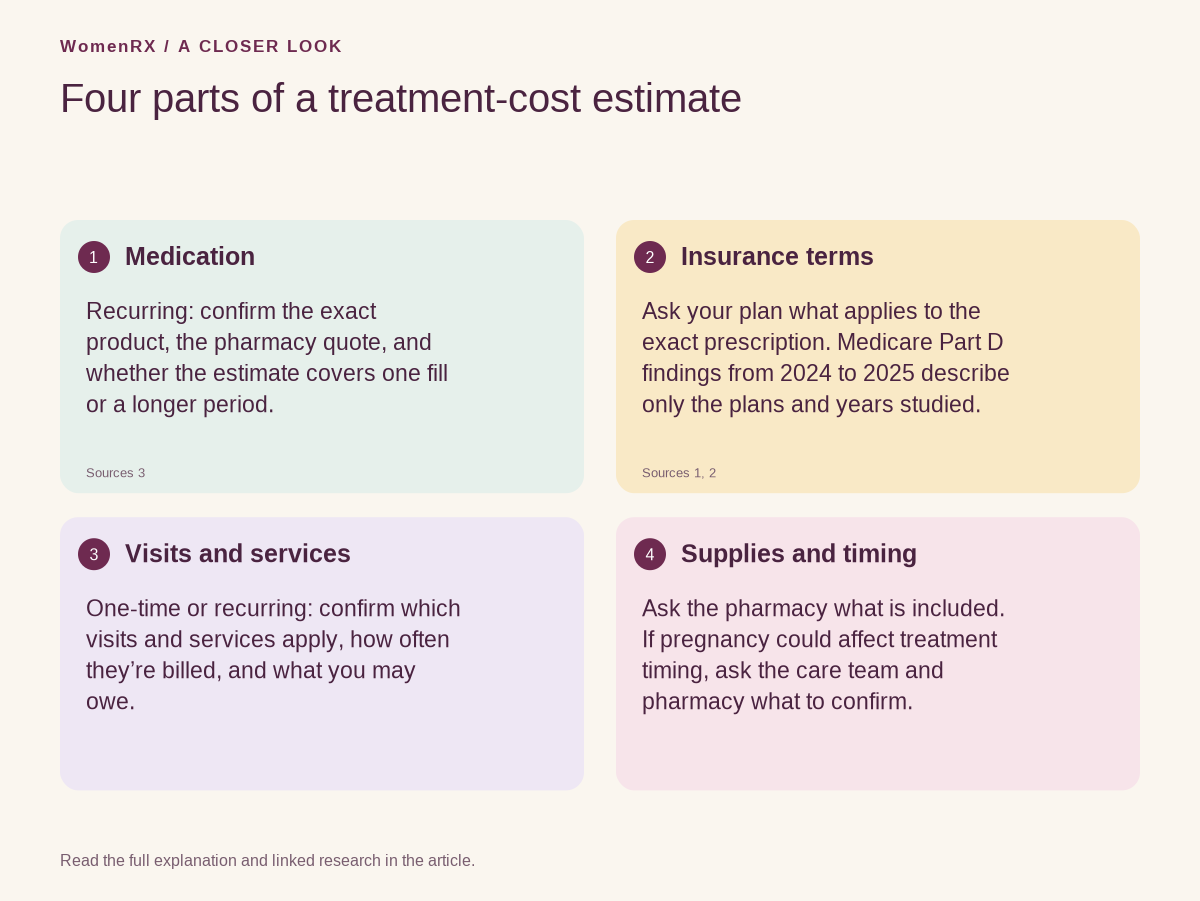
Four parts of a treatment-cost estimate
Medication: Recurring: confirm the exact product, the pharmacy quote, and whether the estimate covers one fill or a longer period.3
Insurance terms: Ask your plan what applies to the exact prescription. Medicare Part D findings from 2024 to 2025 describe only the plans and years studied.12
Visits and services: One-time or recurring: confirm which visits and services apply, how often they’re billed, and what you may owe.
Supplies and timing: Ask the pharmacy what is included. If pregnancy could affect treatment timing, ask the care team and pharmacy what to confirm.
Read the figure as text
Separate the medication quote from plan terms and care charges, then verify which items apply to your situation.- Medication: Recurring: confirm the exact product, the pharmacy quote, and whether the estimate covers one fill or a longer period.3
- Insurance terms: Ask your plan what applies to the exact prescription. Medicare Part D findings from 2024 to 2025 describe only the plans and years studied.12
- Visits and services: One-time or recurring: confirm which visits and services apply, how often they’re billed, and what you may owe.
- Supplies and timing: Ask the pharmacy what is included. If pregnancy could affect treatment timing, ask the care team and pharmacy what to confirm.
More questions, answered
Does insurance coverage mean I’ll have no medication cost?
Not necessarily. Coverage status alone doesn’t tell you what you’ll owe under your specific plan. Insurance is a contract that pays part of covered expenses according to its terms, so ask your insurer for an estimate for the exact prescription. 1
Should I use an old cost estimate to plan next year?
Treat it as a starting point, not a guarantee. The Medicare Part D plans in a 2024-to-2025 comparison showed changes in coverage and cost-sharing structures. That analysis doesn’t predict changes in other plans or your current plan, so confirm your own terms and get a fresh pharmacy estimate. 2
Sources you can check
- Health Insurance: MedlinePlusAccessed 2026-09-25Return to first citation
- Assessing the impact of the Inflation Reduction Act on Medicare prescription drug coverage.Zhang YW, Blyumin MG, Qu C, Guo X, Zhang M. · American journal of health-system pharmacy : AJHP : official journal of the American Society of Health-System Pharmacists · 2026Return to first citation
- Clinical Insight on Semaglutide for Chronic Weight Management in Adults: Patient Selection and Special Considerations.Chao AM, Tronieri JS, Amaro A, Wadden TA. · Drug design, development and therapy · 2022Return to first citation