Pins and Needles During Perimenopause: What Needs Checking?
Tingling can happen during the menopause transition, but its pattern and accompanying symptoms matter more than the timing of your periods.
Pins and needles can occur in women with perimenopausal symptoms, but that doesn’t show that changing hormones caused it.6 Tingling that quickly fades after you change position is different from numbness that persists or keeps returning.2 Call 911 for sudden numbness on one side of your face, arm, or leg, even without other symptoms. Get emergency help if it comes with weakness, speech or vision changes, or trouble walking.9
First, notice what happens when you move
Maybe you wake with a prickly hand after sleeping on your arm, and the feeling disappears once you shift position. Brief pins and needles can happen when pressure temporarily interrupts blood supply to the nerves. It usually clears within minutes after the pressure is removed.2 That pattern gives you a useful clue. It does not explain tingling that stays, repeatedly returns, or appears without an obvious position that brought it on.28
Perimenopause may be part of the context: small studies of women with perimenopausal symptoms included paresthesia, the medical term for tingling, among the symptoms they measured. Those studies did not establish that changes in estradiol caused the sensation. Even if you’re also noticing changes in your periods, don’t use them to explain away new numbness.67
When numbness needs urgent help
Call 911 for sudden numbness in your face, arm, or leg, especially on one side, even if numbness is the only symptom. Call 911 for sudden weakness, trouble speaking or understanding speech, vision changes, confusion, or trouble walking. If stroke-like symptoms disappear after a few minutes, they still need immediate medical attention.9
Get emergency help if numbness or tingling begins just after a head, neck, or back injury, or if you lose bladder or bowel control.8
What the location and pattern can tell you
Tingling isn’t one condition. Where it starts, whether it spreads, and what happens alongside it can point toward different explanations:
- Fingers or part of a hand: Pressure on a nerve at the wrist, as in carpal tunnel syndrome, can cause finger tingling, pain, or numbness. A clinician may also consider a nerve problem elsewhere along the arm or neck.48
- Back pain traveling down a leg toward the foot: This pattern can occur with sciatica. A trapped nerve in the back is another possible explanation for lasting pins and needles.2
- Both feet or hands, especially with burning pain or reduced feeling: These can be features of peripheral neuropathy. Diabetes, low vitamin B12, an underactive thyroid, prolonged heavy alcohol use, and certain medicines are among its possible causes.134
- Fingers or toes that change color: Raynaud phenomenon is another possibility. The color change is a useful detail to mention when describing the tingling.28
These patterns are clues, not a way to diagnose yourself. For example, a hand that falls asleep briefly after you’ve leaned on it calls for a different next step than hand numbness that stays after you’ve moved.28
If it persists or returns, look beyond hormones
Contact a clinician about new tingling with no obvious cause, particularly if you also have neck or arm pain, a rash, dizziness, or leg tingling that worsens when you walk. If tingling is constant or keeps coming back without emergency warning signs, arrange an assessment rather than assuming it’s perimenopause.28 Mention whether it affects one area or both sides, when it began, and whether you’ve noticed pain, weakness, balance changes, or a rash. Those details help guide an examination of sensation, strength, and reflexes.58
Your health history matters too. Some chemotherapy medicines and, in certain circumstances, medicines such as metronidazole, nitrofurantoin, phenytoin, or amiodarone can contribute to peripheral neuropathy. Tell the clinician what you take rather than stopping a medicine on your own.18 Depending on the pattern, an assessment may include blood tests for causes such as diabetes or vitamin B12 deficiency. Some people need nerve-conduction testing or other investigations.5
If an area has become numb, protect it from burns, cuts, and other injuries you might not feel right away.8 You can take your perimenopausal symptoms seriously while still asking the more useful question about tingling: What is affecting sensation here, and does this pattern need urgent care?
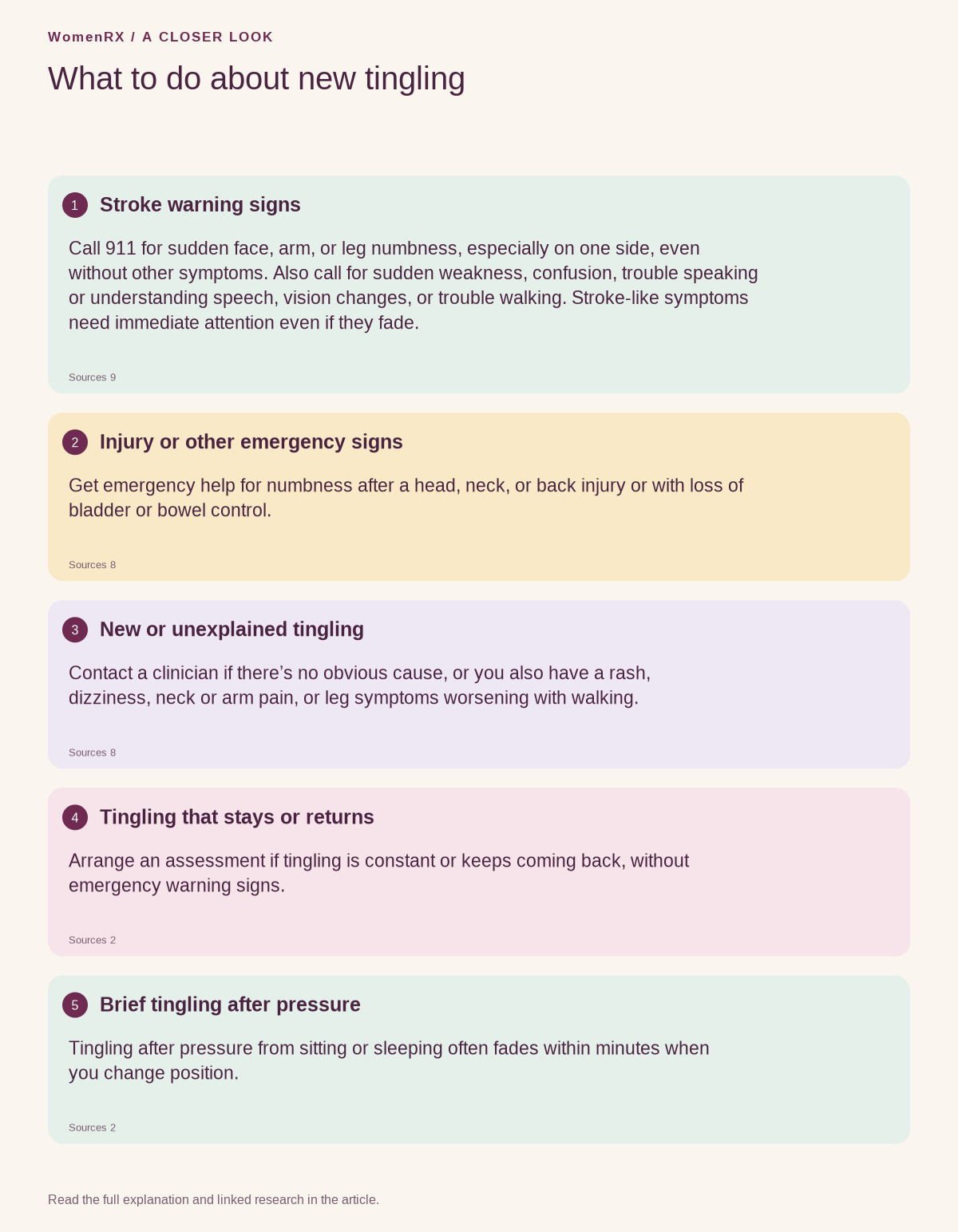
What to do about new tingling
Stroke warning signs: Call 911 for sudden face, arm, or leg numbness, especially on one side, even without other symptoms. Also call for sudden weakness, confusion, trouble speaking or understanding speech, vision changes, or trouble walking. Stroke-like symptoms need immediate attention even if they fade.9
Injury or other emergency signs: Get emergency help for numbness after a head, neck, or back injury or with loss of bladder or bowel control.8
New or unexplained tingling: Contact a clinician if there’s no obvious cause, or you also have a rash, dizziness, neck or arm pain, or leg symptoms worsening with walking.8
Tingling that stays or returns: Arrange an assessment if tingling is constant or keeps coming back, without emergency warning signs.2
Brief tingling after pressure: Tingling after pressure from sitting or sleeping often fades within minutes when you change position.2
Read the figure as text
Check for emergency signs first, then consider whether the sensation is unexplained, recurring, or clearly linked to position.- Stroke warning signs: Call 911 for sudden face, arm, or leg numbness, especially on one side, even without other symptoms. Also call for sudden weakness, confusion, trouble speaking or understanding speech, vision changes, or trouble walking. Stroke-like symptoms need immediate attention even if they fade.9
- Injury or other emergency signs: Get emergency help for numbness after a head, neck, or back injury or with loss of bladder or bowel control.8
- New or unexplained tingling: Contact a clinician if there’s no obvious cause, or you also have a rash, dizziness, neck or arm pain, or leg symptoms worsening with walking.8
- Tingling that stays or returns: Arrange an assessment if tingling is constant or keeps coming back, without emergency warning signs.2
- Brief tingling after pressure: Tingling after pressure from sitting or sleeping often fades within minutes when you change position.2
More questions, answered
Does tingling in my fingers mean I have carpal tunnel syndrome?
Not necessarily. Carpal tunnel syndrome can cause tingling, pain, or numbness in the fingers, but pressure on a nerve elsewhere and other conditions can also affect a hand. Tingling that persists or recurs is worth having assessed rather than naming its cause from the location alone.248
Sources you can check
- Peripheral neuropathy - Causes - NHSAccessed 2026-09-25Return to first citation
- Pins and needles - NHSAccessed 2026-09-25Return to first citation
- Peripheral neuropathy - NHSAccessed 2026-09-25Return to first citation
- Peripheral neuropathy - Symptoms - NHSAccessed 2026-09-25Return to first citation
- Peripheral neuropathy - Diagnosis - NHSAccessed 2026-09-25Return to first citation
- Effect of health education combining diet and exercise supervision in Chinese women with perimenopausal symptoms: a randomized controlled trial.Xi S, Mao L, Chen X, Bai W. · Climacteric : the journal of the International Menopause Society · 2017Return to first citation
- Effect of Gua sha therapy on perimenopausal syndrome: a randomized controlled trial.Meng F, Duan PB, Zhu J, Lou QQ, Fang ZH, An HL, Liu LY, Hu Y, Hu Q. · Menopause (New York, N.Y.) · 2017Return to first citation
- Numbness and tingling: MedlinePlus Medical EncyclopediaAccessed 2026-09-25Return to first citation
- Signs and Symptoms of Stroke | Stroke | CDCAccessed 2026-09-26Return to first citation