Peptide Cycling: What Would Make a Schedule Evidence-Based?
A break schedule is a treatment claim, and evidence for one peptide or purpose doesn’t automatically apply to another.
A scheduled break is evidence-based only if the same peptide, reason for use, and on-off schedule have been tested for the outcome being promised. In GLP-1-based weight-loss care, continued medication has stronger direct evidence for limiting regain; intermittent rescue is a proposed strategy that still needs validation. That doesn’t establish cycles for other peptides or show that breaks prevent side effects or hormonal changes. 2

“Cycle it” can sound like a standard safety rule. But it’s a claim about a particular treatment plan: take a specific peptide for a set period, stop for a set period, then restart. Whether that plan works or reduces risk depends on the molecule, the reason for taking it, and the schedule. Evidence about one peptide can’t establish a cycle for another.
Start with the claim behind the schedule
A useful recommendation should name the peptide, the reason for taking it, the length of treatment and breaks, and what the schedule is meant to improve. “Prevent tolerance,” “give your body a reset,” and “protect your hormones” are different claims. Each needs evidence for the particular peptide and schedule.
A study that follows people taking a medicine for a defined period can show what happened during that treatment. It doesn’t, by itself, show that a planned break is beneficial or safe, or establish when to restart. To support cycling, research would need to test the on-off plan itself and measure the outcome the plan promises to change. A comparison with continued treatment or another relevant approach can help show whether the schedule makes a difference.
What GLP-1 weight-loss research can tell you
GLP-1 receptor agonists are one group of peptide medicines, not a stand-in for every product called a peptide. A 2026 narrative perspective on maintenance after incretin-related weight loss says continued obesity medication currently has the strongest direct evidence for limiting weight regain. The authors also discuss intermittent rescue therapy as a possible strategy, while noting that such approaches need prospective validation. That is not evidence for a standard, pre-set cycling schedule. 2
The distinction matters: a proposed strategy is a question for further study, not an established regimen. And evidence about weight maintenance doesn’t answer whether cycling prevents tolerance, side effects, or hormonal effects for other peptides.
A separate systematic review collected 12 case reports describing 13 people with suspected GLP-1-related gastroparesis. Some reports involved rapid dose increases or inappropriate restarting, and symptoms were reported to resolve after the medicine was stopped. These case reports describe a possible adverse effect; they don’t test planned cycling or show that breaks prevent harm. They also don’t establish a safe restart schedule. 1
Check whether the proposed cycle was actually tested
Before treating a schedule as evidence-based, look for answers to these questions:
- Same substance? Is the research on the exact peptide, rather than another member of a broad category?
- Same purpose? Were participants using it for the same condition or outcome?
- Same schedule? Did a study test the treatment period, break, and restart pattern being recommended?
- Useful comparison? Was cycling compared with continued treatment or another relevant plan?
- Relevant outcome? Did researchers measure the promised benefit, such as fewer side effects or less tolerance, rather than simply report that treatment stopped?
- Relevant participants? Were people like you included? If pregnancy, reproductive health, or menopause matters to your decision, did the research address those circumstances?
If the recommendation can’t point to research on the same substance, purpose, schedule, and outcome, it may be a theory or a personal protocol rather than a tested plan. That doesn’t prove it can’t help; it means the claimed benefit hasn’t been demonstrated by that research.
What to do when someone recommends a cycle
Ask for the study that tested that exact substance and schedule, and ask what outcome it found. If the explanation relies on research about another peptide, a general claim about “receptor resets,” or a study of treatment duration without planned breaks, it doesn’t establish that cycling works.
If you use a prescribed peptide medicine, don’t assume a self-planned break and restart are equivalent to the schedule studied for your treatment. The GLP-1 case reports show that restarting and dose escalation are separate questions from whether planned breaks have benefits. 1
For women, the same evidence check applies: look for research on the specific peptide and schedule that includes outcomes relevant to pregnancy, reproductive health, or menopause when those factors matter. The GLP-1 weight-maintenance perspective doesn’t establish that cycling protects hormones or reproductive health. 2
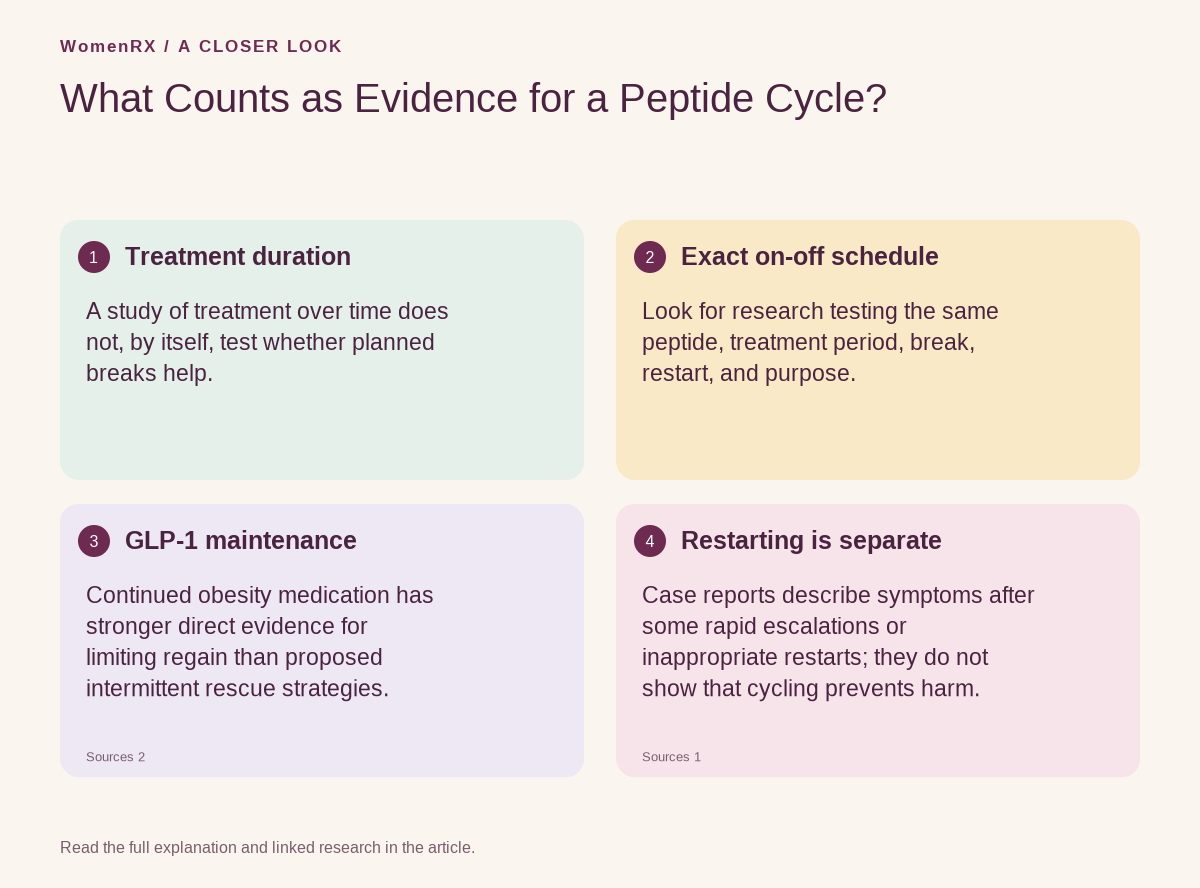
What Counts as Evidence for a Peptide Cycle?
Treatment duration: A study of treatment over time does not, by itself, test whether planned breaks help.
Exact on-off schedule: Look for research testing the same peptide, treatment period, break, restart, and purpose.
GLP-1 maintenance: Continued obesity medication has stronger direct evidence for limiting regain than proposed intermittent rescue strategies.2
Restarting is separate: Case reports describe symptoms after some rapid escalations or inappropriate restarts; they do not show that cycling prevents harm.1
Read the figure as text
A proposed schedule needs research on the same treatment pattern and the outcome it promises.- Treatment duration: A study of treatment over time does not, by itself, test whether planned breaks help.
- Exact on-off schedule: Look for research testing the same peptide, treatment period, break, restart, and purpose.
- GLP-1 maintenance: Continued obesity medication has stronger direct evidence for limiting regain than proposed intermittent rescue strategies.2
- Restarting is separate: Case reports describe symptoms after some rapid escalations or inappropriate restarts; they do not show that cycling prevents harm.1
More questions, answered
Does taking a break mean a peptide will work better when restarted?
Not by itself. A break followed by a restart would need to be tested for that peptide and the outcome in question. In incretin-based weight-loss care, continued medication has stronger direct evidence for limiting regain than intermittent rescue, which still needs prospective validation. 2
Does peptide cycling protect reproductive health or hormones?
Don’t assume that it does. The GLP-1 weight-maintenance perspective addresses strategies for limiting weight regain, not a demonstrated reproductive or hormonal benefit from cycling. Look for evidence on the exact peptide and schedule that addresses the life stage or outcome relevant to you. 2
Sources you can check
- Gastroparesis induced by glucagon-like peptide-1 receptor agonists: A systematic review of clinical features, diagnosis, management, and outcomes.Olubodun T, Osundina MA, Soyoye DO, de Oliveira NMB, Olubodun AB, Ogundele OO. · PloS one · 2026Return to first citation
- Adaptive maintenance after incretin-induced weight loss: Moving beyond the continue-or-stop paradigm.van Bruggen FH, Damhof MA, van Roon EN. · Obesity pillars · 2026Return to first citation