Pelvic Pain: Which Details Change Your Next Step
How pelvic pain starts, whether pregnancy is possible, and what comes with it can help you decide how soon to get care.
Seek emergency care for pelvic pain that’s severe, worsening, or hurts when you move or touch the area, or comes with fainting, shoulder-tip pain, or heavy vaginal bleeding. If you’re pregnant or may be pregnant, get prompt medical advice for pelvic pain, even without those signs. Pain with fever, painful or frequent urination, blood in urine or stool, or unusual bleeding also needs prompt assessment. Make an appointment for pain that persists or returns. Location helps describe the pain, but cannot identify its cause. 1
Pelvic pain can come from reproductive organs, the bladder or urinary tract, the bowel, or muscles. A sharp pain on one side, cramps around a period, and aching that comes with urination may point toward different possibilities, but none identifies a cause by itself. What matters for your next step is how the pain began, whether pregnancy is possible, and what else is happening. 1 3 5
First, decide how soon you need care
Go to an emergency department now if pelvic pain is severe, getting worse, or hurts when you move or touch the area. Do the same if you feel faint or pass out, have pain at the tip of your shoulder, have trouble breathing, or have heavy vaginal bleeding. These signs call for emergency assessment whether or not you know the cause. If you feel faint or cannot travel safely, don’t drive yourself; ask someone to take you or call emergency services. 1
If you’re pregnant or may be pregnant, get prompt medical advice for pelvic pain. Use the emergency threshold above if you also have severe or worsening pain, fainting, shoulder-tip pain, or heavy bleeding. Ectopic pregnancy is one urgent possibility clinicians need to consider; urinary and other causes are possible too. 1 3 5
Seek prompt assessment if pelvic pain comes with difficulty peeing or having a bowel movement, blood in your urine or stool, pain when peeing or needing to pee more often, unusual vaginal bleeding or discharge, fever or chills, or vomiting and diarrhea. Severe or worse-than-usual period pain that hasn’t improved with painkillers also needs prompt advice. If the pain becomes severe or you develop an emergency sign, use the emergency route instead. 1 2
Make an appointment for pain that persists or keeps returning, even if it isn’t severe. Recurring pain is worth investigating rather than repeatedly guessing at the cause. 1 4
Use the pattern as a clue, not a diagnosis
Pain linked to your period may fit menstrual cramps, which happen as the uterus tightens. Cramps often start just before or around the beginning of bleeding and may spread to the back or thighs. If periods are becoming more painful, heavier, or irregular, or the pain interrupts daily activities, make an appointment to discuss the change. 2
Pain with peeing, sex, or exercise is useful to mention. Pelvic pain can occur during these activities and can have urinary, infectious, gynecologic, or musculoskeletal causes. What brings it on can help guide questions and testing; it doesn’t prove which body system is responsible. 1 5
Pain that starts suddenly or intensifies needs a different response from familiar, recurring cramps. Acute pelvic pain has a broad range of gynecologic and non-gynecologic causes, including conditions that need urgent treatment, such as ovarian torsion, a ruptured cyst, ectopic pregnancy, and appendicitis. Clinicians use your history and an examination to decide which tests or imaging are needed. 1 3 5
Pain that lasts or returns is still worth investigating. Persistent pelvic pain can involve conditions such as endometriosis or bladder pain, as well as muscle and other contributors. Sometimes more than one factor may be involved. 4
Tell the story in a few useful details
You don’t need to know what the pain means before describing it. If you can, note:
- When it began, whether it came on suddenly, and whether it’s constant or comes and goes.
- Where you feel it, whether it spreads, and whether it’s getting better, staying the same, or worsening.
- Whether it connects with a period, sex, urination, exercise, or another activity.
- Other symptoms, such as changes in bleeding, urinary or bowel symptoms, or fever.
- Whether pregnancy is possible or confirmed.
These details help a clinician consider different causes and decide what evaluation is appropriate. For acute pain, assessment may include a pregnancy test when relevant and imaging chosen according to the suspected cause. 5 6
Pelvic pain can affect anyone. Menstrual or pregnancy history may be relevant to mention, but pain shouldn’t automatically be attributed to reproductive organs. Urinary, bowel, and musculoskeletal causes belong in the picture too. 1 3 5
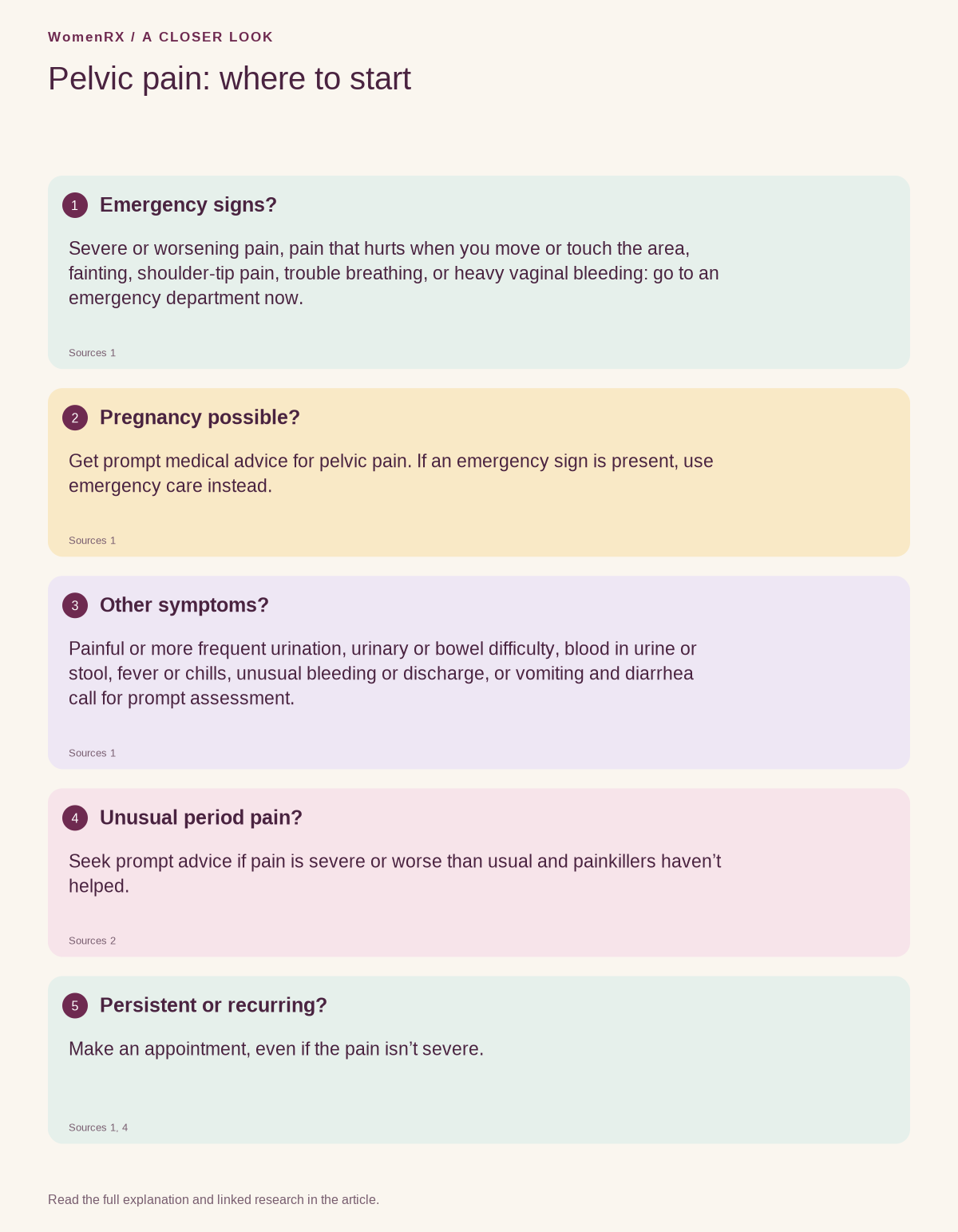
Pelvic pain: where to start
Emergency signs?: Severe or worsening pain, pain that hurts when you move or touch the area, fainting, shoulder-tip pain, trouble breathing, or heavy vaginal bleeding: go to an emergency department now.1
Pregnancy possible?: Get prompt medical advice for pelvic pain. If an emergency sign is present, use emergency care instead.1
Other symptoms?: Painful or more frequent urination, urinary or bowel difficulty, blood in urine or stool, fever or chills, unusual bleeding or discharge, or vomiting and diarrhea call for prompt assessment.1
Unusual period pain?: Seek prompt advice if pain is severe or worse than usual and painkillers haven’t helped.2
Persistent or recurring?: Make an appointment, even if the pain isn’t severe.14
Read the figure as text
Check for emergency signs first, then consider pregnancy possibility and other symptoms before deciding whether to seek prompt assessment or make an appointment.- Emergency signs?: Severe or worsening pain, pain that hurts when you move or touch the area, fainting, shoulder-tip pain, trouble breathing, or heavy vaginal bleeding: go to an emergency department now.1
- Pregnancy possible?: Get prompt medical advice for pelvic pain. If an emergency sign is present, use emergency care instead.1
- Other symptoms?: Painful or more frequent urination, urinary or bowel difficulty, blood in urine or stool, fever or chills, unusual bleeding or discharge, or vomiting and diarrhea call for prompt assessment.1
- Unusual period pain?: Seek prompt advice if pain is severe or worse than usual and painkillers haven’t helped.2
- Persistent or recurring?: Make an appointment, even if the pain isn’t severe.14
More questions, answered
Does pain on one side tell me what’s causing it?
Not reliably. Location is one useful detail, but acute pelvic pain has a broad range of possible causes, and symptoms can overlap. Onset, pregnancy possibility, and associated symptoms also help guide evaluation. 3 5
Sources you can check
- Pelvic pain - NHSAccessed 2026-09-25Return to first citation
- Period pain - NHSAccessed 2026-09-25Return to first citation
- ESR Essentials: Gynaecological causes of acute pelvic pain in women: a primer for emergent evaluation-practice recommendations by the European Society of Emergency Radiology.Dick EA, Blanco A, De La Hoz Polo M, Basilico R. · European radiology · 2025Return to first citation
- Chronic Pelvic Pain, Vulvar Pain Disorders, and Proteomics Profiles: New Discoveries, New Hopes.Di Tucci C, Muzii L. · Biomedicines · 2023Return to first citation
- Evaluation of Acute Pelvic Pain in Women.Frasca DJ, Jarrio CE, Perdue J. · American family physician · 2023Return to first citation
- Acute Abdominal Pain in Adults: Evaluation and Diagnosis.Yew KS, George MK, Allred HB. · American family physician · 2023Return to first citation