PCOS and GLP-1 Telehealth: Questions to Ask First
A good service should connect any weight-management plan to your PCOS symptoms, reproductive plans, follow-up, and full out-of-pocket cost.
GLP-1 medicines may be considered for weight management in some higher-weight adults with PCOS, but that is not the same as treating every part of PCOS or providing fertility care. Before choosing a telehealth service, ask what it will assess, why a specific medicine fits your goals, how pregnancy plans and contraception will be handled, who follows your progress, and what the complete cost includes. 2 4
First, separate weight care from PCOS care
PCOS can involve metabolic and reproductive concerns. A telehealth plan focused on weight may address one part of that picture, but it shouldn’t be presented as a cure for PCOS or as a fertility treatment. A recent review describes GLP-1 medicines as an option for weight management in some higher-weight adults with PCOS; it also notes that the mechanisms connecting these medicines to reproductive outcomes are not fully understood. 2
That distinction is useful when a service’s advertising makes broad promises. Ask what outcome the clinician is actually proposing to address: weight management, a metabolic concern, a PCOS symptom, or preparation for pregnancy. Those goals can overlap, but they are not interchangeable.
What should the clinician assess?
A thoughtful visit should make room for more than a weight target. Ask how the clinician will review your PCOS history, metabolic concerns, current medicines, and reproductive goals before recommending treatment. You can also ask what kinds of PCOS care the service provides beyond medication for weight management, and what it does if you need care outside that scope.
This matters especially if the clinician won’t be your regular provider. A virtual clinician may not have your full medical history, so ask how records will be gathered and shared, and whether the service will coordinate with your usual clinician. 1
It’s reasonable to ask why a GLP-1 medicine is being considered for you, what benefit the clinician expects, and what other approaches were discussed. PCOS-focused research is growing, but it does not establish that the medicines improve every PCOS outcome. In a 2026 network meta-analysis of 16 randomized trials in non-menopausal women with PCOS, the analysis compared weight and other metabolic measures. It did not evaluate reproductive or patient-centered outcomes, and the authors noted heterogeneity in results. 3
Make pregnancy plans part of the decision
If you might try to conceive, are avoiding pregnancy, or are already pregnant, raise that before treatment begins. A fertility-focused review reports promising findings for some reproductive outcomes in PCOS, but these findings do not make GLP-1 medicines established fertility treatments. The review also advises against their use during pregnancy and emphasizes individualized preconception planning. Ask the clinician to explain the plan for your specific medicine before you start, including what to do if your pregnancy plans change. 4
If you use oral birth control, ask directly whether the proposed medicine could affect it. The review raises this concern for tirzepatide because of delayed stomach emptying. A separate 2026 review of GLP-1 medicines in obstetric and gynecologic care reports manufacturer guidance to use backup contraception for four weeks after starting tirzepatide or increasing its dose. Have the prescriber explain how that guidance applies to you and your contraceptive method. 4 5
Get clear on the medicine and the follow-up
Before signing up, ask which exact medicine is proposed, who prescribes it, and which pharmacy dispenses it. Ask what follow-up is included, how you can reach the clinician between visits, and what happens if you have a problem or want to stop. The service should be able to explain who is responsible for monitoring and how that care connects with your regular clinician.
Ask for the full price in writing, not just the advertised visit fee. Clarify whether the quoted amount includes the medication, visits, any recommended tests, and follow-up; ask what insurance may cover and what you would owe if coverage is denied. Ask for an itemized total rather than relying on the headline visit fee. Insurance coverage for telehealth visits can vary. 1
A practical question list
You can use these questions on an introductory call:
- What parts of my PCOS and health history will the clinician review?
- Is the goal weight management, another PCOS concern, or both?
- What benefits are supported for this medicine in PCOS, and what remains uncertain?
- How will my reproductive plans and contraception affect the decision?
- Who follows my care, and how will they coordinate with my regular clinician?
- What is the complete expected cost, including medication and follow-up?
A service that answers these plainly can help you judge whether its care fits your actual needs. If its offer is only weight management, you can decide whether that’s useful while arranging other PCOS care separately.
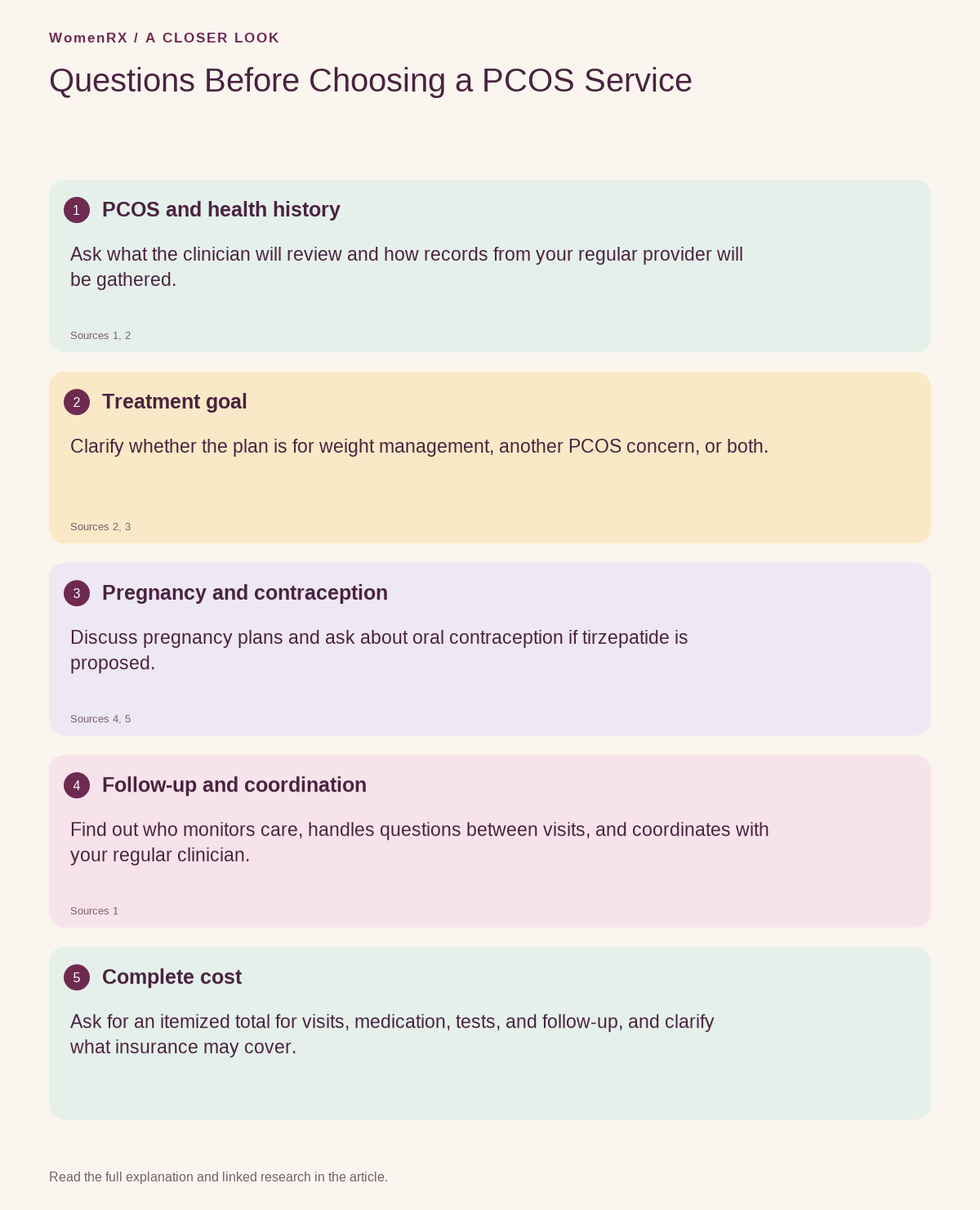
Questions Before Choosing a PCOS Service
PCOS and health history: Ask what the clinician will review and how records from your regular provider will be gathered.12
Treatment goal: Clarify whether the plan is for weight management, another PCOS concern, or both.23
Pregnancy and contraception: Discuss pregnancy plans and ask about oral contraception if tirzepatide is proposed.45
Follow-up and coordination: Find out who monitors care, handles questions between visits, and coordinates with your regular clinician.1
Complete cost: Ask for an itemized total for visits, medication, tests, and follow-up, and clarify what insurance may cover.
Read the figure as text
Use these five areas to see whether a telehealth service is addressing your goals, reproductive plans, follow-up, and full cost.- PCOS and health history: Ask what the clinician will review and how records from your regular provider will be gathered.12
- Treatment goal: Clarify whether the plan is for weight management, another PCOS concern, or both.23
- Pregnancy and contraception: Discuss pregnancy plans and ask about oral contraception if tirzepatide is proposed.45
- Follow-up and coordination: Find out who monitors care, handles questions between visits, and coordinates with your regular clinician.1
- Complete cost: Ask for an itemized total for visits, medication, tests, and follow-up, and clarify what insurance may cover.
More questions, answered
Does a GLP-1 medicine treat PCOS itself?
It may be considered for weight management in some higher-weight adults with PCOS, but that is not the same as treating every metabolic, hormonal, or reproductive concern associated with PCOS. Current PCOS-focused evidence does not establish benefits across all those outcomes. 2 3
Should I mention birth control during the visit?
Yes. If you use oral contraception, ask specifically about the proposed medicine. A review raises a concern about tirzepatide and oral contraceptive effectiveness, and another review reports manufacturer backup-contraception guidance after starting or increasing tirzepatide. 4 5
Sources you can check
- Telehealth: MedlinePlusAccessed 2026-09-25Return to first citation
- GLP-1 Receptor Analogs: Evidence Linking to Effect on Metabolic and Reproductive Functions in Patients with PCOS and Obesity.Celik O, Yazici D, Ciudin A, Macut D, Micic D, Yumuk V, Yildiz BO. · Obesity facts · 2026Return to first citation
- Comparative analysis of glucagon-like peptide-1 receptor agonists, metformin, and inositol in improving anthropometric and metabolic outcomes in women with polycystic ovary syndrome: a network meta-analysis.Omarion A, Ayasa Y, Omarion Z, Jayouse B, Ayesh H. · Frontiers in endocrinology · 2026Return to first citation
- GLP-1 Receptor Agonists and Fertility: What Is Known So Far?Becker AS, Castilhos JP, Shugair SAS, Colombo T, Hentschke M-. · JBRA assisted reproduction · 2026Return to first citation
- What obgyns need to know about GLP-1 receptor agonists.Chauhan I. · Current opinion in obstetrics & gynecology · 2026Return to first citation