Paroxetine for Hot Flashes: Reading Reviews Alongside the Evidence
Online accounts can surface questions worth asking, but controlled trials are better for estimating average benefit and harm.
Treat online reviews as accounts of individual experiences, not forecasts of what will happen to you. Check why the person took paroxetine, what changed, over what period, and whether other treatments were involved. Trials compare groups and measure outcomes such as hot-flash frequency and severity; a meta-analysis found that placebo response accounted for much of the average improvement. 2
Check what the person was taking it for
Paroxetine is used for more than one reason, so a review may be about psychiatric treatment rather than menopause symptoms. Brisdelle is a specific paroxetine product prescribed for moderate to severe menopause-related hot flashes; its prescribing information says it is not for psychiatric conditions. 1 4
That distinction matters when a review talks about mood, sleep, or day-to-day life. The experience may be genuine, but without knowing the treatment purpose and the change the person hoped for, it can be hard to tell whether the account relates to hot flashes.
Read a review for context, not a prediction
An online review is a self-selected account. It doesn’t tell you how many people took the medicine without posting, or what might have happened to the reviewer without it. A dramatic positive or negative story can help you identify a concern, but it can’t estimate how often other women will have that experience.
Look for details that make an account easier to interpret: What were the hot flashes like before treatment? What changed, and when? Was another treatment being used? Did the person describe fewer or less severe hot flashes, better sleep, or a different outcome? If those details are missing, the story may still matter to the person who wrote it, but it’s difficult to compare with your own situation.
What trials add to personal accounts
Randomized, placebo-controlled trials compare groups, which helps estimate the average difference between a medicine and placebo under study conditions. A meta-analysis of six paroxetine trials involving 1,486 women examined hot-flash frequency and severity. Its authors estimated that placebo response accounted for 79% of the mean response in frequency and 68% of the mean response in severity. These figures describe shares of average response, not percentages of women who benefit. The authors estimated the remaining drug-specific effect at no more than 21% for frequency and 32% for severity. 2
The studies in that review varied in design, duration, and participants. The listed trials lasted 8 to 24 weeks and included women with different symptom levels, as well as a study of gynecological cancer survivors. Those differences matter: an average across trials is useful context, but it can’t tell you exactly what will happen in a particular situation. 2
One randomized trial focused on postmenopausal women who had completed treatment for gynecological cancer. The study reports that 80 women completed it. At weeks 4 and 16, the paroxetine group had greater reductions in hot-flash frequency and severity than the placebo group. The study also reported fewer nighttime awakenings attributed to hot flashes and longer sleep duration in the paroxetine group. These findings add information about measured outcomes in that specific group; they aren’t a forecast for every woman considering treatment. 3
The trial and meta-analysis aren’t necessarily in conflict. One study can find a difference between its two groups, while a meta-analysis looks across several trials to estimate the average contribution of the medicine. The useful question isn’t whether a single review or study settles the decision. It’s which change matters to you, and how the evidence can help set expectations.
Turn a review into a focused question
If someone describes better sleep, for example, ask whether the evidence measured sleep directly or focused on hot flashes. The meta-analysis assessed hot-flash frequency and severity; the cancer-survivor trial measured sleep outcomes as well. 2 3
Questions you could bring into a treatment discussion include:
- What change in my hot-flash frequency or severity should I look for, and over what period?
- How will we judge whether it’s helping with the outcome I care about most?
- Does my reason for considering paroxetine or my health history affect whether it’s a fit?
- What should I know about stopping it? The Brisdelle prescribing information reports symptoms after discontinuation in postmenopausal females; it separately notes that symptoms have also been reported with other paroxetine products, particularly after abrupt discontinuation. Ask what a stopping plan would involve for you. 1
- Could any of my other medicines or supplements interact with it? The prescribing information identifies other serotonergic medicines as a concern and discusses bleeding-related interactions with medicines such as NSAIDs, aspirin, and warfarin. 1
You don’t have to dismiss someone’s account to recognize its limits. A review can help you name a worry or a hoped-for change. Trials can add a structured comparison of average outcomes. Together, they can help you focus the decision on your symptoms, the reason for treatment, and the changes you value.
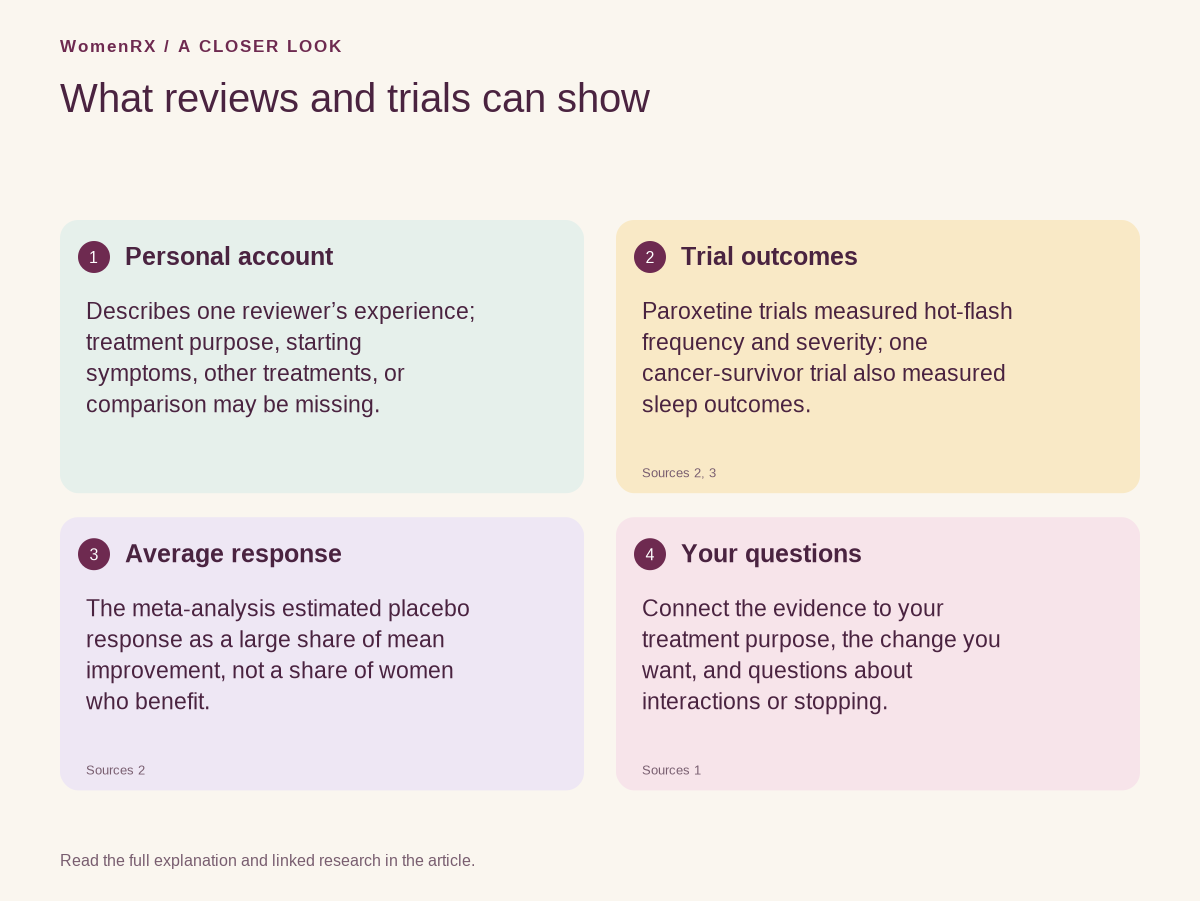
What reviews and trials can show
Personal account: Describes one reviewer’s experience; treatment purpose, starting symptoms, other treatments, or comparison may be missing.
Trial outcomes: Paroxetine trials measured hot-flash frequency and severity; one cancer-survivor trial also measured sleep outcomes.23
Average response: The meta-analysis estimated placebo response as a large share of mean improvement, not a share of women who benefit.2
Your questions: Connect the evidence to your treatment purpose, the change you want, and questions about interactions or stopping.1
Read the figure as text
A personal account can surface a concern; a controlled study can compare average outcomes. Neither tells you exactly what you will experience.- Personal account: Describes one reviewer’s experience; treatment purpose, starting symptoms, other treatments, or comparison may be missing.
- Trial outcomes: Paroxetine trials measured hot-flash frequency and severity; one cancer-survivor trial also measured sleep outcomes.23
- Average response: The meta-analysis estimated placebo response as a large share of mean improvement, not a share of women who benefit.2
- Your questions: Connect the evidence to your treatment purpose, the change you want, and questions about interactions or stopping.1
More questions, answered
Does a positive review mean paroxetine is likely to work for me?
No. It describes one person’s experience, not how often people improve or what your own response will be. Trials estimate group differences, but their averages can’t predict an individual outcome. 2
Why do some studies measure sleep as well as hot flashes?
Sleep may be a separate outcome someone cares about. In a randomized trial of postmenopausal gynecological cancer survivors, researchers measured sleep and hot flashes; the reported sleep findings apply to that study group. 3
Sources you can check
- BRISDELLE (PAROXETINE) CAPSULE [LEGACY PHARMA USA, INC.] | US prescribing information and patient instructionsAccessed 2026-09-25Return to first citation
- Magnitude of placebo response in clinical trials of paroxetine for vasomotor symptoms: a meta-analysis.Rhodes JR, Alldredge CT, Elkins GR. · Frontiers in psychiatry · 2023Return to first citation
- Role of paroxetine in the management of hot flashes in gynecological cancer survivors: Results of the first randomized single-center controlled trial.Capriglione S, Plotti F, Montera R, Luvero D, Lopez S, Scaletta G, Aloisi A, Serra GB, Angioli R. · Gynecologic oncology · 2016Return to first citation
- ParoxetineShrestha P, Fariba KA, Abdijadid S. · 2023Return to first citation