OMAD or 16:8: Which Fasting Window Fits Better?
The main difference is how much time you have to eat, not proof that one schedule causes more weight loss.
OMAD means fitting your food into one meal, while 16:8 allows an eight-hour eating window. There’s no direct comparison here showing that OMAD leads to more weight loss than 16:8. Research on time-restricted eating has studied windows such as eight or ten hours, and broader intermittent-fasting trials have not shown a clear, clinically meaningful advantage over continuous calorie restriction. 3 4 5
The real trade-off is one meal versus several chances to eat
OMAD, or one meal a day, concentrates eating into a single meal. A 16:8 schedule means fasting for 16 hours and eating during an eight-hour window, which can leave room for more than one meal. The names describe different routines, not a proven ranking for weight loss.
The practical distinction is meal flexibility. With 16:8, someone might fit lunch and dinner into their eating window; with OMAD, that same person would need to get their food into one meal. Those are examples of how the schedules can work, not tested recommendations. A narrower window may be harder to fit around work, family meals, or a medication schedule. The trials cited don’t establish how often those problems occur or which schedule is easier to maintain.
What the weight-loss evidence can tell you
The most relevant trials here don’t test OMAD against 16:8. A 12-week randomized trial tested a ten-hour eating window against standard dietary counseling in 61 adults with obesity who didn’t have diabetes. Thirty-five of the 61 randomized participants were women, and 52 participants completed the study. The time-restricted group lost more weight on average than the counseling group, but this was a ten-hour window, not 16:8, and the study doesn’t show what would happen with one meal a day. 4
A separate randomized trial assigned 99 adults with overweight or obesity, half of them women, to usual care or an eight-hour eating window at an early, late, or self-selected time. Everyone also received Mediterranean-diet education. At a follow-up 12 months after the 12-week intervention, the early- and late-window groups had maintained greater weight loss than the usual-care group. The trial can compare assignment to an eight-hour window with usual care alongside that shared education. It doesn’t compare 16:8 with OMAD or establish whether the weight difference came from timing itself, changes in food intake, or adherence. 5
A Cochrane review of intermittent-fasting trials found that fasting reduced weight compared with eating without a specific calorie restriction in the short term, but the evidence was low certainty and the difference wasn’t considered clinically significant. Compared with continuous calorie restriction, the review found no clear, clinically meaningful difference in weight outcomes. These trials covered several fasting patterns, so the finding isn’t a direct verdict on OMAD versus 16:8. It does help separate the appeal of a schedule from the more basic question of whether it helps someone eat less and stick with the pattern. 3
In other words, a fasting window isn’t evidence that weight loss will happen independently of food intake or adherence. If a restrictive window makes eating feel unmanageable or doesn’t fit your life, its theoretical appeal may not translate into a useful routine.
What women-specific evidence leaves open
The trials summarized here included women and reported weight and body-composition outcomes, but they don’t establish how OMAD or 16:8 affects menstrual cycles, fertility, pregnancy, breastfeeding, or menopause. 4 5
Research on fasting during pregnancy has examined intermittent fasting, with a particular focus on Ramadan fasting. A 2025 systematic review and meta-analysis included observational studies, not randomized trials. It found a small average difference in birth weight, but no association with low birth weight; the authors noted uncertainty and called for more prospective research. Those findings can’t establish whether OMAD or a planned 16:8 weight-loss schedule is safe during pregnancy. 1
If you’re pregnant, don’t assume these weight-loss schedules have been shown safe for you. Ask for individualized guidance before restricting your eating window. 1 If you’re breastfeeding, seek individualized guidance before adopting a restrictive fasting schedule, too. Lactation has distinct nutritional needs, but a review of pregnancy and lactation nutrition doesn’t establish what OMAD or 16:8 does to breastfeeding. 2 For an eating-disorder history, the Cochrane review specifically identifies safety in people with eating disorders as an area where more research is needed. A clinician who understands your history can help you consider whether a restrictive schedule is appropriate. 3
If you have diabetes, the Cochrane review identifies fasting safety in people with diabetes as an area needing more research. It doesn’t establish a safe schedule for you. 3
A useful way to choose
Don’t choose OMAD because it sounds more intense, or 16:8 because it sounds automatically gentle. The evidence doesn’t establish that either is superior. Instead, compare the actual eating windows: how many meals could fit, whether the hours suit your daily routine, and whether you can eat adequately without turning one meal into a stressful constraint.
If your main question is weight loss, the best-supported conclusion here is modest: intermittent fasting can differ from unrestricted eating, but it hasn’t shown a clear advantage over continuous calorie restriction in the reviewed trials. And without a direct OMAD-versus-16:8 comparison, you can’t use these findings to predict which will work better for you. 3
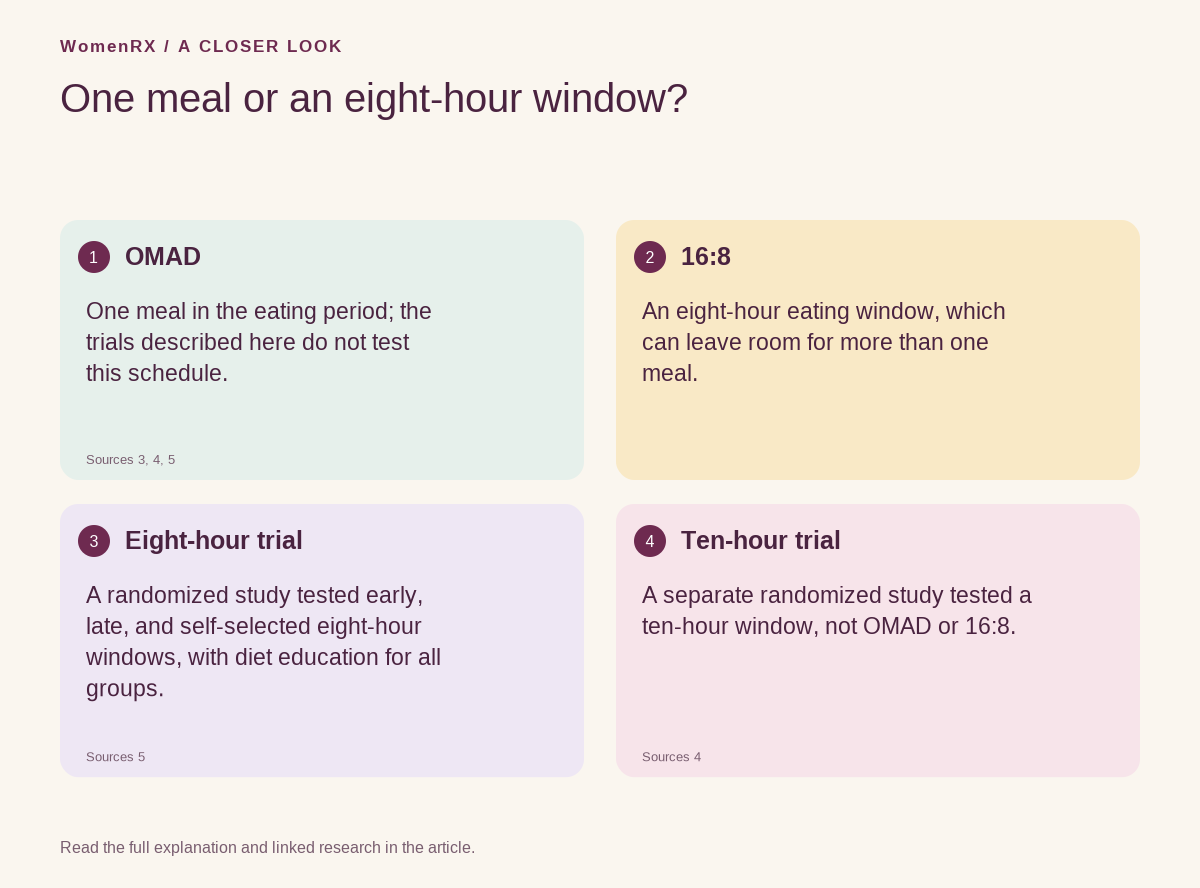
One meal or an eight-hour window?
OMAD: One meal in the eating period; the trials described here do not test this schedule.345
16:8: An eight-hour eating window, which can leave room for more than one meal.
Eight-hour trial: A randomized study tested early, late, and self-selected eight-hour windows, with diet education for all groups.5
Ten-hour trial: A separate randomized study tested a ten-hour window, not OMAD or 16:8.4
Read the figure as text
Compare the schedules’ meal opportunities and the limits of the evidence without treating the illustration as a tested weight-loss comparison.- OMAD: One meal in the eating period; the trials described here do not test this schedule.345
- 16:8: An eight-hour eating window, which can leave room for more than one meal.
- Eight-hour trial: A randomized study tested early, late, and self-selected eight-hour windows, with diet education for all groups.5
- Ten-hour trial: A separate randomized study tested a ten-hour window, not OMAD or 16:8.4
More questions, answered
Does 16:8 have more research than OMAD?
The trials in this article include an eight-hour eating window, while none directly tests OMAD against 16:8. That supports saying an eight-hour window has been studied here, not that 16:8 is proven safer or more effective than OMAD. 5
Does fasting work better than a calorie-restricted eating plan?
In the Cochrane review, intermittent fasting showed no clear, clinically meaningful weight advantage over continuous calorie restriction. The review combined different fasting patterns, so it can’t answer whether OMAD and 16:8 differ. 3
Sources you can check
- Intermittent Fasting During Pregnancy and Neonatal Birth Weight: A Systematic Review and Meta-Analysis.Giorno A, De Simone C, Lopez G, Pisaturo ML, Niccolini L, Guida M, Sarno L, Schettini SCA. · Nutrients · 2025Return to first citation
- An updated review of popular dietary patterns during pregnancy and lactation: Trends, benefits, and challenges.Chouli M, Bothou A, Kyrkou G, Kaliarnta S, Dimitrakopoulou A, Diamanti A. · Metabolism open · 2025Return to first citation
- Intermittent fasting for the prevention of cardiovascular disease.Allaf M, Elghazaly H, Mohamed OG, Fareen MFK, Zaman S, Salmasi AM, Tsilidis K, Dehghan A. · The Cochrane database of systematic reviews · 2021Return to first citation
- Time-Restricted Eating Promotes Weight Loss and Favorable Changes in Adipose in Obesity: The TREAD Randomized Control Trial.Wilkinson MJ, Padilla E, Wang Y, Raygani S, Manoogian ENC, Laing K, Tong K, Liu L, Van D, Nguyen J, Saltiel AR, Reilly SM, O'Neal M, Panda S, Majithia AR, Taub PR. · Obesity (Silver Spring, Md.) · 2026Return to first citation
- Effects of an early, late, and self-selected time-restricted eating intervention on weight loss maintenance in adults with overweight or obesity: A 12-month follow-up of a randomized controlled trial.Camacho-Cardenosa A, Merchán-Ramírez E, Clavero-Jimeno A, De-la-O A, Romero-Noguera JM, Martín-Rodríguez JL, Muñoz-Torres M, Labayen I, Ruiz JR, Dote-Montero M. · Clinical nutrition (Edinburgh, Scotland) · 2026Return to first citation