Intermittent Fasting: What It Can and Cannot Do
For women with overweight or obesity, time-restricted eating may lead to modest weight loss, but it has not clearly beaten calorie restriction alone.
A review of 13 randomized trials involving 612 participants in populations that were at least 85% female found a modest average weight reduction with time-restricted eating, but no significant advantage over calorie restriction alone. The studies measured outcomes over 6 to 52 weeks; they don’t establish long-term safety or suitability during pregnancy, breastfeeding, or for people with an eating-disorder history. 23
What the research has measured
Intermittent fasting covers several eating patterns. Time-restricted eating, or TRE, is one: you eat within a set daily window and fast the rest of the day. Other approaches change eating across days. These patterns aren’t interchangeable, so a result for TRE doesn’t automatically apply to every kind of fasting. 3
A predominantly female review included 13 randomized trials and 612 participants in populations that were at least 85% female, all with overweight or obesity. Compared with the studies’ control approaches, TRE was associated with an average weight difference of about 1.9 kg in favor of TRE. The trials lasted 6 to 52 weeks, and the review found no significant effects on several other measured outcomes, including fat mass, blood glucose, blood lipids, blood pressure, and insulin resistance. The result is a modest weight signal, not evidence that fasting improves every aspect of health. 3
The comparison matters: TRE did not show significantly greater weight loss than calorie restriction alone. So fasting may be one way to organize eating, but the evidence doesn’t show that the schedule itself reliably adds weight-loss benefit beyond reducing calories. 3
A schedule is only useful if it works for you
Adherence is different from effectiveness. A person may find a defined eating window simpler than keeping track of food throughout the day; someone else may find it clashes with work, family meals, exercise, or hunger. The predominantly female review reported better adherence and concluded that TRE may be feasible, but it also called for larger studies and longer follow-up. That finding doesn’t establish that all women will find fasting easier to maintain or that TRE is better for adherence in every setting. 3
In four trials, participants reported minor effects such as hunger or headache that resolved on their own. That gives a limited view of short-term tolerability, not a guarantee that a schedule will feel manageable or be appropriate for you. 3
A practical comparison: if a fasting window makes shared meals or a steady eating routine difficult, a non-fasting approach may fit better. If the structure feels comfortable, it’s still the overall eating pattern and its sustainability that matter, not the fasting label.
When to be especially cautious
Pregnancy or breastfeeding: Research summarized in a review leaves important gaps in reproductive outcomes and safety across women’s life stages. A cohort study classified exposure by whether Ramadan overlapped with Muslim mothers’ estimated conception dates; it did not measure whether individual mothers fasted. That study is not a trial of intentional weight-loss fasting during pregnancy and can’t establish safety for pregnancy or breastfeeding. If you’re considering a fasting schedule in either life stage, a useful question for your pregnancy or postpartum care team is whether limiting eating hours would fit your nutritional needs. 24
A history of an eating disorder: The trials summarized here don’t establish whether fasting is safe or suitable for people with an eating-disorder history. If adding a fasting rule could bring back distressing or rigid patterns around food, choosing a non-fasting approach is a reasonable alternative. The trials don’t show that TRE produces greater weight loss than calorie restriction alone. 3
Diabetes or other significant medical conditions: The predominantly female TRE review excluded some participants with severe conditions, including diabetes, so its findings don’t settle safety for those groups. A separate 12-week pilot randomized trial included just 10 women with type 2 diabetes. Mild hypoglycemia was among the effects reported, but the trial report doesn’t identify which group experienced it. The small study can’t establish broad safety, but it shows why fasting and diabetes treatment shouldn’t be considered separately. 13
If you take glucose-lowering medication or have a significant health condition, a useful question for your care team is how a fasting schedule would fit your treatment and health needs. That’s more useful than asking whether fasting is simply “good” or “bad” for women.
What the evidence can’t tell you about women
A narrative review of intermittent fasting found limited evidence about long-term safety and reproductive outcomes; it also noted that perimenopausal women are underrepresented. The available research doesn’t support a universal claim that fasting improves or harms women’s hormones. Menopause, menstrual cycling, and other life stages shouldn’t be treated as if they have all been tested equally. 2
If weight management is your goal, TRE is one possible structure, not a uniquely effective requirement. The evidence supports a modest average weight effect in predominantly female trial populations with overweight or obesity, without a clear advantage over calorie restriction alone. Whether it suits you depends on your life stage, health, and ability to maintain the pattern without distress.
What fasting evidence can tell you
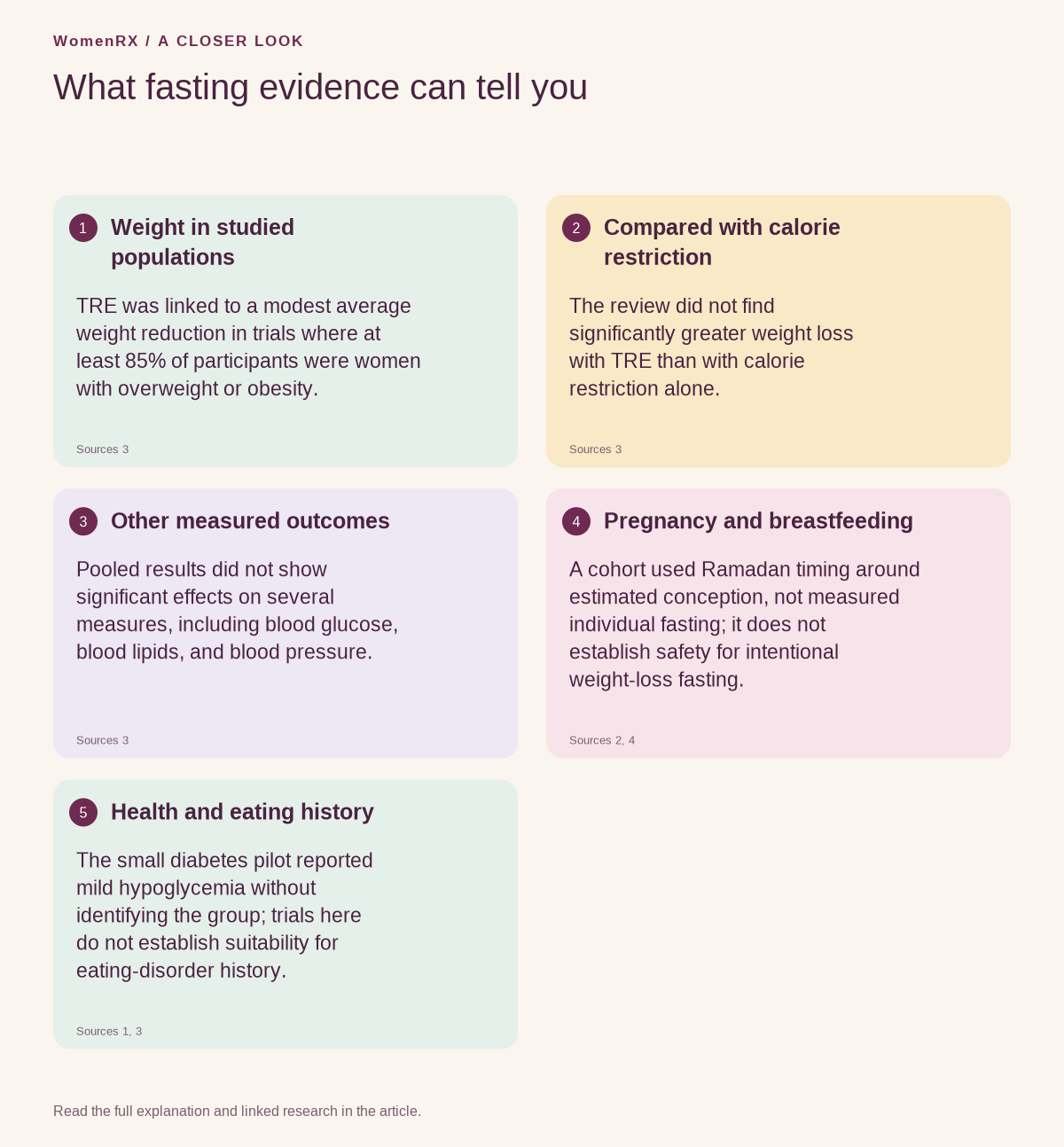
Weight in studied populations: TRE was linked to a modest average weight reduction in trials where at least 85% of participants were women with overweight or obesity.3
Compared with calorie restriction: The review did not find significantly greater weight loss with TRE than with calorie restriction alone.3
Other measured outcomes: Pooled results did not show significant effects on several measures, including blood glucose, blood lipids, and blood pressure.3
Pregnancy and breastfeeding: A cohort used Ramadan timing around estimated conception, not measured individual fasting; it does not establish safety for intentional weight-loss fasting.24
Health and eating history: The small diabetes pilot reported mild hypoglycemia without identifying the group; trials here do not establish suitability for eating-disorder history.13
Read the figure as text
Separate the weight result from questions about other outcomes and who may need a different approach.- Weight in studied populations: TRE was linked to a modest average weight reduction in trials where at least 85% of participants were women with overweight or obesity.3
- Compared with calorie restriction: The review did not find significantly greater weight loss with TRE than with calorie restriction alone.3
- Other measured outcomes: Pooled results did not show significant effects on several measures, including blood glucose, blood lipids, and blood pressure.3
- Pregnancy and breastfeeding: A cohort used Ramadan timing around estimated conception, not measured individual fasting; it does not establish safety for intentional weight-loss fasting.24
- Health and eating history: The small diabetes pilot reported mild hypoglycemia without identifying the group; trials here do not establish suitability for eating-disorder history.13
Sources you can check
- Feasibility and preliminary evaluation of a lacto-vegetarian diet combined with intermittent fasting in women with type 2 diabetes: A pilot randomized controlled trial.Mahajan A, Muley A. · Nutrition and health · 2026Return to first citation
- Sexual Dimorphism and Menopausal Transition: A Narrative Review of the Metabolic and Physical Effects of Intermittent Fasting.Drinnon AR, Calderon A, Dhanasekaran M, Shakil J, Patham B. · Nutrients · 2026Return to first citation
- Effects of time-restricted eating on body composition and metabolic parameters in overweight and obese women: a systematic review and meta-analysis.Chen S, Zhang X, Kortas J, Liu H. · Frontiers in nutrition · 2025Return to first citation
- Are babies conceived during Ramadan born smaller and sooner than babies conceived at other times of the year? A Born in Bradford Cohort Study.Daley A, Pallan M, Clifford S, Jolly K, Bryant M, Adab P, Cheng KK, Roalfe A. · Journal of epidemiology and community health · 2017Return to first citation