Intermittent Fasting or Calorie Tracking: Which Fits Better?
Fasting sets a rule about when you eat; calorie tracking records how much you eat, and fasting has no clear weight-loss advantage over comparable energy restriction.
Intermittent fasting can set a daily eating window or vary eating across days; calorie tracking records intake. In a review of adult trials, fasting generally produced weight loss comparable to continuous energy restriction when the amount of restriction was similar. That doesn’t tell us whether fasting or keeping a calorie log is easier to sustain. Choose based on the work each asks of you, or choose neither. 46
A clock rule and an intake record aren't the same thing
Intermittent fasting changes when you eat, though the rules vary. Time-restricted eating uses a daily eating window; alternate-day fasting changes the eating pattern across days. 46 Calorie tracking, by contrast, records how much energy you eat. You could track calories without changing meal times, or fast without counting calories. The approaches can also overlap.
That distinction matters in ordinary life. If deciding when to stop eating feels simpler than logging meals, a timing rule might appeal to you. If your work shifts or family meals make a fixed window awkward, tracking may feel more flexible. Those are questions of fit, not evidence that one approach works better for women.
What the weight-loss comparison actually shows
A systematic review and network meta-analysis combined 167 randomized trials enrolling 11,998 adults with overweight, obesity, or metabolic abnormalities. It compared several forms of intermittent fasting with different degrees of continuous energy restriction. Most fasting approaches produced weight loss comparable to continuous restriction when the amount of energy restriction was similar. The authors concluded that the extent of energy restriction mattered more for weight loss than the meal-timing pattern. 6
There are two useful limits to that finding. First, continuous energy restriction isn't synonymous with calorie tracking: it describes a lower-energy eating plan, not necessarily someone logging every bite. The review therefore helps compare fasting with ongoing energy restriction, but it doesn't settle whether using a tracking app is better than following an eating window. Second, the review doesn't establish a women-specific advantage for fasting or show that it works differently during cycling years, perimenopause, or postmenopause. 6
What about sticking with it? A plan only helps if it remains workable, yet the review doesn't establish which method people find easier to maintain. Treat convenience claims as personal considerations rather than proven advantages. 6
Safety deserves its own question
The weight-loss comparison does not establish which approach is safer overall. Its findings focus on weight and metabolic outcomes, not a general comparison of adverse effects from fasting versus calorie tracking. 6
If you've had an eating disorder, neither rule is an automatic default. A review of meal-timing trials excluded people with eating disorders. A separate review of time-restricted eating found reports of eating-related stress, although disordered-eating questionnaire scores generally didn't change. That doesn't show fasting causes a relapse or tell us how calorie tracking affects people with that history. If you're considering either approach, individualized guidance can take your recovery and relationship with food into account. 78
Pregnancy calls for particular attention to adequate nutrient intake. A consensus statement flags potential risks from intermittent fasting during pregnancy and breastfeeding, as well as for people with diabetes, and recommends professional advice. If any of those apply to you, get advice suited to your circumstances before adopting a fasting plan. 35
Research into time-restricted eating during pregnancy shouldn't be mistaken for an established recommendation: a published pilot-trial design describes a study intended to examine its safety, feasibility, and acceptability, not results showing it is safe or effective. 4
If neither rule appeals to you
You can work on weight-related health without choosing a clock or a calorie log. A healthy dietary pattern and physical activity are part of the foundation for long-term weight management, while a useful health goal can involve more than a number on the scale. For example, you might focus on meals that fit your day and activity you can keep doing, without making food timing or logging the centerpiece. 12
If you do prefer a structured approach, choose based on what the rule asks of you: fasting requires your meals to fit its timing pattern; tracking requires the repeated work of recording intake. Neither is required, and the trial comparison offers no reason to declare one the best choice for women. 6
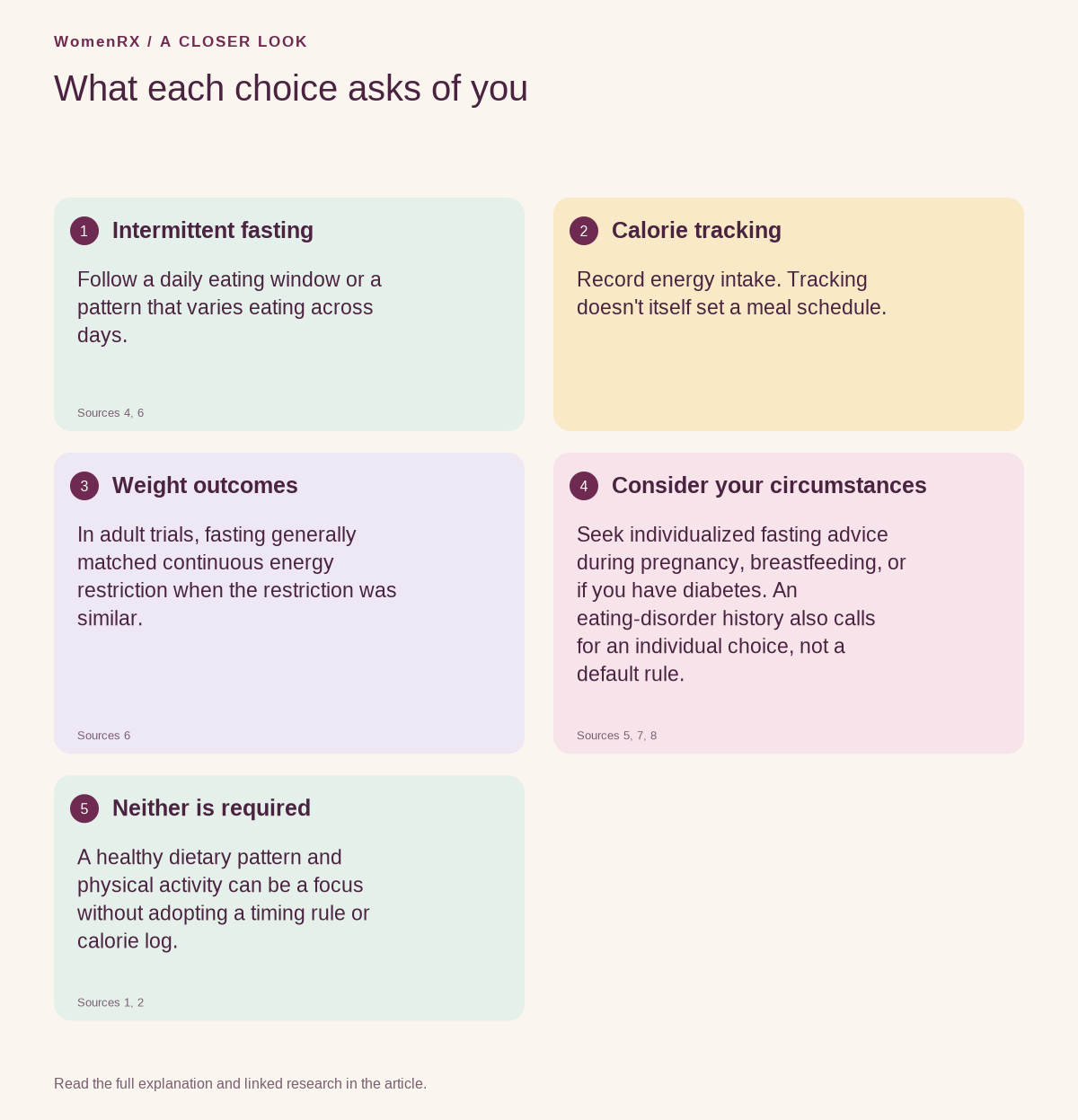
What each choice asks of you
Intermittent fasting: Follow a daily eating window or a pattern that varies eating across days.46
Calorie tracking: Record energy intake. Tracking doesn't itself set a meal schedule.
Weight outcomes: In adult trials, fasting generally matched continuous energy restriction when the restriction was similar.6
Consider your circumstances: Seek individualized fasting advice during pregnancy, breastfeeding, or if you have diabetes. An eating-disorder history also calls for an individual choice, not a default rule.578
Neither is required: A healthy dietary pattern and physical activity can be a focus without adopting a timing rule or calorie log.12
Read the figure as text
A decision aid separating the rule you follow from what the weight-loss research can tell you.- Intermittent fasting: Follow a daily eating window or a pattern that varies eating across days.46
- Calorie tracking: Record energy intake. Tracking doesn't itself set a meal schedule.
- Weight outcomes: In adult trials, fasting generally matched continuous energy restriction when the restriction was similar.6
- Consider your circumstances: Seek individualized fasting advice during pregnancy, breastfeeding, or if you have diabetes. An eating-disorder history also calls for an individual choice, not a default rule.578
- Neither is required: A healthy dietary pattern and physical activity can be a focus without adopting a timing rule or calorie log.12
More questions, answered
Does intermittent fasting work without counting calories?
You can follow a fasting schedule without logging calories, but that doesn't mean energy intake is irrelevant. Across the adult trials reviewed, fasting and continuous restriction produced broadly comparable weight loss when energy restriction was similar. 6
Sources you can check
- Dietary Supplements for Weight Loss - Health Professional Fact SheetAccessed 2026-09-25Return to first citation
- Body Weight: MedlinePlusAccessed 2026-09-25Return to first citation
- Dietary Supplements and Life Stages: Pregnancy - Health Professional Fact SheetAccessed 2026-09-25Return to first citation
- Trial design: Evaluating the safety, feasibility, and acceptability of time-restricted eating in pregnant women with obesity.DiPiazza B, Patel B, Li Y, Tardif A, Pezley L, Fought-Boudaia A, Steffen A, Buhimschi I, Burton T, Varady K, Koenig MD, Tussing-Humphreys L. · Contemporary clinical trials · 2026Return to first citation
- [Consensus document on healthy lifestyles].Abellán Alemán J. · Nutricion hospitalaria · 2026Return to first citation
- Comparison of Different Intermittent Fasting Patterns or Different Extents of Calorie Restriction for Weight Loss and Metabolic Improvement in Adults: A Systematic Review and Network Meta-Analysis of Randomized Controlled Trials.Wu X, Ding Y, Cao Q, Huang J, Xu X, Jiang Y, Xu Y, Lu J, Xu M, Wang T, Zhao Z, Wang W, Ning G, Bi Y, Li M. · Nutrition reviews · 2026Return to first citation
- The impact of time restricted eating on appetite and disordered eating in adults: A mixed methods systematic review.Vizthum D, Katz SE, Pacanowski CR. · Appetite · 2023Return to first citation
- Meal Timing and Anthropometric and Metabolic Outcomes: A Systematic Review and Meta-Analysis.Liu HY, Eso AA, Cook N, O'Neill HM, Albarqouni L. · JAMA network open · 2024Return to first citation