Mushrooms: Nutrients, Protein, and How to Choose Them
A cup of raw white mushrooms offers a little protein, while vitamin D depends strongly on whether the mushrooms were exposed to UV light.
A cup of raw white mushrooms (70 grams) provides about 2.2 grams of protein, along with small amounts of fiber and other nutrients. That makes mushrooms a useful meal ingredient, not a major protein source. Their vitamin D varies: UV-exposed mushrooms can contain much more than ordinary mushrooms, so check the specific product and serving. 62
What you get in a cup of raw white mushrooms
For a familiar serving of fresh mushrooms, the USDA SR Legacy record for raw white mushrooms gives a clearer picture than a protein percentage measured in dried mushrooms. One cup of raw pieces or slices weighs 70 grams. The values below are estimates for that serving. 6
| Raw white mushrooms | Amount per serving |
|---|---|
| Serving | 1 cup (70 g) |
| Energy | 15.4 calories |
| Protein | 2.2 g |
| Carbohydrate | 2.3 g |
| Fiber | 0.7 g |
| Fat | 0.2 g |
Mushrooms do contain protein, but the amount in a cup is modest. A study of five wild edible mushroom species in Uganda reported protein percentages on a dry-weight basis. Those figures describe the mushrooms after water is excluded; they aren’t grams of protein in the fresh mushrooms you put in a pan. The study also found differences among species and growing regions, so its results shouldn’t be applied to a carton of fresh button, cremini, or portabella mushrooms. 3
If you’re building a meal around protein, let mushrooms contribute alongside a food you’ve chosen for that purpose. For example, add them to a bean dish or serve them with eggs. Beans and eggs are recognized dietary protein sources. For packaged mushroom products, use the product’s protein amount per serving rather than a dry-weight percentage from another mushroom species. 13
Why one mushroom has more vitamin D than another
Mushrooms provide vitamin D2, but the amount varies. UV light can increase it: mushrooms exposed to UV during production are different, nutritionally, from mushrooms that haven’t had that treatment. Growing conditions and species can also affect mushroom composition. 235
The contrast in NIH’s food table is striking, though it isn’t a controlled comparison of identical mushrooms. A ½-cup serving of raw, diced portabella mushrooms is listed at 0.1 micrograms of vitamin D, while a ½-cup serving of raw, sliced white mushrooms exposed to UV light is listed at 9.2 micrograms. The varieties and preparations differ as well as the UV treatment. Use those figures to see why the specific product matters, not to predict the content of every package. 2
If vitamin D is why you’re buying mushrooms, look for an explicit UV-exposed or vitamin D statement and compare the micrograms per serving on the label. Don’t assume all white mushrooms have the value listed for UV-exposed white mushrooms. A mushroom powder or extract isn’t automatically equivalent to UV-exposed culinary mushrooms; what it contributes depends on the product. Vitamin D supplements are a separate category: they may contain D2 or D3, and their stated vitamin D amount should be read on their own label. 2
Vitamin D content is not the same as a bone-health result
Vitamin D helps the body absorb calcium, which is one reason it matters for bone health. For women, that question can feel more pressing around and after menopause, when bone breakdown can outpace bone building. The US recommended dietary allowance is 15 micrograms (600 IU) daily for adults through age 70, including during pregnancy and lactation, and 20 micrograms (800 IU) after age 70. These are total daily intake targets, not targets to meet with mushrooms alone. 2
A food containing vitamin D is not, by itself, proven to prevent fractures. A review of UV-irradiated mushroom research identified six human studies involving 663 participants, with study periods of one to six months. The review reported an increase in blood 25-hydroxyvitamin D2 [25(OH)D2], but not total 25-hydroxyvitamin D [25(OH)D], and no demonstrated benefit for the clinical outcomes it assessed. It did not establish a bone-health benefit specifically for women at menopause or afterward. 4
That distinction matters when you see a bone-health claim. Choosing a UV-exposed mushroom can be a way to add dietary vitamin D2. Treating it as a proven osteoporosis strategy goes beyond the human mushroom evidence. Even research on vitamin D and calcium supplements in postmenopausal women and older men cannot be transferred directly to mushrooms: some trials found small gains in bone mineral density, while fracture findings for people living independently have been inconsistent. 24
The most useful shopping question is simple: Which nutrient am I counting on this food to provide, and how much does this serving contain? For protein, use the fresh serving amount, not a dried-mushroom percentage. For vitamin D, distinguish ordinary mushrooms from UV-exposed ones, then check the serving information. 234
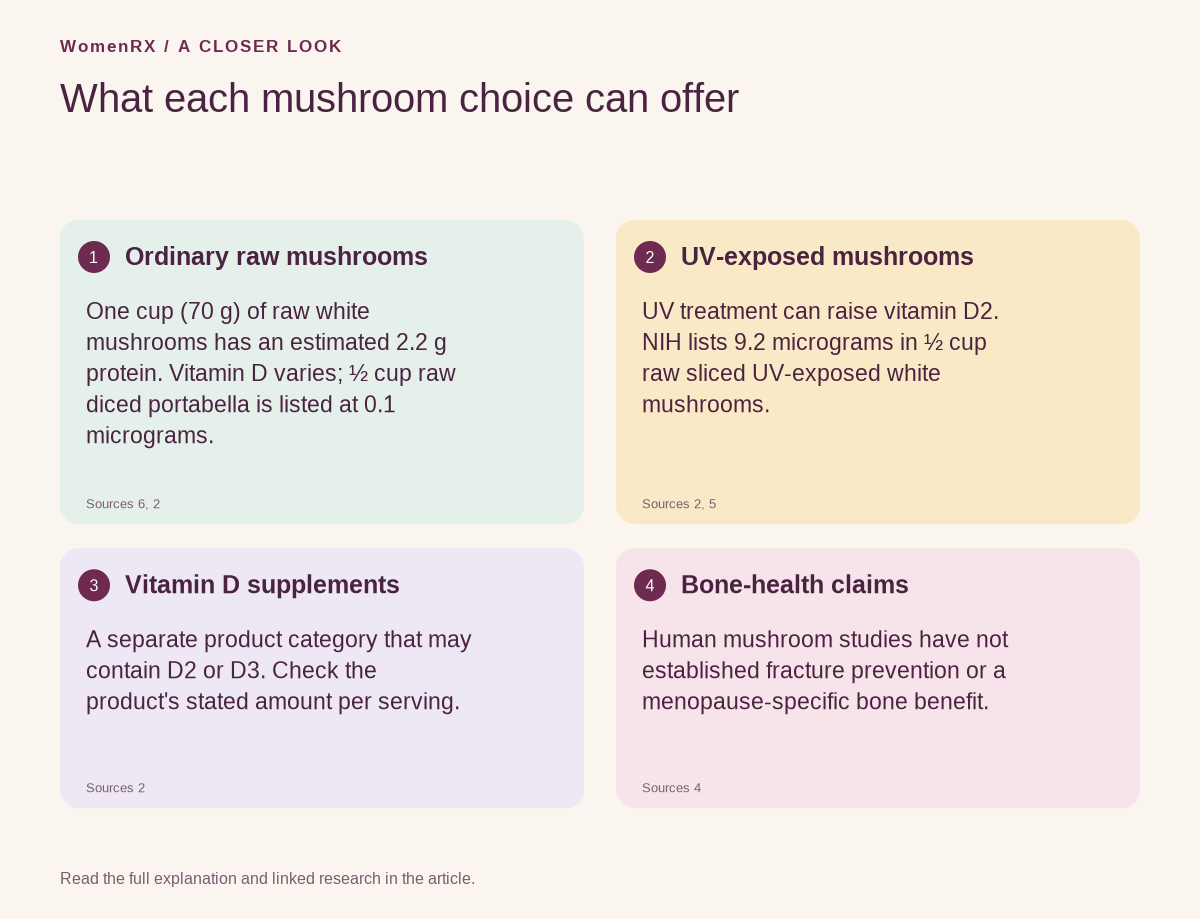
What each mushroom choice can offer
Ordinary raw mushrooms: One cup (70 g) of raw white mushrooms has an estimated 2.2 g protein. Vitamin D varies; ½ cup raw diced portabella is listed at 0.1 micrograms.62
UV-exposed mushrooms: UV treatment can raise vitamin D2. NIH lists 9.2 micrograms in ½ cup raw sliced UV-exposed white mushrooms.25
Vitamin D supplements: A separate product category that may contain D2 or D3. Check the product's stated amount per serving.2
Bone-health claims: Human mushroom studies have not established fracture prevention or a menopause-specific bone benefit.4
Read the figure as text
Compare a serving of ordinary mushrooms, UV-exposed mushrooms, and supplements without treating their nutrient claims as interchangeable.- Ordinary raw mushrooms: One cup (70 g) of raw white mushrooms has an estimated 2.2 g protein. Vitamin D varies; ½ cup raw diced portabella is listed at 0.1 micrograms.62
- UV-exposed mushrooms: UV treatment can raise vitamin D2. NIH lists 9.2 micrograms in ½ cup raw sliced UV-exposed white mushrooms.25
- Vitamin D supplements: A separate product category that may contain D2 or D3. Check the product's stated amount per serving.2
- Bone-health claims: Human mushroom studies have not established fracture prevention or a menopause-specific bone benefit.4
Sources you can check
- Dietary Proteins: MedlinePlusAccessed 2026-09-25Return to first citation
- Vitamin D - Health Professional Fact SheetAccessed 2026-09-25Return to first citation
- Comparative nutrient composition of selected wild edible mushrooms from two agro-ecological zones, Uganda.Nakalembe I, Kabasa JD, Olila D. · SpringerPlus · 2015Return to first citation
- Vitamin D from UV-Irradiated Mushrooms as a Way for Vitamin D Supplementation: A Systematic Review on Classic and Nonclassic Effects in Human and Animal Models.Rondanelli M, Moroni A, Zese M, Gasparri C, Riva A, Petrangolini G, Perna S, Mazzola G. · Antioxidants (Basel, Switzerland) · 2023Return to first citation
- The Effect of UV Irradiation on Vitamin D2 Content and Antioxidant and Antiglycation Activities of Mushrooms.Gallotti F, Lavelli V. · Foods (Basel, Switzerland) · 2020Return to first citation
- USDA SR Legacy: Mushrooms, white, raw (FDC 169251)Accessed 2026-09-25Return to first citation