Mood Swings and Hormones: What Timing Can Tell You
A recurring pattern can help you describe mood changes, even when it can’t tell you their cause.
Reproductive hormones may play a role in mood, particularly during the menopause transition or around a menstrual period. Studies of estrogen treatment and menstrual-cycle stress responses support that possibility, but neither can show why one person’s mood has changed. Notice when symptoms occur, along with sleep, stress, and any existing mental health symptoms. 2 3 5
If you feel more irritable or low before a period, or your mood has changed during perimenopause, hormones are a reasonable question. Timing can give you a useful clue. It isn’t a verdict: the same days can also hold poor sleep, stress, or symptoms you were already managing.
What the menopause research does and doesn’t show
A systematic review and meta-analysis of 14 randomized trials found that exogenous estrogen, used alone or with progesterone or antidepressants, performed better than control treatments for depressive mood. The researchers suggested that response may differ by reproductive stage, with perimenopausal women appearing more responsive than women at other stages. These trial results can’t predict whether estrogen will help a particular person. More importantly, a treatment working for some participants doesn’t prove that low estrogen, or a particular hormone reading, caused any one person’s symptoms. 2
That distinction can keep the question practical. If mood changes arrive alongside the menopause transition, describe both. If hot flashes are also disrupting your days, mention them separately: treatments shown to help hot flashes aren’t automatically treatments for depression. The 2022 North American Menopause Society position statement identifies hormone therapy as the most effective treatment for vasomotor symptoms, while the estrogen review examined depressive mood as a different outcome. 1 2
Before a period: look for repetition and for symptoms between periods
A review of 20 studies found modest support for greater emotional reactivity to laboratory stress during the luteal phase, the part of the cycle before a period. That finding makes menstrual timing worth noticing, but a response to a lab task isn’t the same as a month of everyday mood changes. 3
There’s another distinction that may help you describe what’s happening. Mood symptoms might appear mainly around the premenstrual part of a cycle, or an existing mental health condition might get worse then. Researchers studying menstrually related mood disorders recognize both premenstrual symptoms and premenstrual exacerbation of another psychiatric disorder. A rough week before each period does not, by itself, tell you which explanation fits. 5
For example, if you generally feel well but notice a similar stretch of irritability before several periods, record when it starts and when it eases. If you feel low throughout the month but markedly worse before a period, record both the ongoing symptoms and the change. Either description is more useful than calling every difficult day a “hormone swing.”
Put mood in the context of your actual days
A short record can help you spot a pattern without turning your life into a research project. Note the days when mood changes affect you, menstrual timing if you still have periods, and what happened with sleep and stress. Add symptoms you’re already dealing with and any relevant health or medicine changes. For example, “woke several times, felt irritable at work, period started two days later” tells a fuller story than a mood rating alone.
You don’t need hormone measurements to start that record. Researchers have explored a method that compares repeated hormone measures with repeated mood reports in 94 perimenopausal women, but they describe it as preliminary and in need of validation. A single result would be an even narrower snapshot, not an explanation of your mood. 4
If you’d like support with mood changes, you can seek help without first proving whether hormones are involved. Bring the pattern you’ve noticed, including the symptoms that happen outside a menstrual window. A possible hormone connection and a need for mental health care aren’t competing explanations. 5
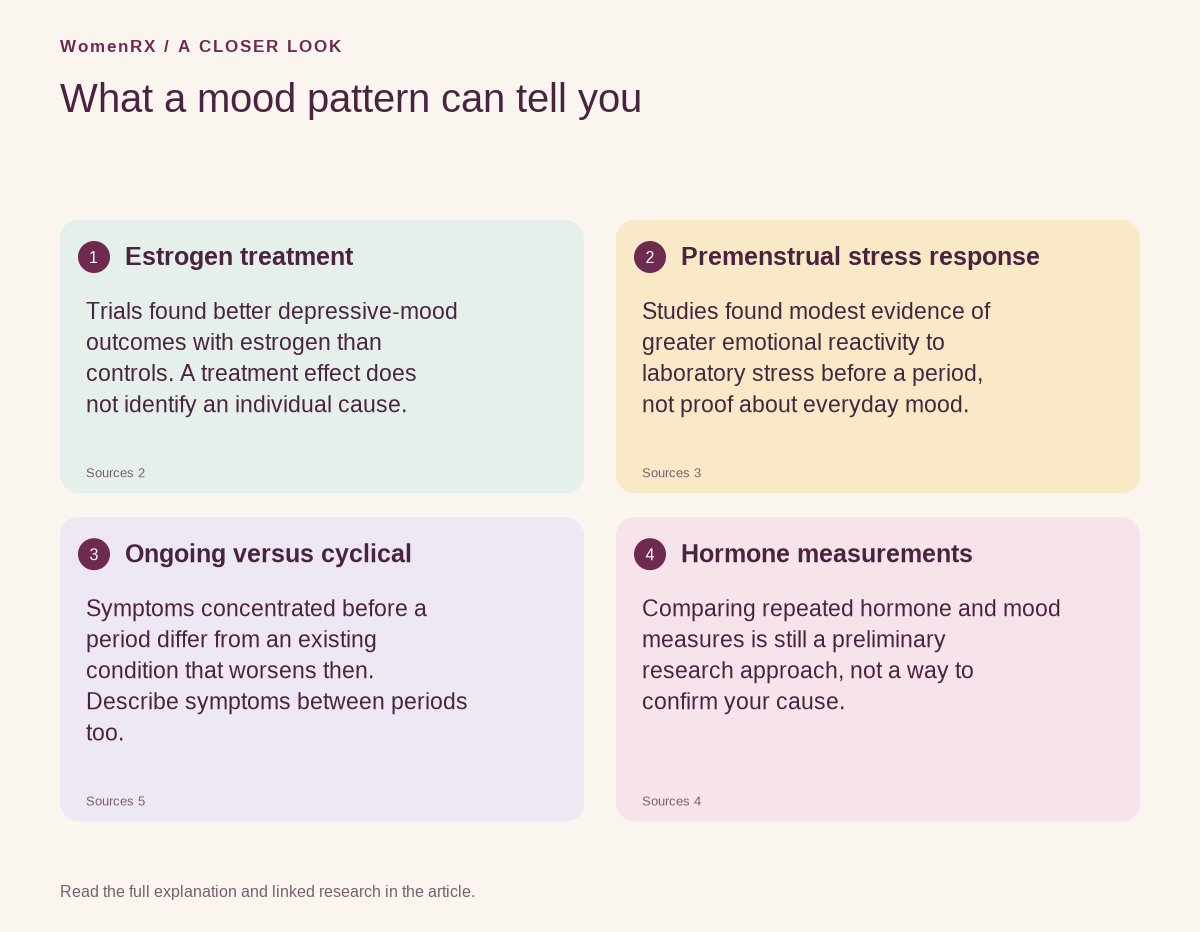
What a mood pattern can tell you
Estrogen treatment: Trials found better depressive-mood outcomes with estrogen than controls. A treatment effect does not identify an individual cause.2
Premenstrual stress response: Studies found modest evidence of greater emotional reactivity to laboratory stress before a period, not proof about everyday mood.3
Ongoing versus cyclical: Symptoms concentrated before a period differ from an existing condition that worsens then. Describe symptoms between periods too.5
Hormone measurements: Comparing repeated hormone and mood measures is still a preliminary research approach, not a way to confirm your cause.4
Read the figure as text
These distinctions help separate a possible hormone connection from an explanation of one person’s symptoms.- Estrogen treatment: Trials found better depressive-mood outcomes with estrogen than controls. A treatment effect does not identify an individual cause.2
- Premenstrual stress response: Studies found modest evidence of greater emotional reactivity to laboratory stress before a period, not proof about everyday mood.3
- Ongoing versus cyclical: Symptoms concentrated before a period differ from an existing condition that worsens then. Describe symptoms between periods too.5
- Hormone measurements: Comparing repeated hormone and mood measures is still a preliminary research approach, not a way to confirm your cause.4
More questions, answered
Does a mood change before my period prove it’s hormonal?
No. Timing is useful context, not proof of cause. Menstrual-cycle research found modest evidence of greater emotional reactivity to laboratory stress before a period; it did not establish the cause of an individual’s everyday symptoms. 3
Sources you can check
- The 2022 hormone therapy position statement of The North American Menopause Society.“The 2022 Hormone Therapy Position Statement of The North American Menopause Society” Advisory Panel. · Menopause (New York, N.Y.) · 2022Return to first citation
- The effect of exogenous estrogen on depressive mood in women: A systematic review and meta-analysis of randomized controlled trials.Zhang J, Yin J, Song X, Lai S, Zhong S, Jia Y. · Journal of psychiatric research · 2023Return to first citation
- Cardiac Autonomic and Affective Reactivity to Laboratory Stressors across the Menstrual Cycle: A Systematic Review.Delcourt ML, Copenhaver E, Cruess DG. · Behavioral medicine (Washington, D.C.) · 2025Return to first citation
- A novel method for quantifying affective sensitivity to endogenous ovarian hormones.Andersen EH, Nagpal A, Eisenlohr-Moul TA, Gordon JL. · Psychoneuroendocrinology · 2024Return to first citation
- Electroencephalography findings in menstrually-related mood disorders: A critical review.Kaltsouni E, Schmidt F, Zsido RG, Eriksson A, Sacher J, Sundström-Poromaa I, Sumner RL, Comasco E. · Frontiers in neuroendocrinology · 2024Return to first citation