Mobility After 50: Match the Work to the Movement
Mobility work may help with a specific restricted movement, but stretching alone won’t necessarily improve every kind of range of motion.
“Mobility” can describe different goals, from reaching overhead to getting up from the floor; it isn’t a single, well-defined exercise category. A useful way to approach the question is to name the task that feels limited, then ask whether stretching, strength work, or another approach seems relevant. In one small study of older women, stretching improved shoulder range of motion but not neck or trunk range. 5
Start with the movement you want back
“Mobility” can be a broad everyday label, rather than a precise exercise category. For this article, use it as a practical question: Which movement or daily task feels limited? Then consider what might help with that task. Stretching and muscle-strengthening are distinct exercise activities in older-adult guidance, but that doesn’t make “mobility” a formal third category or establish what is causing a restriction. 1 2
For example, reaching a high shelf involves reaching; turning to look behind you involves turning your head. Getting down to the floor and back up also asks you to lower and raise your body. These are useful ways to name a goal, not tests that identify the cause. Strength and balance may matter for a whole-body task like getting up; older-adult guidance links strength and balance activities with functional ability and fall prevention, though those sources don’t specifically test floor transfers. 2
What stretching can, and can’t, show
A randomized study of 48 community-dwelling women, average age 75, compared supervised upper-body stretching with lower-body power training. Sessions were 45 minutes, twice weekly, for 12 weeks. Shoulder range of motion improved in the stretching group beyond the change in the comparison group; the study reported a 33% increase. Neck and trunk range did not improve with the stretching program. 5
The practical lesson isn’t that stretching “works” or “doesn’t work.” It’s that a result in one area doesn’t automatically transfer to another. If turning your head is the problem, repeating shoulder stretches may not address it. And even when range improves, that doesn’t establish that every daily task will feel easier.
Other studies show why broad claims about “mobility exercise” are hard to make. A small randomized trial in 20 adults with arthritis found range-of-motion improvements in the back, hips, and shoulders after six weeks of equine-assisted therapy, but not at the knees. That’s a specific intervention in a small group with arthritis, not evidence that any mobility routine will produce the same results. 3
A separate feasibility study in retirement-home residents tested a six-month program combining strength machines, balance training, and cycling. It reported improvements in chair-stand and walking tests, but it was designed to assess whether the program was workable, not to isolate the effect of mobility training. 4
A simple way to choose your focus
Name the task, then notice what seems to stop it. These examples can help you choose a goal, but they can’t identify the cause of a limitation:
- Reaching overhead feels restricted: shoulder range may be relevant. The older-women study found a shoulder change with stretching, but that result doesn’t guarantee the same response for you. 5
- Turning your head feels restricted: neck movement is the task. In the same study, stretching didn’t improve neck range, so stretching alone may not be the right answer. The researchers suggested exploring other exercise options or compensatory strategies. 5
- Getting down to the floor or standing back up is hard: range may be only one piece. Strength and balance are also useful exercise targets for older adults, but the studies here don’t establish a particular floor-transfer program. 1 2
If you’re choosing an activity, ask what it actually trains. Does it stretch a region, build strength, or combine several elements? A program that combines them may be reasonable when your goal is a whole task, but the label “mobility” by itself doesn’t tell you what will improve.
What age and menopause tell us
The stretching study directly involved older women, which makes it relevant to women’s later-life range of motion. But it studied women averaging 75, not women just over 50, and it did not report whether menopause status changed the results. The arthritis and retirement-home studies also don’t establish menopause as a separate factor. These findings can inform exercise goals after 50, but they don’t show that menopause itself explains stiffness or predicts which exercise will help.
Three ways to frame a movement goal
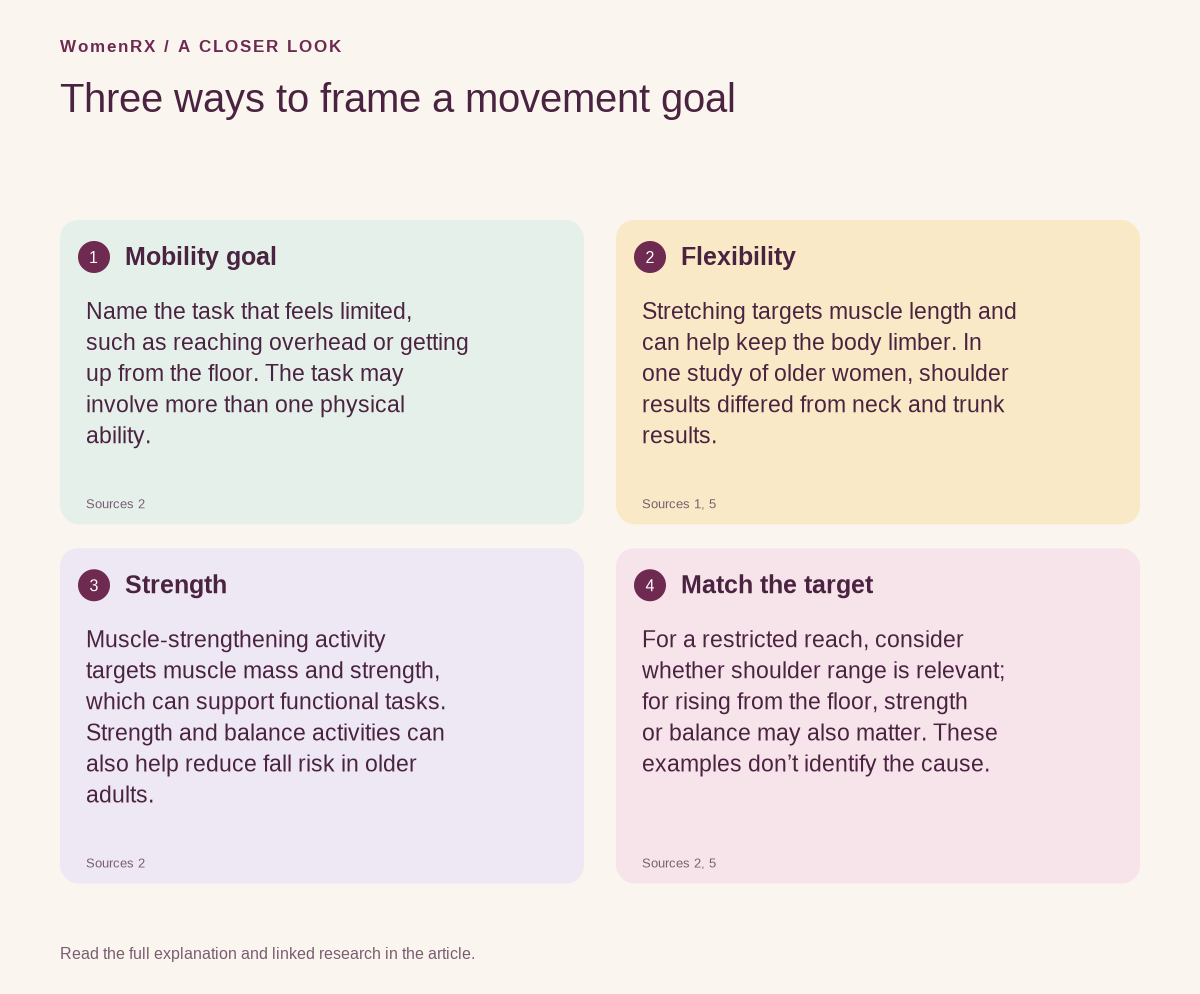
Mobility goal: Name the task that feels limited, such as reaching overhead or getting up from the floor. The task may involve more than one physical ability.2
Flexibility: Stretching targets muscle length and can help keep the body limber. In one study of older women, shoulder results differed from neck and trunk results.15
Strength: Muscle-strengthening activity targets muscle mass and strength, which can support functional tasks. Strength and balance activities can also help reduce fall risk in older adults.2
Match the target: For a restricted reach, consider whether shoulder range is relevant; for rising from the floor, strength or balance may also matter. These examples don’t identify the cause.25
Read the figure as text
“Mobility” is used here as the daily movement you want to do, not a formal exercise category. Flexibility and strength describe different exercise targets that may contribute to a task.- Mobility goal: Name the task that feels limited, such as reaching overhead or getting up from the floor. The task may involve more than one physical ability.2
- Flexibility: Stretching targets muscle length and can help keep the body limber. In one study of older women, shoulder results differed from neck and trunk results.15
- Strength: Muscle-strengthening activity targets muscle mass and strength, which can support functional tasks. Strength and balance activities can also help reduce fall risk in older adults.2
- Match the target: For a restricted reach, consider whether shoulder range is relevant; for rising from the floor, strength or balance may also matter. These examples don’t identify the cause.25
Sources you can check
- Exercise for Older Adults: MedlinePlusAccessed 2026-09-25Return to first citation
- Benefits of Exercise: MedlinePlusAccessed 2026-09-25Return to first citation
- An equine-assisted therapy intervention to improve pain, range of motion, and quality of life in adults and older adults with arthritis: A randomized controlled trial.White-Lewis S, Johnson R, Ye S, Russell C. · Applied nursing research : ANR · 2019Return to first citation
- Bestform-F - Best Function of Range of Motion: A Feasibility Study of a Multimodal Exercise Training Program for Older Adults in Retirement Homes.Schaller N, Krusemark H, Mende E, Weiß M, Spanier B, Zelger O, Bischof J, Haller B, Halle M, Siegrist M. · Clinical interventions in aging · 2022Return to first citation
- Effect of a Supervised Stretching Program on Neck, Shoulder, and Trunk Range of Motion in Older Women.Webber SC, Porter MM. · Canadian journal on aging = La revue canadienne du vieillissement · 2022Return to first citation