Meal Prep for Weeks That Won’t Follow a Plan
A few flexible ingredients can make meals easier without committing you to a week of identical containers.
Start with the meals that are hardest to manage, not an entire week’s menu. Choose a few ingredients you can combine in different ways, check what you already have, and prep only the task that will save you the most time. Keep an easy backup meal for days that change. In a French adult cohort, food-preparation behaviors weren’t associated with five-year weight change after adjustment.1
Plan around the pinch point
If dinner is usually manageable but lunch gets squeezed between meetings, prep lunches. If you’re caring for someone and evenings are unpredictable, make dinner easier to assemble. You don’t need to cook every meal in advance to benefit from a plan.
Work with the time, equipment, money, and help you actually have. In a small qualitative study of African American adults considering a community cooking program, participants described caregiving, transportation, time, and household composition as factors that shaped cooking. Their circumstances won’t describe everyone’s, but they’re a useful reminder that a meal plan has to fit a real life.3
Build a short list of components
Pick one meal you’d like to make easier, then write a shopping list around ingredients that can do more than one job. For example:
- Something filling: canned beans, eggs, tofu, or a protein you already know how to prepare.
- Produce: a bag of frozen vegetables, fruit, or fresh vegetables you’ll enjoy eating.
- A base: bread, tortillas, rice, or another grain.
- Flavor: salsa, a dressing, herbs, or a sauce you have on hand.
That’s an example, not a required formula. If you have beans, tortillas, frozen vegetables, and salsa, you could make a warm tortilla filling one day and a rice bowl another, provided you have rice. If you’d rather not cook, a sandwich with fruit and ready-to-eat vegetables may be the better plan. Check your kitchen before shopping so the list fills gaps instead of duplicating what’s there.
A U.S. cross-sectional study found that meal-preparation practices and the variety of fruits and vegetables available at home were associated with measures of diet quality. It can’t show that buying or prepping particular foods will improve an individual’s diet, but it supports paying attention to what’s practical to keep on hand.5
Prep the part that slows you down
Ask which step tends to stop the meal from happening. If it’s decision-making, write down two meal combinations. If it’s washing and chopping, prepare some produce. If it’s cooking a base, make that component. You can stop after one task; a short prep session that you’ll repeat is more useful than an ambitious one you dread.
For example, you might prepare rice and wash vegetables, then leave the beans unopened and the sauce separate until you’re ready to eat. Or you might skip advance cooking altogether and put the ingredients for a quick meal together on one shelf. Planning meals, preparing ahead, keeping basic foods on hand, and using leftovers are all recognized food skills.6
Put cooked extras away promptly
Before you cook extra, make room in the refrigerator or freezer for what you won’t eat. Put leftovers away rather than leaving them out for hours, and check your refrigerator temperature with a thermometer. A Canadian survey identified delayed refrigeration as a food-handling concern; a U.S. survey of older adults identified refrigerator-temperature checks and leftover storage as practices needing attention.24 When cooking meat, poultry, or egg dishes, use a food thermometer to check doneness rather than judging by appearance alone.24
If your schedule changes, use the food you’ve prepared instead of trying to rescue the original menu. Freeze a component you can’t use soon, if it’s suitable for freezing, or pair what’s ready with something simpler. Follow the storage and reheating directions on packaged foods.
Let the plan change with you
A backup meal is part of meal prep, not a failure of it. For example, keep the ingredients for a bean-and-vegetable tortilla, an egg-and-toast meal, or another quick combination you like. Choose foods and amounts that meet your appetite and circumstances rather than copying someone else’s portions. If you’re pregnant, lactating, or managing a condition that affects what you eat, use the same flexible planning approach while making food choices that fit your specific needs.
And if weight loss is on your mind, don’t measure success by how much you cooked from scratch. In a five-year prospective study of French adults, measures of food-preparation behavior were not associated with weight change after adjustment for other factors. A finding concerning scratch cooking and obesity risk in women also weakened after dietary factors were included. Meal prep’s more dependable purpose is to make the meals you want to eat easier to put together.1
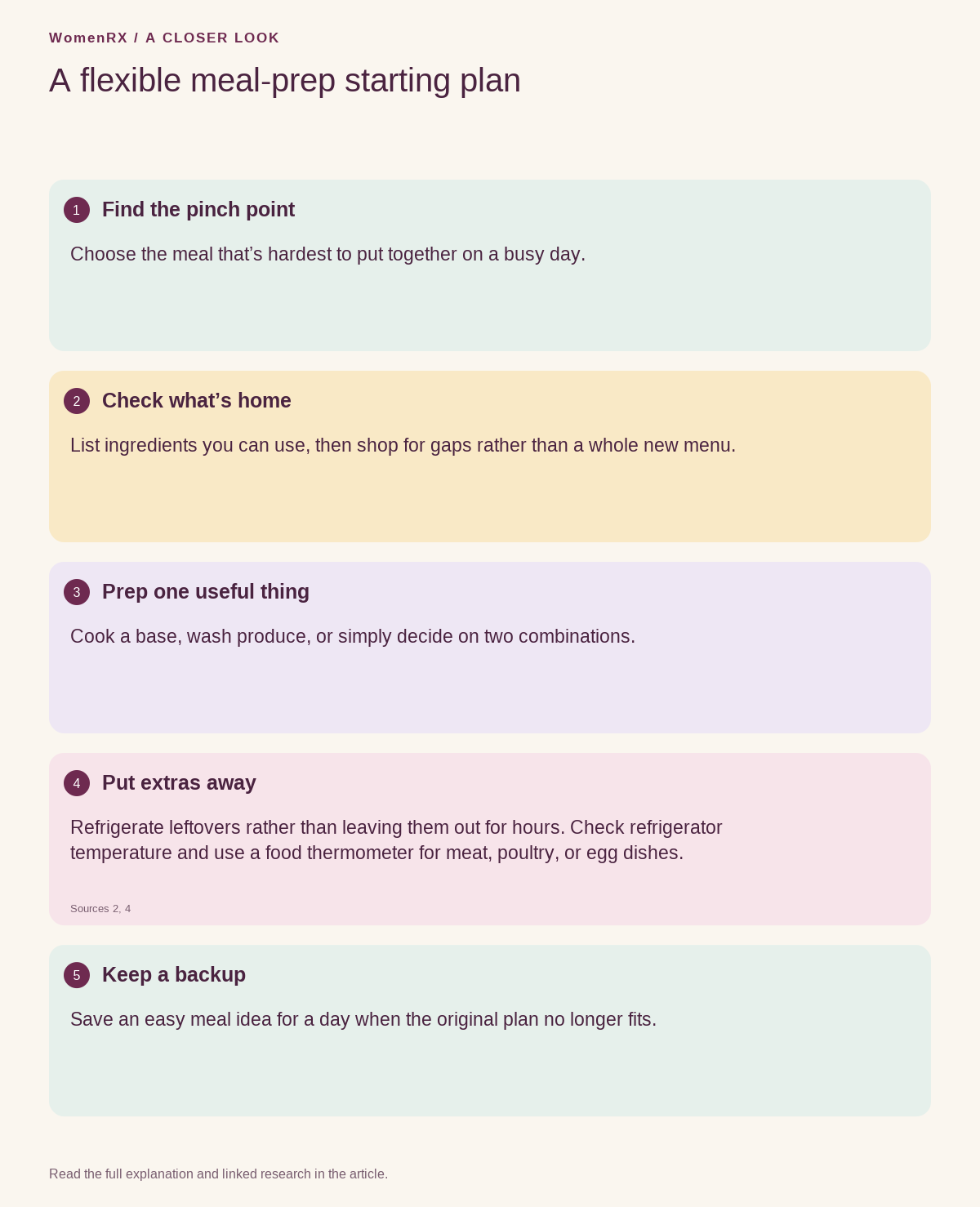
A flexible meal-prep starting plan
Find the pinch point: Choose the meal that’s hardest to put together on a busy day.
Check what’s home: List ingredients you can use, then shop for gaps rather than a whole new menu.
Prep one useful thing: Cook a base, wash produce, or simply decide on two combinations.
Put extras away: Refrigerate leftovers rather than leaving them out for hours. Check refrigerator temperature and use a food thermometer for meat, poultry, or egg dishes.24
Keep a backup: Save an easy meal idea for a day when the original plan no longer fits.
Read the figure as text
Use these as decision points, not a requirement to cook a week’s worth of meals.- Find the pinch point: Choose the meal that’s hardest to put together on a busy day.
- Check what’s home: List ingredients you can use, then shop for gaps rather than a whole new menu.
- Prep one useful thing: Cook a base, wash produce, or simply decide on two combinations.
- Put extras away: Refrigerate leftovers rather than leaving them out for hours. Check refrigerator temperature and use a food thermometer for meat, poultry, or egg dishes.24
- Keep a backup: Save an easy meal idea for a day when the original plan no longer fits.
More questions, answered
Do I need to make every meal ahead of time?
No. You could prepare one component, set aside ingredients for a quick meal, or plan only the part of the day that tends to be difficult. Planning, advance preparation, and using leftovers are different food skills, not requirements you must do all at once.6
Sources you can check
- Influence of food preparation behaviors on 5-year weight change and obesity risk in a French prospective cohort.Méjean C, Lampuré A, Si Hassen W, Gojard S, Péneau S, Hercberg S, Castetbon K. · The international journal of behavioral nutrition and physical activity · 2018Return to first citation
- Food Safety Knowledge and Behaviors of Canadians: Foodbook 2.0.Sy M, Thomas MK, Nesbitt A, Thaivalappil A, Young I. · Journal of food protection · 2026Return to first citation
- Assessing Acceptability: The Role of Understanding Participant, Neighborhood, and Community Contextual Factors in Designing a Community-Tailored Cooking Intervention.Farmer N, Tuason R, Middleton KR, Ude A, Tataw-Ayuketah G, Flynn S, Kazmi N, Baginski A, Mitchell V, Powell-Wiley TM, Wallen GR. · Nutrients · 2024Return to first citation
- Food Safety Knowledge and Practices among Older Adults: Identifying Causes and Solutions for Risky Behaviors.Cates SC, Kosa KM, Karns S, Godwin SL, Speller-Henderson L, Harrison R, Ann Draughon F. · Journal of nutrition for the elderly · 2009Return to first citation
- Home food environment and associations with weight and diet among U.S. adults: a cross-sectional study.Kegler MC, Hermstad A, Haardörfer R. · BMC public health · 2021Return to first citation
- Assessment of Food and Cooking Skills: Validation of a Portuguese Version of a Tool and Characterisation of Food and Cooking Skills in Young Adults.Costa V, Borrego R, Mateus C, Carolino E, Viegas C. · Portuguese journal of public health · 2023Return to first citation