How to Prep Bowls You Won’t Get Bored With
Prep cooked ingredients separately, then change the grain, protein, vegetables, and sauce to make each bowl feel different.
Prep cooked components separately, then change the combination when you assemble a bowl: chickpeas and quinoa with lemon and herbs, for example, or rice and beans with tomato and lime. Variety fits a healthy eating pattern without requiring identical meals. 1 Refrigerate cooked leftovers promptly and use them within 3 to 4 days, or freeze them. 5 Count sauces and swaps when calculating each bowl’s nutrition. 3
Start with a bowl you can measure
You don’t need to assemble identical lunches to make prep worthwhile. Start with these four cooked ingredients for one bowl; make more by multiplying each amount by the number of bowls you want. The weights are for cooked, edible food, not dry quinoa or uncooked chickpeas. 3
| Ingredient | Amount for one bowl |
|---|---|
| Cooked chickpeas, without salt | 82 g |
| Cooked quinoa | 92.5 g |
| Cooked green peas, without salt | 80 g |
| Olive oil | 4.5 g |
Cook or obtain the chickpeas, quinoa, and peas separately according to their cooking instructions. Measure the cooked amounts, combine them in a bowl, and mix in the olive oil. This is an assembly using already cooked ingredients, not a cooking-time estimate. 3
For one bowl, the estimated nutrition is: 3
| Energy | Protein | Carbohydrate | Fat | Fiber |
|---|---|---|---|---|
| 352.5 calories | 15.6 g | 54.7 g | 8.6 g | 13.2 g |
These are rounded estimates calculated from reference values for the ingredients, not a lab analysis of the finished bowl or a target for what you should eat in a day. 3
Prep the parts, then change the combination
Pick components you’d enjoy in more than one setting. Prepare a grain such as quinoa or rice, a protein such as chickpeas, other beans, tofu, or chicken, and vegetables you can combine in different ways. Keep sauces separate until you assemble a bowl. This lets you change the flavor without seasoning every portion alike. Variety across vegetables, whole grains, and protein foods fits a healthy eating pattern; it doesn’t require following a rigid set of meals. 127
Here’s one way to turn those parts into distinct bowls. These are combination ideas, not additional recipes with calculated macros:
- Lemon and herbs: Use the measured chickpea, quinoa, and pea bowl above. Add lemon and chopped herbs when you eat it. Those additions aren’t included in its nutrition table. 3
- Tomato and lime: Pair cooked rice and beans with vegetables such as peppers. Add chopped tomato and lime at assembly.
- Ginger and lime: Pair cooked tofu and quinoa with broccoli, then add a ginger-lime sauce. 7
- Herby yogurt: Pair cooked chicken and rice with carrots, then add a yogurt-and-herb sauce. If you’re pregnant, choose yogurt made with pasteurized milk. 4
For a simple prep sequence, cook or obtain the components, let the measured bowl be your reference portion, and keep the other ingredients ready to combine in different ways. Refrigerate cooked components promptly rather than leaving a batch out while you assemble every bowl. 5 For lunches beyond the 3-to-4-day refrigerated-leftover window, you could freeze portions or plan another prep session later in the week. 5 USDA says it’s fine to prepare food for a packed lunch the night before and to pack the lunch bag just before leaving home. 6 No single set of macros applies to all four combinations.
Want to swap the chickpeas for tofu or chicken, use beans instead of peas, or replace the quinoa with rice? Those are new bowls, not the measured bowl above. They can give you a different combination of foods and flavors, but their calories and macros won’t be the numbers in the table. Protein comes from both animal and plant foods, including beans, tofu, and some grains. 27 A change in sauce or an extra drizzle of oil also changes the totals. 3
Meal prep can make your choices easier to assemble. It doesn’t, by itself, establish that a bowl will cause weight loss. Choose the combination and amount that work for your appetite and the rest of your day.
Keep the parts safe to use
Divide large batches of cooked food into shallow containers so they cool quickly, and refrigerate leftovers within 2 hours of cooking, or within 1 hour if the temperature is over 90°F. Keep the refrigerator at 40°F or below. Refrigerated leftovers can be kept for 3 to 4 days; freeze portions you won’t use in that window. 5
When you reheat a prepared bowl or its cooked components, heat the leftovers to 165°F, checking with a food thermometer. For microwave reheating, cover and rotate the food, then check its temperature in several places because microwaves can leave cold spots. 5
If you pack a bowl for lunch, pack it just before you leave home. USDA advises discarding food left over from a packed lunch rather than saving it for another meal. 6
During pregnancy, the same measured-bowl math applies, but toppings deserve a closer look. If you add cheese or a yogurt-based sauce, choose dairy made with pasteurized milk. Skip homemade dressings containing raw egg; a commercial dressing made with pasteurized eggs is an alternative. Follow the cooling, storage, and reheating steps for cooked components, too. 45
Recalculate when you make a swap
To estimate a changed bowl, write down the cooked edible weight of each ingredient you actually use. For each nutrient, multiply that ingredient’s value per 100 g by its weight in grams, divide by 100, then add the results for every ingredient, including oil and sauce. Round after adding. That’s how the measured bowl’s estimates were calculated from ingredient data. 3
For example, if you add a sauce, look up its nutrition for the amount you poured and add it to the base bowl. If you replace an ingredient, remove its contribution before adding the replacement’s. Keep dry-grain values separate from cooked-grain weights, and use a product’s own nutrition information when your ingredients differ from the reference foods. The result is a useful estimate for your assembled bowl, not a number that follows every variation. 3
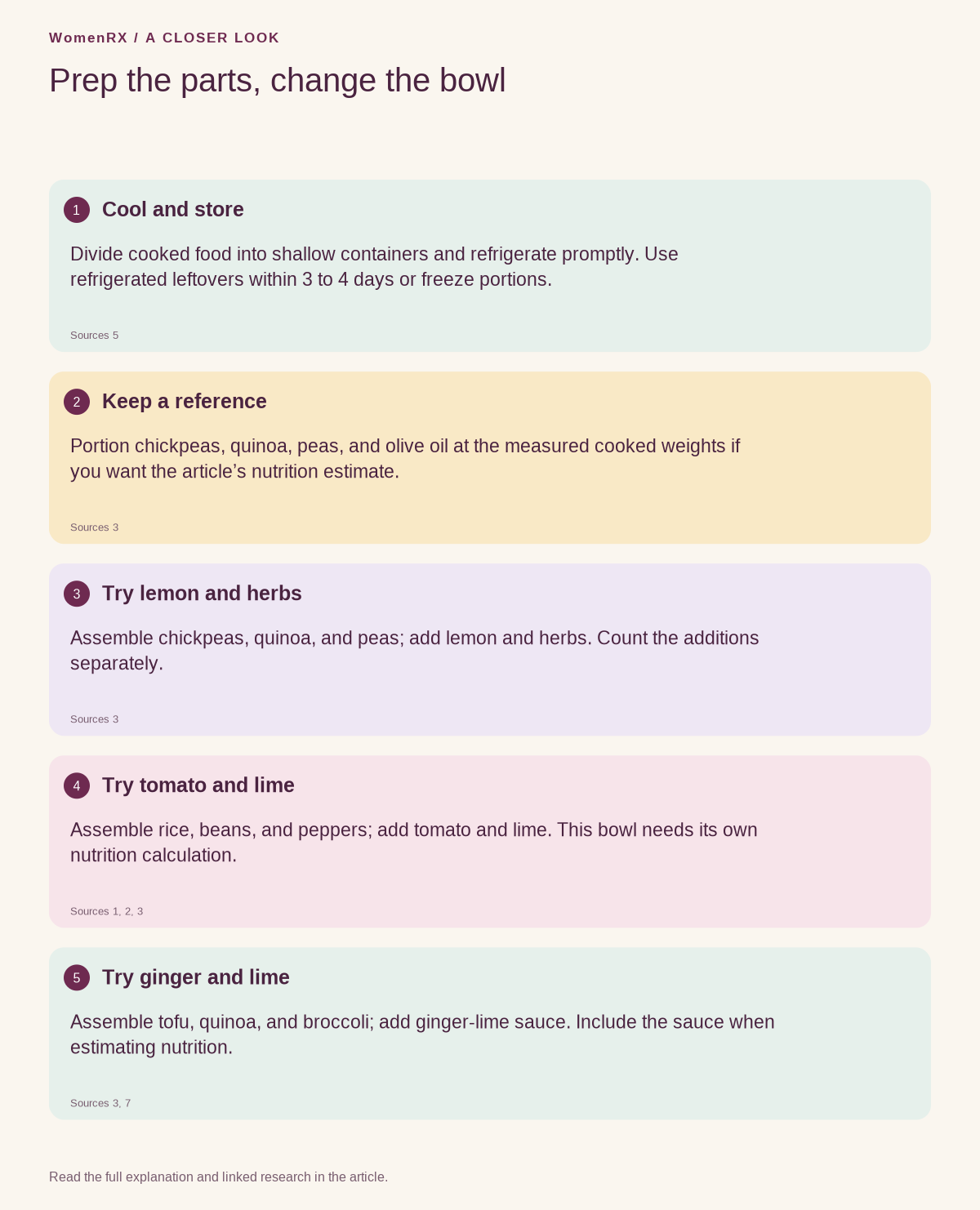
Prep the parts, change the bowl
Cool and store: Divide cooked food into shallow containers and refrigerate promptly. Use refrigerated leftovers within 3 to 4 days or freeze portions.5
Keep a reference: Portion chickpeas, quinoa, peas, and olive oil at the measured cooked weights if you want the article’s nutrition estimate.3
Try lemon and herbs: Assemble chickpeas, quinoa, and peas; add lemon and herbs. Count the additions separately.3
Try tomato and lime: Assemble rice, beans, and peppers; add tomato and lime. This bowl needs its own nutrition calculation.123
Try ginger and lime: Assemble tofu, quinoa, and broccoli; add ginger-lime sauce. Include the sauce when estimating nutrition.37
Read the figure as text
Use a measured bowl as a reference, then change the assembled ingredients and flavors. Make another batch later if that suits your schedule.- Cool and store: Divide cooked food into shallow containers and refrigerate promptly. Use refrigerated leftovers within 3 to 4 days or freeze portions.5
- Keep a reference: Portion chickpeas, quinoa, peas, and olive oil at the measured cooked weights if you want the article’s nutrition estimate.3
- Try lemon and herbs: Assemble chickpeas, quinoa, and peas; add lemon and herbs. Count the additions separately.3
- Try tomato and lime: Assemble rice, beans, and peppers; add tomato and lime. This bowl needs its own nutrition calculation.123
- Try ginger and lime: Assemble tofu, quinoa, and broccoli; add ginger-lime sauce. Include the sauce when estimating nutrition.37
Sources you can check
- Nutrition: MedlinePlusAccessed 2026-09-25Return to first citation
- Dietary Proteins: MedlinePlusAccessed 2026-09-25Return to first citation
- USDA SR Legacy ingredient data: calculated bowl meal exampleAccessed 2026-09-25Return to first citation
- Dairy and Eggs (Food Safety for Moms-to-Be) | FDAAccessed 2026-09-25Return to first citation
- Leftovers and Food Safety | Food Safety and Inspection ServiceAccessed 2026-09-25Return to first citation
- Keeping "Bag" Lunches Safe | Food Safety and Inspection ServiceAccessed 2026-09-25Return to first citation
- Healthy Ways to Add Protein, VA Nutrition and Food ServicesAccessed 2026-09-25Return to first citation