Two High-Protein Dinners Under 500 Calories
A chicken dinner and a tuna dinner both fit under 500 calories in the portions shown, with measured oil included in each estimate.
Yes. One plate of roasted chicken, sweet potato, peas, and olive oil comes to about 337 calories and 32.6 grams of protein. A second plate with cooked tuna, quinoa, peas, and olive oil comes to about 383 calories and 34.1 grams of protein. Both are ingredient-based estimates, not promises of fullness or reasons to make 500 calories your dinner limit. 81011
Start with the cooked portions
For one chicken dinner, use 85 g roasted chicken breast meat, 100 g baked sweet potato flesh, 80 g boiled green peas, and 4.5 g olive oil. The chicken, sweet potato, and peas are weighed after cooking, as edible portions. Adding each ingredient’s contribution from USDA reference-food data gives these estimates, not a measurement of a finished dish. 8
| Ingredient, cooked edible amount | Calories | Protein | Carbohydrate | Fat | Fiber |
|---|---|---|---|---|---|
| Roasted chicken breast, meat only, 85 g | 140 | 26.4 g | 0 g | 3.0 g | 0 g |
| Baked sweet potato flesh, 100 g | 90 | 2.0 g | 20.7 g | 0.2 g | 3.3 g |
| Boiled green peas, 80 g | 67 | 4.3 g | 12.5 g | 0.2 g | 4.4 g |
| Olive oil, 4.5 g | 40 | 0 g | 0 g | 4.5 g | 0 g |
| Estimated plate total | 337 | 32.6 g | 33.2 g | 7.9 g | 7.7 g |
Totals are calculated before rounding, so displayed rows may not add up exactly. No sauce, extra cooking oil, chicken skin, or other additions are included. These are reference-food estimates, not nutrition numbers for every product or preparation. 8
A different dinner: tuna, quinoa, and peas
For a second plate, use 85 g cooked bluefin tuna prepared with dry heat, 100 g cooked quinoa, 80 g boiled green peas, and 4.5 g olive oil. Weigh the cooked edible amounts. The tuna and quinoa figures come from separate USDA reference-food entries; the peas and oil use the same entries as the chicken plate. 81011
| Ingredient, cooked edible amount | Calories | Protein | Carbohydrate | Fat | Fiber |
|---|---|---|---|---|---|
| Bluefin tuna, cooked with dry heat, 85 g | 156 | 25.4 g | 0 g | 5.3 g | 0 g |
| Cooked quinoa, 100 g | 120 | 4.4 g | 21.3 g | 1.9 g | 2.8 g |
| Boiled green peas, 80 g | 67 | 4.3 g | 12.5 g | 0.2 g | 4.4 g |
| Olive oil, 4.5 g | 40 | 0 g | 0 g | 4.5 g | 0 g |
| Estimated plate total | 383 | 34.1 g | 33.8 g | 11.9 g | 7.2 g |
Here, too, the total is the sum of the specified edible weights before rounding. It doesn’t include oil used to cook the fish, a sauce, or any other addition. A different kind of tuna or a packaged quinoa dish needs its own calculation; those numbers aren’t interchangeable with these reference entries. 81011
Make the plates, then choose your portion
For the chicken plate, roast a chicken breast until safely cooked, bake a sweet potato until tender, and boil peas until tender. Remove the chicken skin if present. Weigh out 85 g of cooked breast meat, 100 g of baked sweet potato flesh, and 80 g of drained peas, then add 4.5 g olive oil to the vegetables. The nutrition estimate starts with those cooked weights, not the weights of the raw ingredients. 8
For the tuna plate, cook bluefin tuna using dry heat without added oil, cook quinoa, and boil and drain peas. Weigh 85 g cooked tuna, 100 g cooked quinoa, and 80 g cooked peas, then add 4.5 g olive oil. If oil goes into the pan or a sauce goes onto either plate, count what you actually use rather than assuming it’s covered by the estimate. 81011
If you’re using leftovers, cool large batches in shallow containers and refrigerate them within two hours after cooking. Refrigerated leftovers keep for 3 to 4 days; reheat them to 165°F, measured with a food thermometer. 9
See what changes when you serve more
Here’s a larger portion of the chicken dinner: keep the 85 g cooked chicken and 4.5 g olive oil, but serve 200 g baked sweet potato flesh and 160 g boiled peas. Compared with the first chicken plate, the extra sides add 90 + 67.2 = 157.2 calories, about 6.3 g protein, and 7.7 g fiber. The larger plate totals approximately 494 calories, 38.9 g protein, and 15.4 g fiber. It’s an example of changing the portion, not a claim that the larger plate will satisfy everyone. 8
The oil is easy to overlook because it adds no protein or fiber. The measured 4.5 g portion accounts for about 40 calories. Add another 4.5 g to the original chicken plate, and its estimate rises from about 337 to 377 calories; add it to the larger chicken plate, and the estimate rises from about 494 to 534 calories. That’s before any sauce. A sauce’s contribution depends on the product and amount, so these totals can’t include one you haven’t measured. 8
Will either dinner be satisfying?
It might be. Both plates include a protein food, a starchy food, and peas, which contribute to the calculated fiber. But a nutrition calculation can’t tell you how hungry you’ll be afterward. In a randomized crossover trial of 48 healthy adults, a higher-protein egg breakfast produced greater reported satiety than a lower-protein cereal breakfast. A separate trial of 20 adults found greater fullness with an egg breakfast on the first day of comparison, but not the seventh, and found no significant reduction in later food intake. Both studies tested breakfasts, not these dinners, and neither reported a women’s subgroup result here. 67
If a plate leaves you hungry, you don’t have to treat 500 calories as a ceiling. You could serve more of the dinner or add something else you enjoy, recognizing that the nutrition total will change. You can also skip the arithmetic altogether: assemble a meal with a protein food, vegetables, a starchy food, and the fat or sauce you want, then choose portions that work for your appetite and day. Chicken and fish aren’t the only protein choices; tofu and beans count too, though their portions and nutrition values aren’t interchangeable with either calculated plate. 581011
A fixed dinner cap can be a particularly poor fit when your needs change. Pregnancy energy needs vary by trimester and activity, while breastfeeding has different daily protein and carbohydrate requirements from nonpregnant adulthood. 43 For women footballers, adequate overall energy is a priority for health and performance. 2 Medical needs can matter, too: in a study of people recovering from distal gastrectomy for gastric cancer, lower postoperative energy intake relative to body weight was associated with more short-term weight loss. That finding doesn’t set a dinner target, but it shows why adequate intake may need individual attention during medical recovery. 1 These are reasons to judge the plates as meal examples, not a daily eating rule.
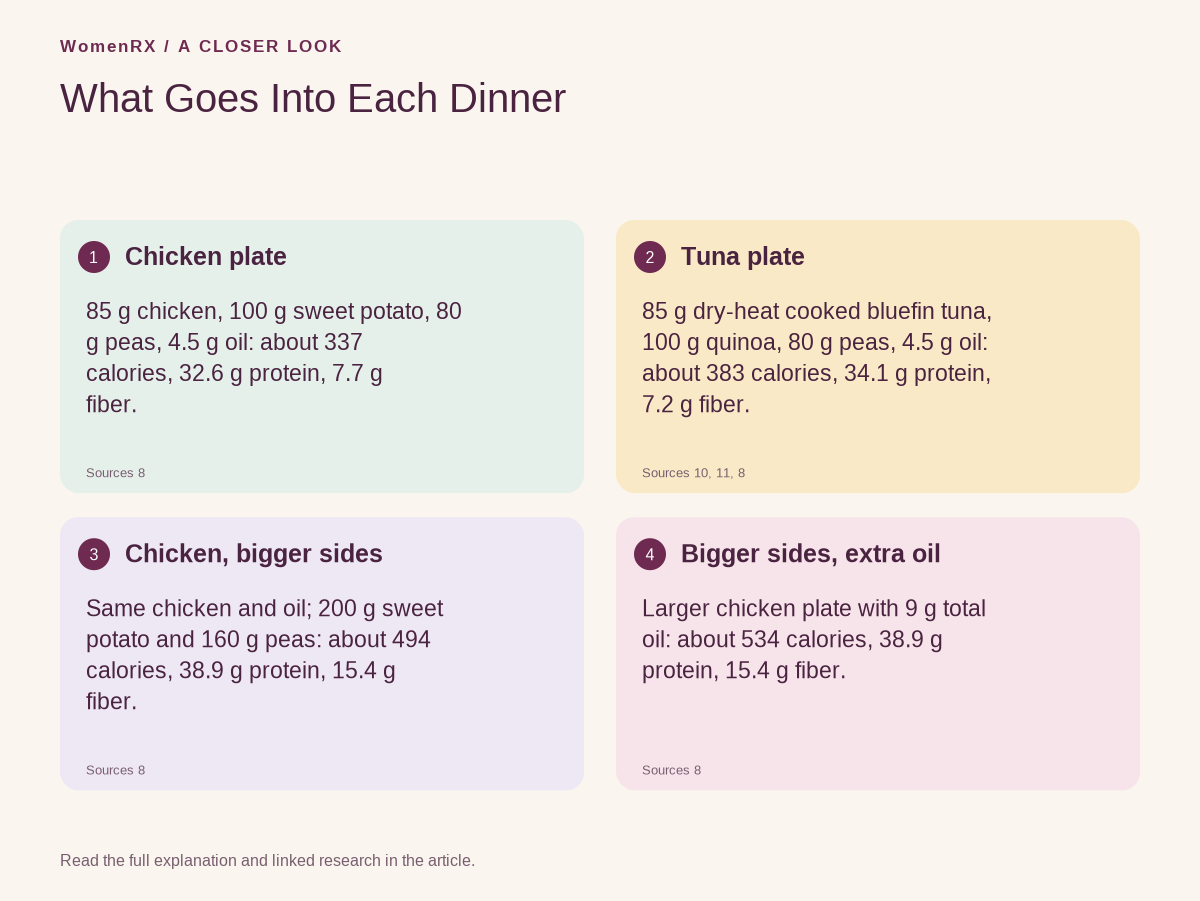
What Goes Into Each Dinner
Chicken plate: 85 g chicken, 100 g sweet potato, 80 g peas, 4.5 g oil: about 337 calories, 32.6 g protein, 7.7 g fiber.8
Tuna plate: 85 g dry-heat cooked bluefin tuna, 100 g quinoa, 80 g peas, 4.5 g oil: about 383 calories, 34.1 g protein, 7.2 g fiber.10118
Chicken, bigger sides: Same chicken and oil; 200 g sweet potato and 160 g peas: about 494 calories, 38.9 g protein, 15.4 g fiber.8
Bigger sides, extra oil: Larger chicken plate with 9 g total oil: about 534 calories, 38.9 g protein, 15.4 g fiber.8
Read the figure as text
Cooked edible weights make the estimates comparable. The chicken variations show what changes when sides or oil increase.- Chicken plate: 85 g chicken, 100 g sweet potato, 80 g peas, 4.5 g oil: about 337 calories, 32.6 g protein, 7.7 g fiber.8
- Tuna plate: 85 g dry-heat cooked bluefin tuna, 100 g quinoa, 80 g peas, 4.5 g oil: about 383 calories, 34.1 g protein, 7.2 g fiber.10118
- Chicken, bigger sides: Same chicken and oil; 200 g sweet potato and 160 g peas: about 494 calories, 38.9 g protein, 15.4 g fiber.8
- Bigger sides, extra oil: Larger chicken plate with 9 g total oil: about 534 calories, 38.9 g protein, 15.4 g fiber.8
Sources you can check
- When Tolerating Diet Is Not Enough: Hidden Underfeeding After Distal Gastrectomy.Taketani K, Furukawa H, Saijo T, Akamaru Y, Ryomoto K. · The American surgeon · 2026Return to first citation
- Fueling Women's Football: Evidence-Informed Practical Nutrition Strategies for Performance and Health.Smith-Ryan AE, Moore SR, Arent M, Cantu E, Cornejo L, Hackney AC, Ihalainen JK, Mikkonen RS, Bruinvels G. · Sports medicine (Auckland, N.Z.) · 2026Return to first citation
- Nutritional Gaps and Supplementation in the First 1000 Days.Beluska-Turkan K, Korczak R, Hartell B, Moskal K, Maukonen J, Alexander DE, Salem N, Harkness L, Ayad W, Szaro J, Zhang K, Siriwardhana N. · Nutrients · 2019Return to first citation
- Practice paper of the Academy of Nutrition and Dietetics abstract: nutrition and lifestyle for a healthy pregnancy outcome.Kaiser LL, Campbell CG, Academy Positions Committee Workgroup. · Journal of the Academy of Nutrition and Dietetics · 2014Return to first citation
- MedlinePlus: Protein in diet, including tofu and other plant sourcesAccessed 2026-09-25Return to first citation
- The effects of the combination of egg and fiber on appetite, glycemic response and food intake in normal weight adults - a randomized, controlled, crossover trial.Bonnema AL, Altschwager DK, Thomas W, Slavin JL. · International journal of food sciences and nutrition · 2016Return to first citation
- A randomized trial to manipulate the quality instead of quantity of dietary proteins to influence the markers of satiety.Bayham BE, Greenway FL, Johnson WD, Dhurandhar NV. · Journal of diabetes and its complications · 2014Return to first citation
- USDA SR Legacy ingredient data: calculated dinner meal exampleAccessed 2026-09-25Return to first citation
- Leftovers and Food Safety | Food Safety and Inspection ServiceAccessed 2026-09-25Return to first citation
- USDA SR Legacy reference composition: tunaAccessed 2026-09-25Return to first citation
- USDA SR Legacy reference composition: quinoaAccessed 2026-09-25Return to first citation