A Beginner’s Meal-Prep Plan That Leaves Room for Life
Prepare a few flexible ingredients, then refresh midweek so changing plans don’t leave you with a fridge full of unwanted meals.
Start by making two early-week lunches easier, not by cooking seven days of food. Shop for ingredients you can reuse, cook a small batch, and make a fresh batch midweek for later meals. Keep a couple of no-cook or cook-on-the-day options for the weekend. Refrigerate cooked leftovers promptly and use refrigerated portions within three to four days.6 Meal prep doesn’t guarantee weight loss. Long-term weight management involves broader eating and activity patterns.1
Meal prep can mean washing a vegetable, cooking a grain, or making enough for tomorrow’s lunch. It doesn’t have to mean filling every container in your fridge. For a first try, pick two meals that regularly get complicated. Maybe lunch is hard on workdays. Start there, then leave the rest of the week flexible.
If weight management is one of your goals, meal prep can help you organize food you enjoy, but it doesn’t guarantee weight loss.
Long-term weight management involves broader eating and activity patterns.1 The number on the scale doesn’t capture every aspect of health.2
Shop for meals that share ingredients
Here’s a one-person example covering one chosen meal on each day, not every meal you’ll eat. Change the portions for your appetite and the foods for your preferences. Check what you already have before shopping:
- For four lunches: enough rice for two portions now and two more at a midweek refresh; tofu for Monday; eggs for Thursday; two cans of chickpeas for Tuesday, Wednesday, Friday, and Sunday.
- For produce and flavor: a cucumber or another vegetable you like raw; frozen vegetables; salsa; and a lemon.
- For flexible meals: bread for Wednesday and the weekend. If bread is something you often use, keep a portion frozen rather than buying extra just for this plan.
The rice, chickpeas, vegetables, and salsa do different jobs across the week. You’re buying for several possibilities, not committing to seven separate recipes. A review of household leftover research found that daily routines, food-handling skills, and access to storage all affect how leftovers are managed.3
Make the first batch small, then refresh
At your first prep session: Cook rice for Monday and Tuesday lunches, prepare the tofu for Monday, and wash the cucumber. Put the cooked food into shallow containers and refrigerate it promptly. USDA advises refrigerating leftovers within two hours of cooking, dividing large amounts into shallow containers so they cool quickly, and keeping refrigerated leftovers for three to four days.6
Here’s where those components go:
- Monday lunch: Reheat a portion of rice and the prepared tofu with frozen vegetables; add salsa. This uses the first rice portion and the tofu.
- Tuesday lunch: Use the second rice portion with chickpeas from the first can, cucumber, and lemon. Keep the chickpeas you don’t use covered in the fridge for Wednesday.
- Wednesday dinner: Make a chickpea-and-cucumber sandwich with the remaining chickpeas from Tuesday’s can. This is an assembled-on-the-day meal, not a sandwich stored since the weekend.
On Wednesday, make a fresh batch for later lunches: Cook two more rice portions. There’s no need to repeat the whole prep session. Refrigerate the rice promptly in shallow containers, then use it for Thursday and Friday.6 Leave the eggs uncooked until Thursday and keep the second can of chickpeas unopened until Friday.
- Thursday lunch: Make eggs that day and serve them with a reheated portion of Wednesday’s rice, frozen vegetables, and salsa.
- Friday lunch: Reheat the last rice portion and frozen vegetables; add chickpeas from the second can and lemon. Cover and refrigerate the chickpeas you don’t use for Sunday.
- Saturday meal: Make eggs and salsa on toast that day. Nothing for this meal needs to have been cooked on Wednesday.
- Sunday backup: Make a chickpea-and-salsa sandwich using the chickpeas saved from Friday, provided they’ve stayed refrigerated. If Friday’s plan changed and the can is still unopened, it can be Sunday’s backup instead.
These are examples, not required portions or a complete diet. Swap the days when you need to. If Wednesday becomes a dinner out, for instance, the unopened second can still gives you an easy option later. The useful question is what will still be useful if Thursday changes? A cooked component can go into more than one meal; a fully assembled dish may be simpler to grab but less appealing if your plans or tastes change. Neither approach is automatically better.
If you share meals with other people, make the plan together where you can. Someone else might choose a meal, shop, cook, or handle cleanup. You don’t have to become the household’s food manager for meal prep to work.
Give prepared food a safe place to go
Before you cook extra food, look at your actual fridge and freezer space. USDA says cooked leftovers can be kept refrigerated for three to four days or frozen for longer storage. Reheat cooked leftovers to 165°F, checking with a food thermometer. If a prepared portion won’t fit safely in the fridge or your plans move it beyond that refrigerator window, freeze it promptly or make less next time.6 If you carry a perishable lunch without access to a refrigerator, it needs a cold source while in transit.7
A backup works best when it doesn’t depend on another big cooking session. Bread, an unopened can of chickpeas, and salsa can wait for a day when your plans change. If you’re postpartum and your days feel unpredictable, make the plan smaller or keep more meals flexible. If you’re pregnant, use food planning to make meals easier, not as a reason to pursue weight loss; pregnancy nutrition research addresses appropriate gestational weight gain instead.4 If eggs are in your plan during pregnancy, cook them until the yolks and whites are firm.5
Check whether it helped you
After a week or two, ask three practical questions: Did the prep replace a stressful decision? Did you eat what you bought, or throw some away? Did it fit the money, kitchen space, and time you had? Count shopping, cooking, and cleanup time, not just the minutes saved at lunch. For cost, compare what you actually spent and used with a similar week when you didn’t prep; don’t assume a larger grocery trip saved money.
Keep the part that paid off and drop the rest. If the early lunches helped but the midweek refresh didn’t fit your schedule, prep only those lunches next time. That’s a workable beginner routine, even if it looks nothing like a row of matching containers.
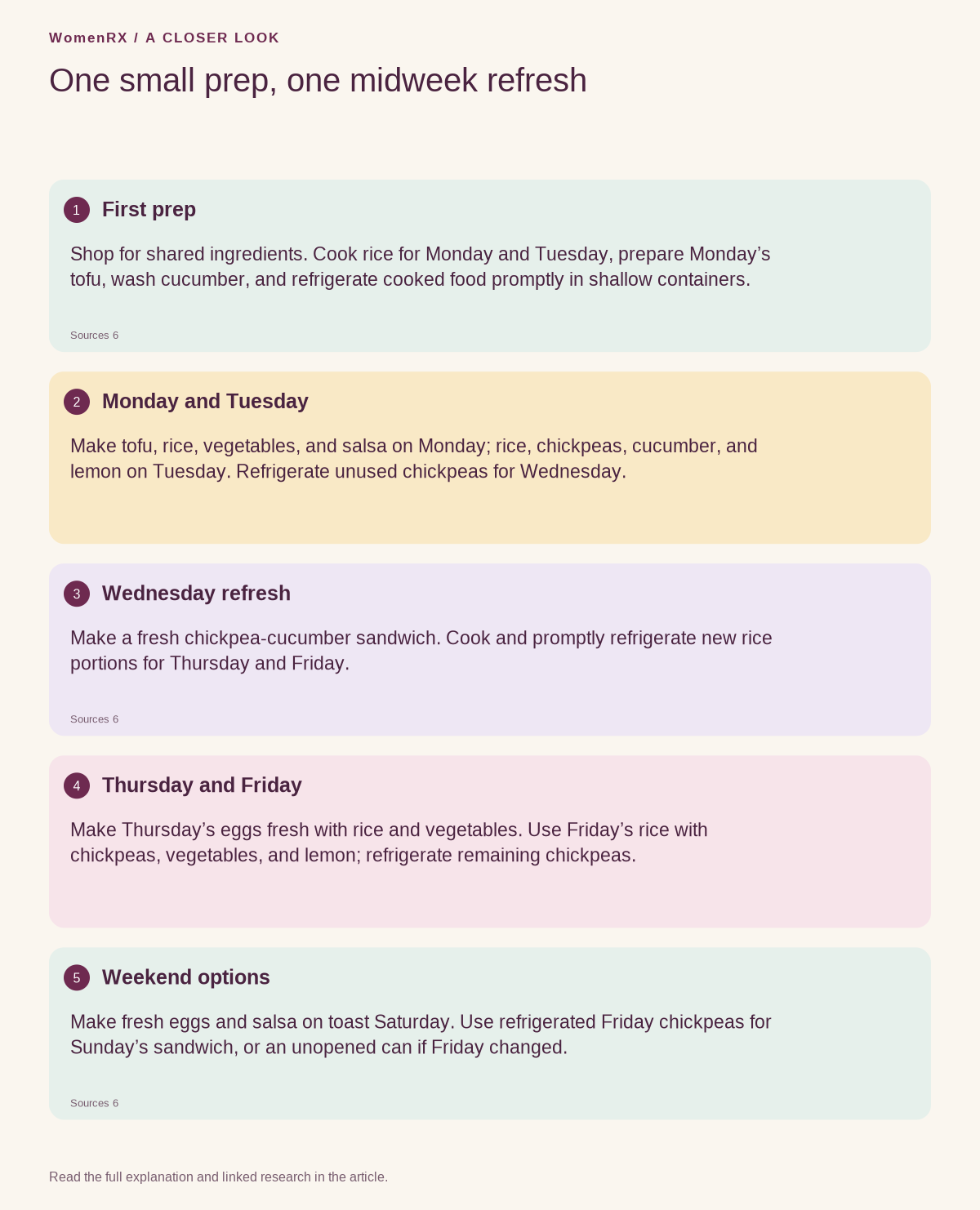
One small prep, one midweek refresh
First prep: Shop for shared ingredients. Cook rice for Monday and Tuesday, prepare Monday’s tofu, wash cucumber, and refrigerate cooked food promptly in shallow containers.6
Monday and Tuesday: Make tofu, rice, vegetables, and salsa on Monday; rice, chickpeas, cucumber, and lemon on Tuesday. Refrigerate unused chickpeas for Wednesday.
Wednesday refresh: Make a fresh chickpea-cucumber sandwich. Cook and promptly refrigerate new rice portions for Thursday and Friday.6
Thursday and Friday: Make Thursday’s eggs fresh with rice and vegetables. Use Friday’s rice with chickpeas, vegetables, and lemon; refrigerate remaining chickpeas.
Weekend options: Make fresh eggs and salsa on toast Saturday. Use refrigerated Friday chickpeas for Sunday’s sandwich, or an unopened can if Friday changed.6
Read the figure as text
This example maps one chosen meal per day to two short prep points and flexible weekend meals.- First prep: Shop for shared ingredients. Cook rice for Monday and Tuesday, prepare Monday’s tofu, wash cucumber, and refrigerate cooked food promptly in shallow containers.6
- Monday and Tuesday: Make tofu, rice, vegetables, and salsa on Monday; rice, chickpeas, cucumber, and lemon on Tuesday. Refrigerate unused chickpeas for Wednesday.
- Wednesday refresh: Make a fresh chickpea-cucumber sandwich. Cook and promptly refrigerate new rice portions for Thursday and Friday.6
- Thursday and Friday: Make Thursday’s eggs fresh with rice and vegetables. Use Friday’s rice with chickpeas, vegetables, and lemon; refrigerate remaining chickpeas.
- Weekend options: Make fresh eggs and salsa on toast Saturday. Use refrigerated Friday chickpeas for Sunday’s sandwich, or an unopened can if Friday changed.6
Sources you can check
- Dietary Supplements for Weight Loss - Health Professional Fact SheetAccessed 2026-09-25Return to first citation
- Body Weight: MedlinePlusAccessed 2026-09-25Return to first citation
- Why people are bad at leftover food management? A systematic literature review and a framework to analyze household leftover food waste generation behavior.Aloysius N, Ananda J, Mitsis A, Pearson D. · Appetite · 2023Return to first citation
- Pairing Evidence-Based Strategies With Motivational Interviewing to Support Optimal Nutrition and Weight Gain in Pregnancy.Jevitt CM, Ketchum K. · The Journal of perinatal & neonatal nursing · 2024Return to first citation
- Dairy and Eggs (Food Safety for Moms-to-Be) | FDAAccessed 2026-09-25Return to first citation
- Leftovers and Food Safety | Food Safety and Inspection ServiceAccessed 2026-09-25Return to first citation
- Keeping "Bag" Lunches Safe | Food Safety and Inspection ServiceAccessed 2026-09-25Return to first citation