Make Your Fertility Testing Visit More Useful
A short record of your history and a few clear questions can help connect each proposed test to a decision that matters to you.
Bring a simple timeline of your cycles, how long you’ve been trying, prior pregnancies, relevant symptoms or pelvic history, medications, and any previous results. Ask what each suggested test is meant to find out, whether its timing matters, and how the result could change the next step. When relevant, ask whose history or testing fits your conception plan. Fertility concerns can involve one or more people. 12
Start with what you want from the visit
You don’t need to arrive with a diagnosis or know which tests to request. A useful first goal is to leave understanding what the clinician is considering, why it fits your history, and what would happen after the results. Testing can vary; it may include blood tests or imaging, and evaluation can involve a semen test when relevant. Fertility concerns may relate to one person, another person, or a combination of factors. 1
If this is a follow-up visit, bring earlier results or a list of tests already completed. Ask whether anything needs repeating and what new question a repeat test would answer.
Make a one-page history
Jot down what you know. Estimates are fine, and it’s okay to say you’re unsure.
- Your cycles: When your most recent period began; whether your cycles are usually predictable; and any notable changes, skipped periods, or bleeding patterns.
- Time trying: When you began trying to conceive, and what that means in your situation. If you’re using donor sperm or another conception route, describe the steps so far and what you hope to do next.
- Pregnancy history: Any prior pregnancies, including how they ended, and any fertility evaluation or treatment you’ve had before.
- Symptoms and pelvic history: For example, significant pelvic pain, a history of pelvic inflammatory disease, endometriosis, or pelvic or ovarian procedures. You can mention these details as part of your history; this list doesn’t mean they point to a particular test or diagnosis.
- Medications and health history: Bring a medication list, including supplements, and note major health conditions or past treatments you think may matter.
- Other relevant factors: If another person’s sperm is part of the plan, ask what history or testing from that person would be useful. Fertility evaluation can include factors on both sides. 12
A brief timeline is often easier to use than trying to remember everything during the appointment. You can also bring questions in writing and take notes, or ask if you may bring a support person.
Ask what each test is for
A proposed test is most useful when you know the question behind it. A blood test, imaging test, or semen test can each contribute different information; the fact that a test is commonly used doesn’t mean it answers every fertility question. 1
Try asking:
- What are you looking for with this test? Ask what possible finding it can detect or help evaluate.
- Why does it make sense for me now? Connect the test to your cycle pattern, symptoms, history, time trying, or conception plan.
- Does timing affect the result? If it needs to happen at a particular point in your cycle or alongside another step, ask how you’ll know when to schedule it.
- What might the result change? Would it lead to another test, a treatment discussion, or a different plan? What would a normal result leave unanswered?
- Are there alternatives or a reason to wait? Ask about the tradeoffs of testing now versus starting with a different step.
These questions are especially helpful when several tests are being discussed. The goal isn’t to accept or refuse a test based on its name; it’s to understand how its answer could help guide your next decision.
Agree on the next step before you leave
Ask when and how you’ll receive results, who will explain them, and whether you should schedule a follow-up now. Find out what the plan is if a result is unclear or if different results point in different directions. Evaluation and care depend on the findings and the people involved, rather than one fixed plan for everyone. 13
If you’re deciding whether to seek an evaluation, MedlinePlus suggests seeing a provider sooner if you’re over 40, have irregular periods, a history of pelvic inflammatory disease, or previous fertility concerns. Separately, it defines infertility as not becoming pregnant after a year of frequent, unprotected sex, or after six months for someone age 35 or older. Those definitions aren’t a requirement to wait before raising a concern or asking about evaluation. 1
You can close the visit by repeating the plan in your own words: which tests are next, what each one is meant to answer, and when you’ll talk about the results. That gives you a clear point to return to, even if the answers take more than one step.
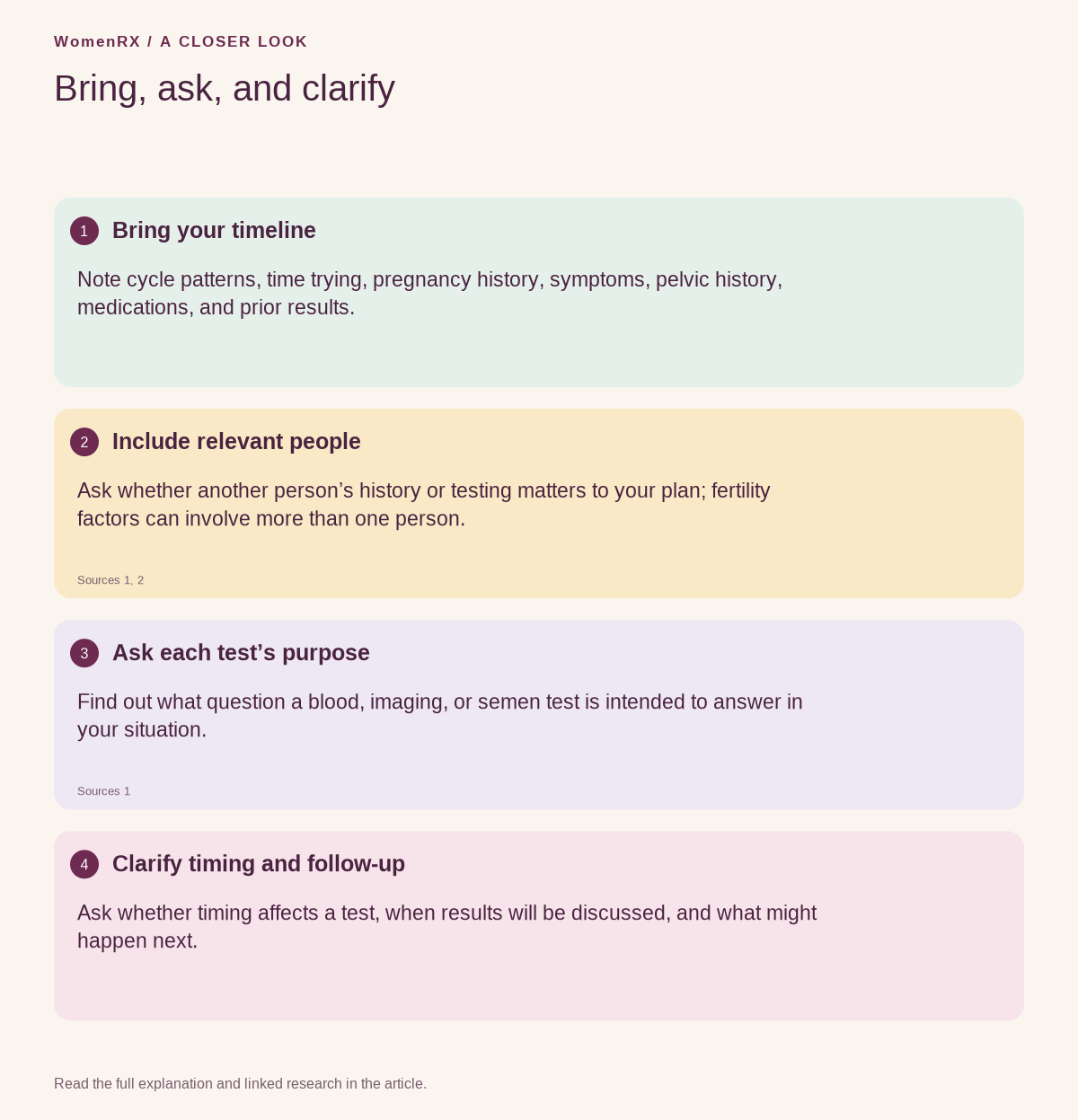
Bring, ask, and clarify
Bring your timeline: Note cycle patterns, time trying, pregnancy history, symptoms, pelvic history, medications, and prior results.
Include relevant people: Ask whether another person’s history or testing matters to your plan; fertility factors can involve more than one person.12
Ask each test’s purpose: Find out what question a blood, imaging, or semen test is intended to answer in your situation.1
Clarify timing and follow-up: Ask whether timing affects a test, when results will be discussed, and what might happen next.
Read the figure as text
Use these prompts to organize your history and understand what each proposed test is meant to contribute.- Bring your timeline: Note cycle patterns, time trying, pregnancy history, symptoms, pelvic history, medications, and prior results.
- Include relevant people: Ask whether another person’s history or testing matters to your plan; fertility factors can involve more than one person.12
- Ask each test’s purpose: Find out what question a blood, imaging, or semen test is intended to answer in your situation.1
- Clarify timing and follow-up: Ask whether timing affects a test, when results will be discussed, and what might happen next.
More questions, answered
Should I ask for the same fertility tests everyone else gets?
There isn’t one test list that fits every history or conception plan. Ask the clinician to connect each proposed test to a question it can answer for you, and to explain what its result could change. Evaluation may include different kinds of testing and may involve more than one person. 1
What if I’m not trying to conceive through sex with a partner?
Explain your conception plan in the terms that fit you, such as using donor sperm, and ask which parts of your history or testing are relevant. This is a practical question to tailor the conversation to your plan, not a claim that one testing approach applies to every conception route.
Sources you can check
- Infertility | Infertility Treatments | MedlinePlusAccessed 2026-09-25Return to first citation
- Infertility - NHSAccessed 2026-09-25Return to first citation
- Treatment for infertility - NHSAccessed 2026-09-25Return to first citation