Hormones and Hair Loss: Which Clues Make Testing Useful?
The pattern of hair loss and the symptoms alongside it can tell you more about useful tests than a broad hormone panel.
Hormone or thyroid testing is most useful when something besides hair loss points to a possible imbalance: a change in periods, facial hair growth, or symptoms such as unusual fatigue and weight change. A clinician can also learn a great deal from how your hair and scalp look. Female pattern hair loss occurs with or without hyperandrogenism, so the scalp examination remains central. 2356
Start with what your hair is doing
More hair in the shower, a part that looks wider, and a distinct patch of missing hair may feel like versions of the same problem. They don’t necessarily point to the same cause. When evaluating hair loss, a dermatologist asks how quickly it started and examines the scalp, nails, and any other areas with hair loss. Blood tests or a scalp biopsy may follow if that examination raises suspicion of a disease, deficiency, hormone imbalance, or infection. 5
That’s why the first useful question isn’t usually “Which hormone panel should I order?” It’s “What kind of hair loss does this look like, and what else is happening?” For example, a hairstyle that repeatedly pulls on the hair can cause loss without a hormone disorder. Some kinds of hair loss need treatment to prevent further loss, while others can regrow without it. 5
DHT and androgens: look beyond a single number
Androgens matter to some hair-loss questions, but female pattern hair loss is not proof of hyperandrogenism. A systematic review of treatment trials included women with female pattern hair loss both with and without hyperandrogenism, and found that topical minoxidil was effective in both groups. That review did not evaluate whether a DHT blood test helps identify the cause of hair loss; the scalp examination remains part of finding the cause. 35
Other changes can make a conversation about hormones more relevant. If your periods have become irregular and you’ve also noticed more facial hair, weight gain, or changes in your skin, mention the combination rather than focusing on the hair alone. Irregular periods can have several causes, including thyroid problems and an ovarian condition often called PCOS; facial hair growth is one of the accompanying symptoms clinical guidance asks women to report. Those signs don’t establish a diagnosis, but they give a clinician a more specific question to investigate than hair loss alone does. 2
Thyroid tests answer a different question
Thyroid hormones, including thyroxine (T4), help regulate how the body uses energy. An underactive thyroid can cause dry hair or hair loss alongside symptoms such as tiredness and weight gain. An overactive thyroid can also cause thinning or patchy loss, with possible clues including heat sensitivity, sweating, a fast or irregular heartbeat, and weight loss. Hair loss on its own doesn’t distinguish the two. 167
If your symptoms suggest a thyroid problem, thyroid-stimulating hormone (TSH) is usually the first blood test ordered; T4 and other tests may help clarify the result. A clinician assessing possible hypothyroidism may also ask about a family history of thyroid disease and whether you’ve recently been pregnant. Thyroid testing checks thyroid function. It does not identify every other reason you might be losing hair. 16
Where pregnancy timing and menopause fit
If hair loss began around pregnancy or after birth, say when you first noticed it and whether you have other symptoms. Recent pregnancy is relevant to an assessment for an underactive thyroid, but timing alone doesn’t show that a thyroid condition caused the hair loss. 6
Menopause is another piece of context, not a diagnosis. Estrogen declines across the menopausal transition, and a systematic review found associations between postmenopause and several forms of alopecia, including female pattern hair loss. The review also found that evidence about menopausal hormone therapy and hair conditions is limited and inconsistent. Noticing thinning near menopause doesn’t, on its own, establish that low estradiol is the cause or show that estrogen treatment would restore your hair. 4
What testing can and can’t settle
A focused evaluation connects three things: the pattern on your scalp, the timing of the change, and symptoms elsewhere in your body. A blood test can investigate a suspected thyroid problem or hormone imbalance; it cannot replace the scalp examination that helps identify what type of hair loss you have. And because female pattern hair loss can occur without hyperandrogenism, even a set of hormone results may leave the hair-loss question unanswered. 35
For example, if your part has gradually widened and you feel well otherwise, ask what the scalp examination suggests. If that change comes with newly irregular periods and facial hair growth, bring up all three. If you’re shedding hair and also feel unusually tired or notice weight gain, those symptoms make thyroid function a more specific question. The useful test is the one aimed at the cause your overall picture makes plausible. 256
Three hormone-related clues, three different questions
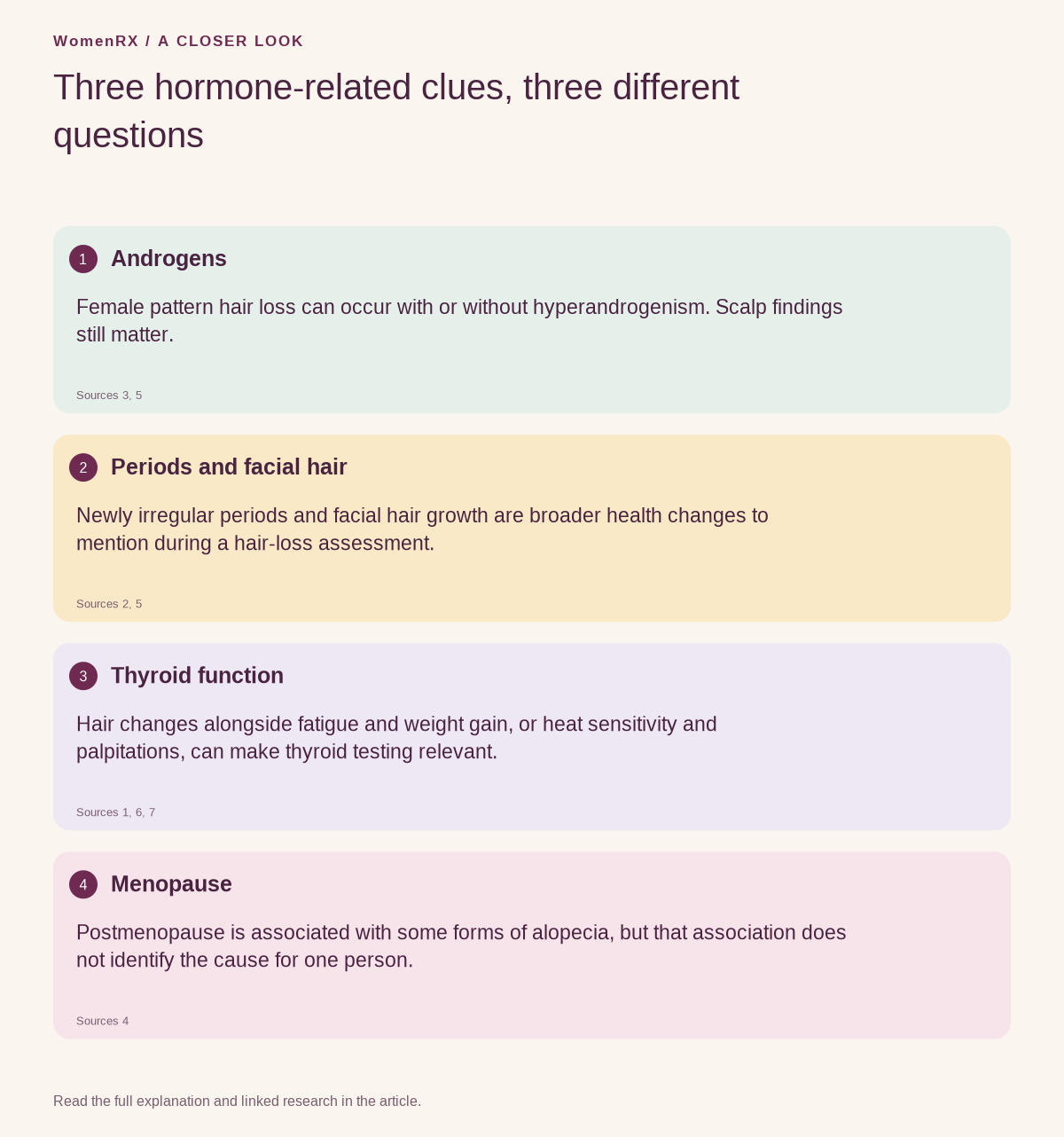
Androgens: Female pattern hair loss can occur with or without hyperandrogenism. Scalp findings still matter.35
Periods and facial hair: Newly irregular periods and facial hair growth are broader health changes to mention during a hair-loss assessment.25
Thyroid function: Hair changes alongside fatigue and weight gain, or heat sensitivity and palpitations, can make thyroid testing relevant.167
Menopause: Postmenopause is associated with some forms of alopecia, but that association does not identify the cause for one person.4
Read the figure as text
These pathways point to different possibilities; none diagnoses the cause from hair loss alone.- Androgens: Female pattern hair loss can occur with or without hyperandrogenism. Scalp findings still matter.35
- Periods and facial hair: Newly irregular periods and facial hair growth are broader health changes to mention during a hair-loss assessment.25
- Thyroid function: Hair changes alongside fatigue and weight gain, or heat sensitivity and palpitations, can make thyroid testing relevant.167
- Menopause: Postmenopause is associated with some forms of alopecia, but that association does not identify the cause for one person.4
More questions, answered
Does female pattern hair loss always mean androgen excess?
No. Female pattern hair loss has been studied in women both with and without hyperandrogenism. The appearance of the hair and scalp remains part of identifying the cause. 35
Can both an underactive and an overactive thyroid affect hair?
Yes. Hair loss or thinning is listed among the possible signs of both conditions. Symptoms elsewhere in the body and thyroid blood tests help distinguish them. 167
Sources you can check
- Thyroid Tests: MedlinePlusAccessed 2026-09-25Return to first citation
- Irregular periods - NHSAccessed 2026-09-25Return to first citation
- Treatment of female pattern hair loss.Hassani M, Gorouhi F, Babakoohi S, Moghadam-Kia S, Firooz A. · Skinmed · 2012Return to first citation
- Menopause and Common Dermatoses: A Systematic Review.Roster K, Fleshner L, Karatas TB, Ecanow A, Sayegh A, Farabi B, Marmon S. · American journal of clinical dermatology · 2026Return to first citation
- Hair loss: Diagnosis and treatmentAccessed 2026-09-25Return to first citation
- Underactive thyroid (hypothyroidism) - NHSAccessed 2026-09-25Return to first citation
- Overactive thyroid (hyperthyroidism) - Symptoms - NHSAccessed 2026-09-25Return to first citation