Make Breakfast Protein Easier, One Familiar Food at a Time
You don’t need a special recipe or a fixed protein target: adding one protein food to a breakfast you already like is a practical place to start.
Try pairing a familiar breakfast food with dairy, nuts, beans, or another protein-rich food you enjoy. For example, add nuts to yogurt or beans to a tortilla. Protein at breakfast may help you feel less hungry for a while, but short-term studies haven’t shown that it reliably reduces what people eat later. Choose an option that fits your time, appetite, and eating pattern. 1 3 4
Start with one addition
If breakfast is usually toast, cereal, or fruit, you don’t have to replace it with a complicated meal. Add one protein food: try yogurt with nuts, milk alongside cereal, or beans in a tortilla. These are examples using foods that provide protein; the best fit is the one you’ll actually want to eat. Protein needs vary with factors such as age, health, and activity, so there isn’t one breakfast target that applies to everyone. 1
For a plant-based breakfast, beans or nuts can make a familiar meal more substantial. Grains also contain protein, and eating a variety of plant foods across the day helps provide the amino acids your body needs. You don’t have to combine specific plant foods at every meal. 1
What breakfast protein can do for fullness
Protein may affect how full you feel, but that doesn’t mean a higher-protein breakfast guarantees you’ll eat less later or lose weight. In a small crossover study of 18 adults, a plant-based drink with 30 grams of protein led to greater subjective appetite suppression than a lower-protein, high-carbohydrate breakfast. The animal-based breakfast, also with 30 grams of protein, was not reported to produce that same significant difference in subjective appetite. Both higher-protein breakfasts increased the satiety-related hormones GLP-1 and PYY compared with the lower-protein meal. Participants’ food intake at a later meal did not differ significantly between the three breakfasts. 3
Another study tested adding whey or pea protein to a lower-protein breakfast in middle-to-older-aged adults. Appetite ratings changed temporarily after breakfast, but the study found no difference between the two protein sources in appetite response. It did not establish that adding either one leads to lasting fullness or changes in eating over time. 2
Whole foods may also bring other qualities that matter. In a crossover trial with older adults, bean-based breakfast meals and a beef-based meal increased reported fullness and satisfaction, with no significant differences between meals in appetite ratings or food intake later that day. The bean meals contained less protein and more fiber than the beef meal. This is a useful comparison, not proof that the foods will affect everyone’s appetite in the same way. 4
Match the option to your morning
- Rushing out: Pour milk over the cereal you already eat. It takes little assembly and adds a dairy protein source without changing your usual breakfast. 1
- Want a warm, plant-based meal: Warm canned beans and fold them into a tortilla. Beans are a protein source; a study tested bean-based tortilla breakfast meals, though not this exact preparation. 1 4
- Not very hungry: Start with a small bowl of yogurt and fruit rather than forcing a large meal. The yogurt supplies protein; the studies here don’t test this smaller breakfast as a way to manage low appetite. 1 2
- Want something plant-based with no cooking: Pair fruit with nuts. The nuts provide protein, and you can choose an amount that suits your appetite. 1
Keep expectations realistic
These studies look at short-term appetite or food intake, not long-term weight loss. They also don’t establish that women respond differently from men, or that effects vary by menstrual cycle, perimenopause, menopause, pregnancy, or postpartum stage. The reported findings aren’t a reason to chase a high-protein breakfast if it doesn’t suit you. Start with a preferred food and a manageable preparation, then adjust based on what feels satisfying and workable.
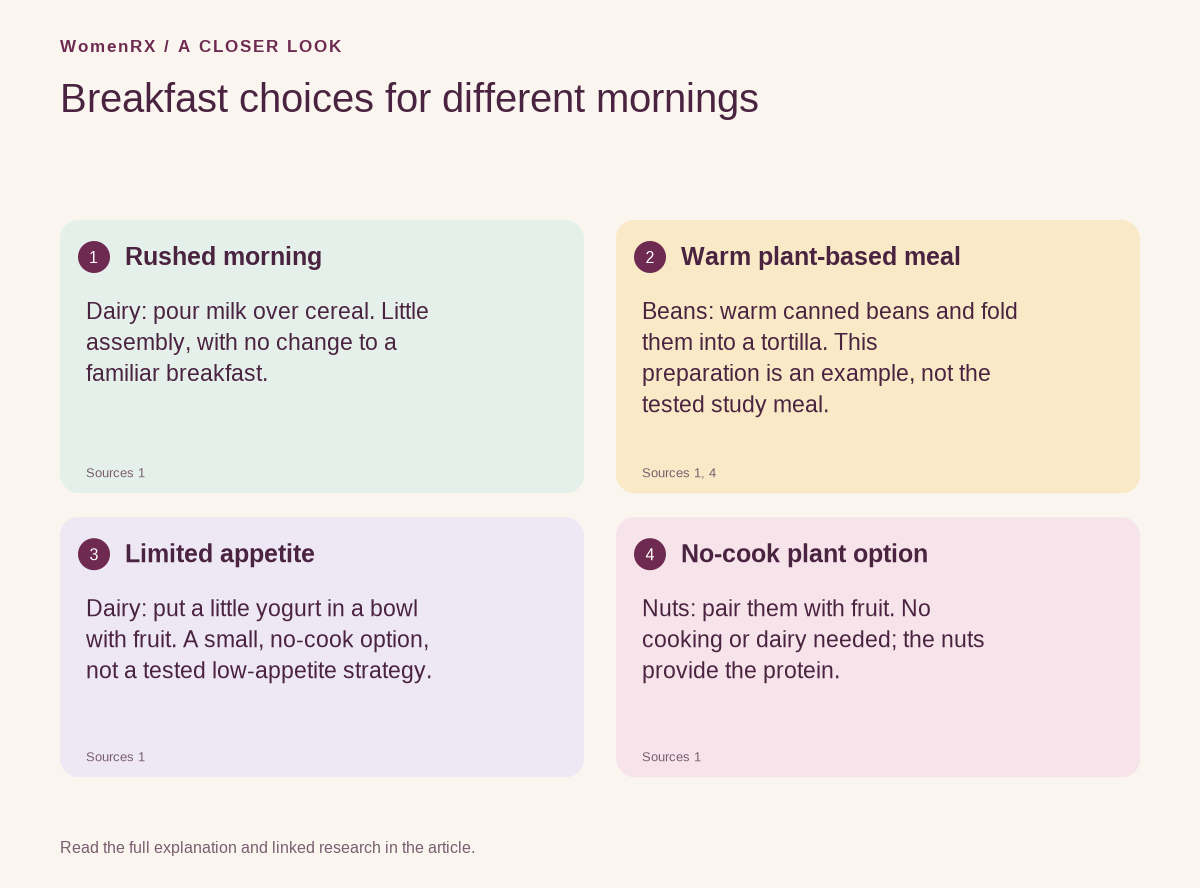
Breakfast choices for different mornings
Rushed morning: Dairy: pour milk over cereal. Little assembly, with no change to a familiar breakfast.1
Warm plant-based meal: Beans: warm canned beans and fold them into a tortilla. This preparation is an example, not the tested study meal.14
Limited appetite: Dairy: put a little yogurt in a bowl with fruit. A small, no-cook option, not a tested low-appetite strategy.1
No-cook plant option: Nuts: pair them with fruit. No cooking or dairy needed; the nuts provide the protein.1
Read the figure as text
Compare the protein source, eating pattern, and steps for each example. These are practical combinations, not ranked or trial-tested recipes.- Rushed morning: Dairy: pour milk over cereal. Little assembly, with no change to a familiar breakfast.1
- Warm plant-based meal: Beans: warm canned beans and fold them into a tortilla. This preparation is an example, not the tested study meal.14
- Limited appetite: Dairy: put a little yogurt in a bowl with fruit. A small, no-cook option, not a tested low-appetite strategy.1
- No-cook plant option: Nuts: pair them with fruit. No cooking or dairy needed; the nuts provide the protein.1
More questions, answered
Is plant protein as filling as animal protein at breakfast?
There isn’t one answer for every food or person. In a small study of young and older adults, a plant-based high-protein drink and an energy- and protein-matched animal-based breakfast meal produced no difference in appetite response. In a separate trial among older adults, bean and beef breakfast meals also did not differ significantly in appetite ratings or later food intake. Because the first study compared a drink with a meal, and both studies measured short-term responses, they don’t establish that all plant and animal protein foods have identical effects. 3 4
Sources you can check
- Dietary Proteins: MedlinePlusAccessed 2026-09-25Return to first citation
- Postprandial plasma amino acid and appetite responses to a low protein breakfast supplemented with whey or pea protein in middle-to-older aged adults.Korzepa M, Marshall RN, Rogers LM, Belfield AE, Quinlan JI, Huang Y, Gritsas A, Churchward-Venne TA, Glover EI, van Loon LJC, Wallis GA, Breen L. · European journal of nutrition · 2025Return to first citation
- The effect of consuming different dietary protein sources at breakfast upon self rated satiety, peptide YY, glucagon like peptide-1, and subsequent food intake in young and older adults.Watson AW, Brooks A, Moore L, Barley S, Holliday A. · European journal of nutrition · 2025Return to first citation
- Beans Improve Satiety to an Effect that Is Not Significantly Different from Beef in Older Adults: A Randomized, Crossover Trial.Fluit MJ, Adams BF, Ribau ZJ, Duncan AM. · The Journal of nutrition · 2025Return to first citation