Leafy Greens and Menopause Symptoms: What We Know
Greens can fit into a balanced diet, but the findings on vegetables and menopause timing don’t show that they ease hot flashes.
Leafy greens can be part of everyday meals, but they haven’t been established as a treatment for menopause symptoms. Menopause guidance does not recommend dietary changes as a treatment for hot flashes and night sweats. A separate review found an association between green and yellow vegetables and the timing of natural menopause, which is a different question from whether vegetables relieve symptoms. 2 4
Three different questions about vegetables
“Menopause and diet” can refer to when menopause begins, general health during the transition, or symptoms such as hot flashes and night sweats. Evidence about one of these questions doesn’t answer the others.
For hot flashes and night sweats, the North American Menopause Society’s 2023 position statement does not recommend dietary modification as a treatment. It rates the evidence for that approach as Level III. That guidance concerns dietary changes broadly; it does not say that researchers tested every leafy green and proved it ineffective. 2
A systematic review of prospective studies looked at diet and the age when natural menopause began. It reported an association between higher green and yellow vegetable intake and earlier natural menopause. This was an observational finding about timing, not a trial of leafy greens for hot flashes, sleep, mood, or other symptoms. It also cannot show that vegetables caused the difference. 4
General nutrition is not symptom treatment
A 2024 review included studies of women in the menopausal transition and after menopause, but focused on nutrient deficiencies and broader health conditions. It discussed balanced diets that include fruits and vegetables; it did not establish leafy greens as a way to relieve menopause symptoms. The review also found enough variation among studies that it could not combine their results in a meta-analysis. 3
So it’s reasonable to include vegetables in meals if you enjoy them, while keeping expectations clear: general nutrition and symptom relief are separate claims. There’s no need to make greens carry the job of treating hot flashes.
A simple way to add them to meals
Choose a form and meal that suit your routine. For example, stir spinach into eggs or beans, add chopped greens to soup, or serve a salad with dinner. These are meal ideas, not a menopause treatment, and the evidence discussed above doesn’t identify a particular green or preparation as best for symptoms.
If hot flashes or night sweats are disrupting your life, food changes alone may not be the answer. The 2023 position statement supports cognitive behavioral therapy and clinical hypnosis among nonhormonal options for vasomotor symptoms; it also lists several prescription treatments. Hormone therapy remains the most effective treatment for these symptoms, with its risks and benefits depending on individual circumstances. 1 2
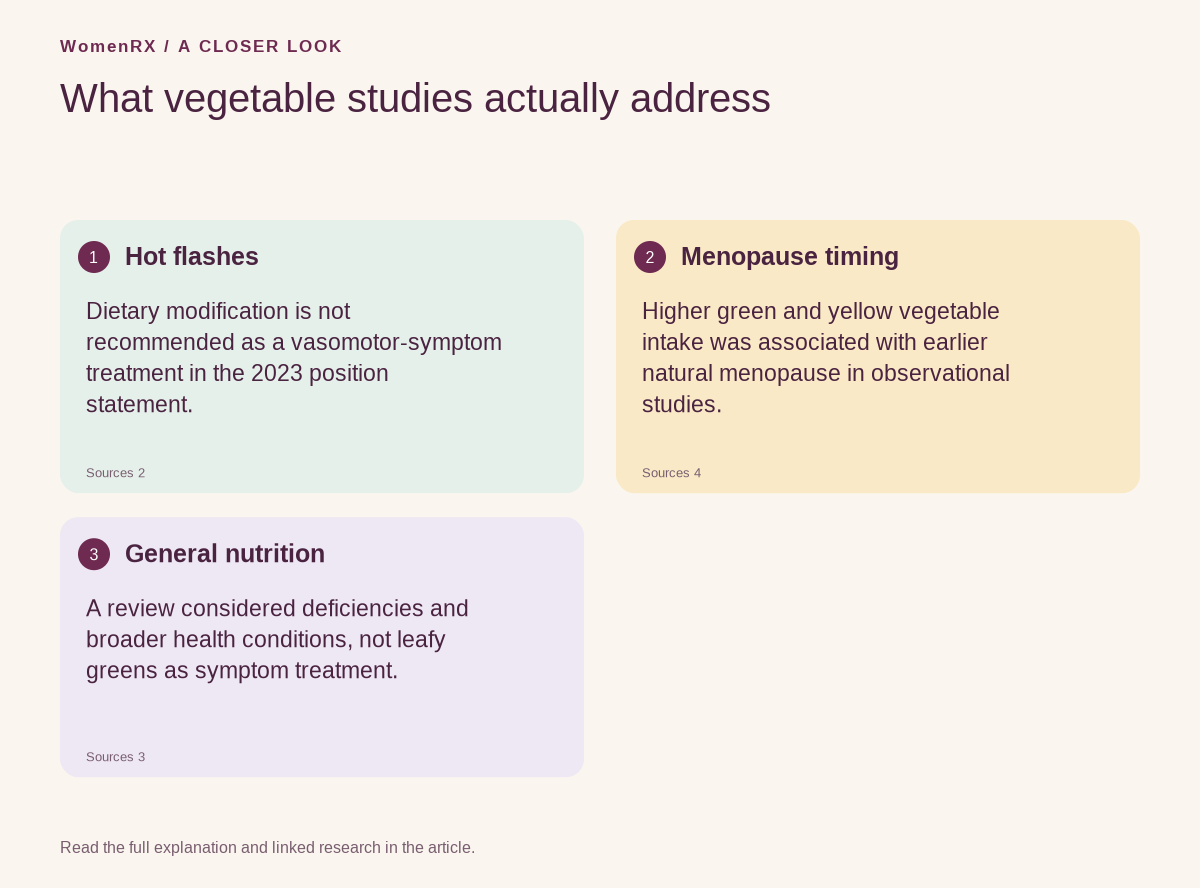
What vegetable studies actually address
Hot flashes: Dietary modification is not recommended as a vasomotor-symptom treatment in the 2023 position statement.2
Menopause timing: Higher green and yellow vegetable intake was associated with earlier natural menopause in observational studies.4
General nutrition: A review considered deficiencies and broader health conditions, not leafy greens as symptom treatment.3
Read the figure as text
These findings concern different outcomes: hot-flash treatment, menopause timing, and general nutrition.- Hot flashes: Dietary modification is not recommended as a vasomotor-symptom treatment in the 2023 position statement.2
- Menopause timing: Higher green and yellow vegetable intake was associated with earlier natural menopause in observational studies.4
- General nutrition: A review considered deficiencies and broader health conditions, not leafy greens as symptom treatment.3
More questions, answered
Does the vegetable research apply to perimenopause symptoms?
The finding about green and yellow vegetables concerns the age at natural menopause, not symptom relief during perimenopause. The nutrition review included women in the menopausal transition, but examined nutrient deficiencies and broader health conditions rather than leafy greens as a symptom treatment. 3 4
Sources you can check
- The 2022 hormone therapy position statement of The North American Menopause Society.“The 2022 Hormone Therapy Position Statement of The North American Menopause Society” Advisory Panel. · Menopause (New York, N.Y.) · 2022Return to first citation
- The 2023 nonhormone therapy position statement of The North American Menopause Society.Menopause (New York, N.Y.) · 2023Return to first citation
- A systematic review on the impact of nutrition and possible supplementation on the deficiency of vitamin complexes, iron, omega-3-fatty acids, and lycopene in relation to increased morbidity in women after menopause.Wylenzek F, Bühling KJ, Laakmann E. · Archives of gynecology and obstetrics · 2024Return to first citation
- Dietary factors and onset of natural menopause: A systematic review and meta-analysis.Grisotto G, Farago JS, Taneri PE, Wehrli F, Roa-Díaz ZM, Minder B, Glisic M, Gonzalez-Jaramillo V, Voortman T, Marques-Vidal P, Franco OH, Muka T. · Maturitas · 2022Return to first citation