Kettlebells for Beginners: Start With a Lift You Can Control
Learn the hip hinge, choose a manageable weight and build toward swings when the basics feel familiar.
A kettlebell deadlift is a useful place to start: lift the bell from the floor by bending and extending at your hips, with instruction on your setup and back position. Choose a load you can control. ACE’s beginner coaching emphasizes technique before heavier weights, and learning the hip hinge before progressing. There is no single starting weight that fits every woman. 1516
Give your first session one job
A kettlebell can make the first decision feel surprisingly complicated. Which weight, which exercise, how many repetitions? Make the session about learning a controlled lift. You can add variety after you know what that movement feels like.
ACE’s coaching guidance uses the hip hinge as a foundation: move your hips backward with your knees slightly bent, rather than rounding your back to reach the floor. One teaching drill is to face away from a wall and gently reach your hips back toward it. A trainer can use this to show the difference between hinging and squatting. 16
If those words are hard to translate into movement, ask for a demonstration and feedback. “Can you watch my setup?” is a useful request, even if you have exercised for years with other equipment.
A first movement: the two-handed deadlift
ACE describes starting with feet around shoulder width and toes turned slightly outward. Bend at the hips with a small knee bend to take the handle in both hands, keeping the chest lifted and back straight. Stand by extending the hips, with the trunk braced. 15
Treat this as a movement to learn with coaching, rather than a challenge to lift the heaviest bell available. If reaching the floor does not fit your current mobility, ACE describes raising the weight on suitable blocks as one teaching option. Have the instructor set that up securely. 16
Leave swings for a session in which the basic movement is already under control. A swing adds speed and a moving arc, so being able to pick up a kettlebell is not the same as knowing how to swing it. 15
Choose weight by control, not a women’s weight chart
Ask for a weight you can move smoothly while maintaining the setup you have just learned. ACE’s deadlift guidance uses the ability to control 8 to 12 repetitions before attempting heavier loads as a progression check. That is coaching guidance, not a requirement to finish twelve difficult repetitions at any cost. 16
Record the exercise and weight you actually used. A note such as “deadlift, this bell, setup felt clear” is more useful next time than remembering that someone else in the room used a heavier one. You are building a repeatable skill, not collecting a score from the class.
What benefits are reasonable to expect?
Strengthening exercise is one part of a balanced activity routine. General adult guidance includes working the major muscle groups at least twice a week, along with aerobic activity. A kettlebell is one tool for doing that work; it does not have a special women-only fat-loss mechanism. 12
Resistance exercise can also support bone health, which is relevant as bone loss becomes a concern with age. NIAMS recommends discussing exercise choices if you have osteoporosis, low bone density or physical limitations. That guidance does not mean one beginner kettlebell session has been shown to prevent fractures. 11
Let symptoms change the plan
If you already have pelvic organ prolapse, NHS guidance includes avoiding activities that strain the pelvic floor, such as heavy lifting. Urine leakage or pelvic heaviness is worth discussing with a clinician or pelvic-health professional rather than using a generic online kettlebell modification as treatment. 24
For a first session, tell the instructor what you are working around. They can help with the exercise setup, while a clinician can assess symptoms. You do not need to solve both questions by choosing an arbitrarily lighter bell and pushing through.
End with a clear next step: repeat the movement, adjust the setup, or ask for more teaching. That gives you a foundation for the next session, whether it eventually includes swings or simply stronger, more confident lifting.
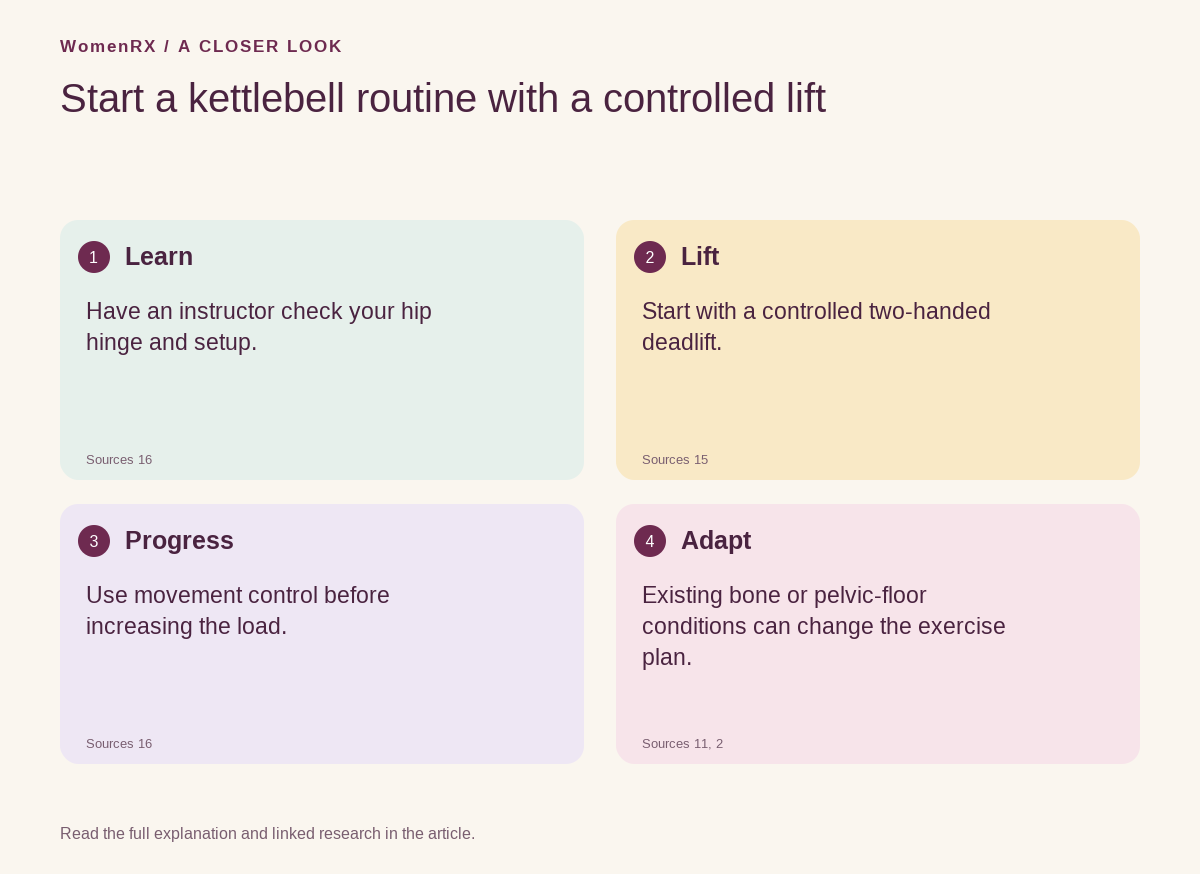
Start a kettlebell routine with a controlled lift
Learn: Have an instructor check your hip hinge and setup.16
Lift: Start with a controlled two-handed deadlift.15
Progress: Use movement control before increasing the load.16
Adapt: Existing bone or pelvic-floor conditions can change the exercise plan.112
Read the figure as text
Learn the hip hinge, choose a manageable weight and build toward swings when the basics feel familiar.Sources you can check
- Pelvic organ prolapse - NHSAccessed 2026-09-25Return to first citation
- Urinary incontinence - NHSAccessed 2026-09-25Return to first citation
- Exercise for Your Bone Health | NIAMSAccessed 2026-09-25Return to first citation
- How Much Exercise Do I Need?: MedlinePlusAccessed 2026-09-25Return to first citation
- ACE: How to Get Started With KettlebellsAccessed 2026-09-26Return to first citation
- ACE: The Deadlift, December 2024Accessed 2026-09-26Return to first citation