IUI or IVF: What Actually Changes?
IUI places prepared sperm in the uterus; IVF brings eggs and sperm together outside the body before an embryo is transferred.
With IUI, prepared sperm is placed in the uterus, and fertilization must happen inside the body. With IVF, eggs are retrieved and fertilized with sperm in a lab, then an embryo is transferred to the uterus. IVF adds ovarian stimulation, egg retrieval and embryo handling. For most couples with unexplained infertility, one guideline recommends trying stimulated IUI before IVF if those attempts are unsuccessful. 231
The difference is where fertilization happens
The names make these treatments sound more alike than they are. Intrauterine insemination (IUI) places prepared sperm into the uterus through a thin tube passed through the cervix. It doesn't collect eggs or create an embryo in a lab. Sperm and egg still need to meet inside the body. 2
In vitro fertilization (IVF) moves that meeting to the lab. Fertility medicine is used to encourage the ovaries to produce eggs, eggs are removed from the ovaries, and sperm is used to fertilize them. An embryo can then be transferred to the uterus. That extra set of steps is the practical difference to picture when you're weighing the two treatments. 23
What each pathway asks of you
For IUI, sperm is collected and washed before it is placed in the uterus. IUI may be paired with medication that stimulates the ovaries, but stimulation isn't part of the definition of IUI. For example, guidance for unexplained infertility discusses both natural-cycle IUI and IUI with ovarian-stimulation medicines. If someone suggests IUI, ask which version they mean: the medication plan changes what the treatment involves. 21
IVF includes ovarian stimulation and an egg-retrieval procedure before any embryo transfer. Unlike IUI's sperm-placement procedure, retrieval removes eggs from your ovaries; transfer is a separate step if an embryo is placed in the uterus. IVF also creates a decision point that IUI doesn't: embryos are made outside the body, so you and the treatment team need to discuss the transfer plan. Limiting the number of embryos transferred can reduce the risk of a multiple pregnancy. These steps don't mean IVF is automatically the right choice. They do mean that an IVF proposal involves procedures and decisions beyond sperm placement. 23
Neither treatment name tells you how many monitoring visits a particular plan will involve. To compare the practical load of two proposals, ask what medication, monitoring and procedures each includes. That matters especially when the proposed IUI involves ovarian stimulation: comparing it with IVF as though one uses medication and the other doesn't would miss a real part of the decision. 12
Where the treatment recommendation gets specific
There is one useful example of how a recommendation can be sequenced. For most couples with unexplained infertility, the American Society for Reproductive Medicine's 2020 guideline recommends starting with a course of ovarian stimulation using oral medication plus IUI, then moving to IVF if those attempts are unsuccessful. It describes a typical course as three or four cycles. That's guidance for unexplained infertility, not a rule that everyone must try IUI before IVF. 1
A tubal finding changes the question. IUI leaves sperm and egg to meet inside the body, while IVF brings retrieved eggs and sperm together outside it. Blocked or scarred fallopian tubes are a fertility problem that may prompt discussion of tubal surgery. If you've been told your tubes are affected, ask how that finding changes the case for IUI, IVF or another option. The procedural difference explains why the finding matters; it doesn't establish that every person with tubal damage needs IVF. 2
An ovarian finding needs a different conversation. Because IVF involves stimulating the ovaries and retrieving eggs, ask what your finding means for those steps and for the proposed alternatives. Age belongs in that conversation too: ask whether it changes the estimates you're being shown or the value of spending time on a course of IUI before considering IVF. The unexplained-infertility guideline's typical sequence is not an age cutoff or a prediction for someone with a particular ovarian result. 21
Treatment history and pregnancy goals deserve their own discussion. If unexplained infertility is the diagnosis, whether a course of stimulated IUI has already been unsuccessful matters to the guideline's proposed next step. If IVF is being considered, the embryo-transfer plan also matters, including the risk of a multiple pregnancy. 13
Donor involvement doesn't make this an either-or choice. Donor sperm may be part of assisted conception, while treatment with donor eggs is usually done through IVF. IVF can also use previously frozen embryos. If you're considering donor sperm or eggs, ask which steps would happen in your proposed plan rather than assuming that every IUI or IVF cycle looks the same. 23
Compare the outcome that matters to you
A single success figure can hide more than it tells you. A pregnancy rate and a live-birth rate are different outcomes; a result per attempt is different from a result after a course of treatment. The guideline's suggested course for most couples with unexplained infertility does not give an individual's chance of success on the next attempt. The guideline assessed several outcomes, including live birth and multiple pregnancy, across different treatment approaches rather than treating all IUI cycles as one identical intervention. 1
If you're comparing two proposed plans, a sharper question than “Which has the higher success rate?” is: “For someone with my findings, what outcome are these estimates measuring, over how many attempts, and what would make us change plans?” That gets at the real tradeoff: what each treatment requires of you, what it addresses, and when its results would prompt a different next step. 12
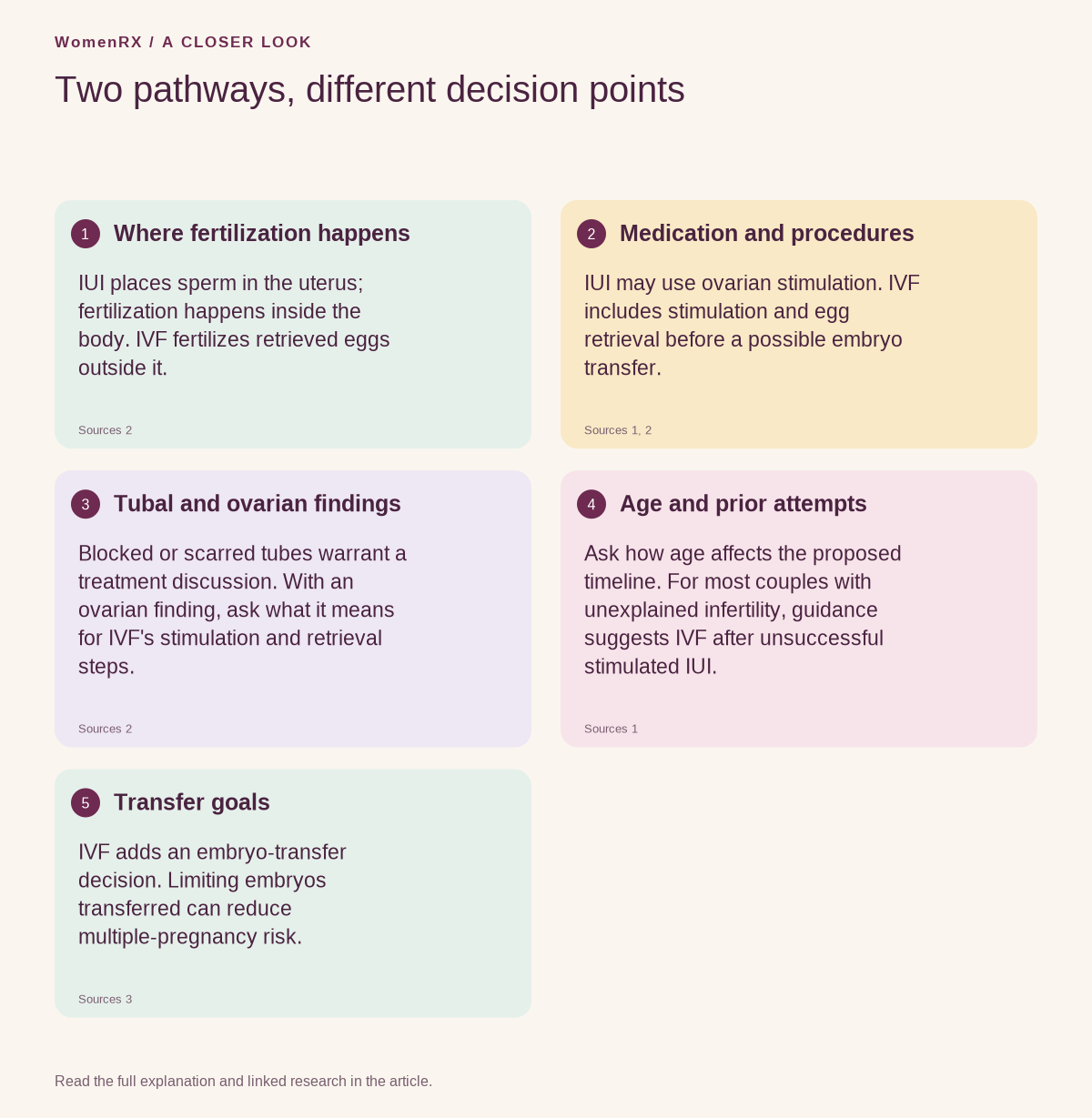
Two pathways, different decision points
Where fertilization happens: IUI places sperm in the uterus; fertilization happens inside the body. IVF fertilizes retrieved eggs outside it.2
Medication and procedures: IUI may use ovarian stimulation. IVF includes stimulation and egg retrieval before a possible embryo transfer.12
Tubal and ovarian findings: Blocked or scarred tubes warrant a treatment discussion. With an ovarian finding, ask what it means for IVF's stimulation and retrieval steps.2
Age and prior attempts: Ask how age affects the proposed timeline. For most couples with unexplained infertility, guidance suggests IVF after unsuccessful stimulated IUI.1
Transfer goals: IVF adds an embryo-transfer decision. Limiting embryos transferred can reduce multiple-pregnancy risk.3
Read the figure as text
Compare the steps each treatment includes and the findings or goals that can change the discussion.- Where fertilization happens: IUI places sperm in the uterus; fertilization happens inside the body. IVF fertilizes retrieved eggs outside it.2
- Medication and procedures: IUI may use ovarian stimulation. IVF includes stimulation and egg retrieval before a possible embryo transfer.12
- Tubal and ovarian findings: Blocked or scarred tubes warrant a treatment discussion. With an ovarian finding, ask what it means for IVF's stimulation and retrieval steps.2
- Age and prior attempts: Ask how age affects the proposed timeline. For most couples with unexplained infertility, guidance suggests IVF after unsuccessful stimulated IUI.1
- Transfer goals: IVF adds an embryo-transfer decision. Limiting embryos transferred can reduce multiple-pregnancy risk.3
More questions, answered
Is embryo transfer part of IUI?
No. IUI places prepared sperm in the uterus. Embryo transfer is an IVF step, after eggs have been fertilized outside the body. 2
Does everyone have to try IUI before IVF?
No. A guideline recommends stimulation with oral medication plus IUI before IVF for most couples with unexplained infertility, but that recommendation isn't a sequence for every diagnosis or family-building plan. 1
Sources you can check
- Evidence-based treatments for couples with unexplained infertility: a guideline.Practice Committee of the American Society for Reproductive Medicine. Electronic address: asrm@asrm.org, Practice Committee of the American Society for Reproductive Medicine. · Fertility and sterility · 2020Return to first citation
- Treatment for infertility - NHSAccessed 2026-09-26Return to first citation
- Assisted Reproductive Technology | IVF | MedlinePlusAccessed 2026-09-25Return to first citation