Egg Freezing: What Happens and What It Can Offer
Egg freezing can preserve a chance to try for a pregnancy later, but the number of eggs stored is not a promise of a baby.
Egg freezing involves ovarian stimulation, monitoring, egg retrieval, and freezing mature eggs. If you use them later, the eggs must be warmed and fertilized as part of IVF. Age when you freeze is linked to later live-birth outcomes, but egg freezing cannot guarantee a baby. Before starting, ask for outcomes and a cost estimate that cover both freezing and possible future use. 256
Start with the decision you’re making
You might be considering egg freezing because you’re not ready to try for a pregnancy, or because a medical treatment could affect your fertility. In either case, freezing eggs preserves an option to try later. It doesn’t preserve a certain number of future pregnancies. Planned egg freezing and freezing before potentially fertility-damaging treatment also involve different time pressures and health considerations, so outcome figures from one group shouldn’t automatically be applied to the other. 458
At a consultation, two questions deserve separate answers: How many mature eggs might this cycle produce? and What might those eggs offer when I’m ready to use them? A clinic may use an ovarian reserve measure such as anti-Müllerian hormone (AMH) when planning stimulation. That planning estimate is not the same as a prediction of live birth. Research on planned freezing finds that live-birth outcomes decline as age at freezing rises, without establishing one birthday that works as a universal cutoff. 56
From stimulation to storage
The clinic stimulates the ovaries with medication, then monitors the response. Protocols differ: in one study of planned egg freezing, the compared approaches used different numbers of ultrasound visits and blood draws. A trigger injection precedes retrieval. Ask your clinic what monitoring its proposed approach involves and what might cause the plan to change. 6
At retrieval, the clinic collects eggs and identifies those mature enough to freeze. The number retrieved and the number ultimately frozen can differ, so request both figures afterward. Eggs are commonly frozen by vitrification, a rapid-freezing method. A later attempt involves warming eggs and fertilizing them through IVF or intracytoplasmic sperm injection (ICSI); if embryos develop, an embryo transfer may follow. Each stage is another point at which the number available can change. 1267
Medication and retrieval also carry risks worth discussing before you commit. Ovarian hyperstimulation syndrome (OHSS) and complications after retrieval were among the safety outcomes tracked in a study comparing stimulation approaches. Its participants chose their protocols at one institution, so its risk figures cannot tell you your personal likelihood. Ask how your clinic assesses and responds to these risks in someone with your health history. 6
If you need fertility preservation before treatment that may damage the ovaries, involve the team managing that treatment early. The available time, your medical condition, and whether stimulation is appropriate can affect the plan. A small study of adolescents and young adults preparing for such treatment illustrates why coordinated care matters, but it cannot supply an adult patient’s expected outcome. 8
What an outcome number really means
A clinic may show you an egg survival rate, a fertilization rate, or a live-birth rate. These answer different questions. Survival after warming describes a laboratory step; it does not tell you how many people take home a baby. Likewise, a live-birth rate per embryo transfer leaves out people whose warmed eggs did not lead to a transfer. Ask what the denominator is before comparing percentages. 57
The distinction is substantial in real-world reports. In a single-center study of 921 people who froze eggs for planned future use, 68 returned to use them. Of those who began warming eggs, 32.4% had a live birth using that center’s reported follow-up. That is an outcome among returners who started warming, not a 32.4% chance for everyone who froze eggs, and not a forecast for you. 7
A systematic review of planned freezing found better live-birth outcomes in its younger-at-freezing group than its older-at-freezing group, but results varied substantially across studies. The most useful discussion is therefore about your age when freezing, the mature eggs likely to be stored, and outcomes in patients reasonably similar to you. Ask the clinic to distinguish its own results from estimates drawn from other programs or egg donors. 345
There’s another choice to consider if sperm is available and you want to use it now: freezing eggs leaves the fertilization decision for later, while freezing embryos means making that decision before storage. Neither choice removes uncertainty about a future live birth. Ask what each option would mean for your circumstances rather than assuming one is always better. 4
Get the full plan, not just the first-cycle quote
Before paying, request a written estimate that separates the proposed stimulation and medication costs from monitoring, retrieval, freezing, and storage. Also ask what warming and subsequent IVF care would cost if you return, and which parts might be billed separately. A study at one institution found a sizable difference in charges between two stimulation approaches, partly related to medication use; its prices are not a current quote from your clinic. 6
Storage is a continuing decision, not simply the last day of a retrieval cycle. Ask for the clinic’s written terms: how storage is billed, how you keep your contact and consent information current, what happens if you move your eggs, and what choices you’ll have if you decide not to use them. That conversation belongs alongside the clinical estimate, especially if you may store eggs for years.
The most useful takeaway from a consultation is a comparison you can actually use: the clinic’s estimate of mature eggs from the proposed cycle; its clearly defined outcomes for comparable patients; the risks and monitoring involved; and the costs and terms for both storage and a possible return. None of those figures is a guarantee. Together, they make the choice more concrete. 56
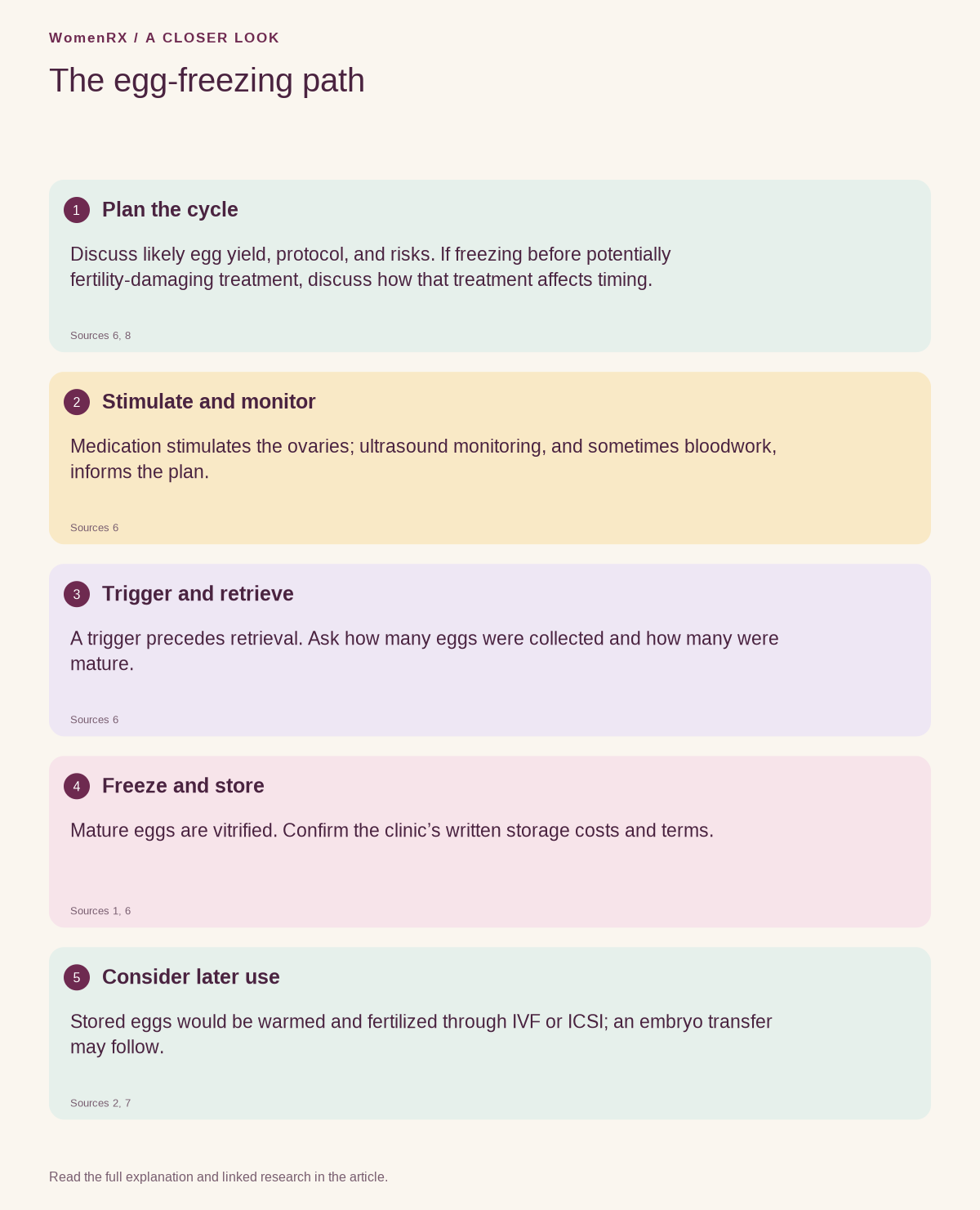
The egg-freezing path
Plan the cycle: Discuss likely egg yield, protocol, and risks. If freezing before potentially fertility-damaging treatment, discuss how that treatment affects timing.68
Stimulate and monitor: Medication stimulates the ovaries; ultrasound monitoring, and sometimes bloodwork, informs the plan.6
Trigger and retrieve: A trigger precedes retrieval. Ask how many eggs were collected and how many were mature.6
Freeze and store: Mature eggs are vitrified. Confirm the clinic’s written storage costs and terms.16
Consider later use: Stored eggs would be warmed and fertilized through IVF or ICSI; an embryo transfer may follow.27
Read the figure as text
Follow what happens now and what would still need to happen if you use the eggs later.- Plan the cycle: Discuss likely egg yield, protocol, and risks. If freezing before potentially fertility-damaging treatment, discuss how that treatment affects timing.68
- Stimulate and monitor: Medication stimulates the ovaries; ultrasound monitoring, and sometimes bloodwork, informs the plan.6
- Trigger and retrieve: A trigger precedes retrieval. Ask how many eggs were collected and how many were mature.6
- Freeze and store: Mature eggs are vitrified. Confirm the clinic’s written storage costs and terms.16
- Consider later use: Stored eggs would be warmed and fertilized through IVF or ICSI; an embryo transfer may follow.27
More questions, answered
If I freeze eggs, will I have to use them?
No. In a systematic review of planned egg freezing, only a minority of participants returned to use their stored eggs during the studies’ follow-up. A low return rate doesn’t, by itself, tell us whether freezing was worthwhile for any one person; some may conceive without those eggs or make different plans. 5
Does a high egg-survival rate mean a high chance of a baby?
No. Survival describes eggs after warming. Fertilization, embryo development, transfer, and live birth are separate outcomes. Ask the clinic to show each step and its denominator rather than using survival as a stand-in for live birth. 137
Sources you can check
- The Effect of Open and Closed Oocyte Vitrification Systems on Embryo Development: A Systematic Review and Network Meta-Analysis.Pantos K, Maziotis E, Trypidi A, Grigoriadis S, Agapitou K, Pantou A, Nikolettos K, Kokkini G, Sfakianoudis K, Pomeroy KO, Simopoulou M. · Journal of clinical medicine · 2024Return to first citation
- Mature oocyte cryopreservation: a guideline.Practice Committees of the American Society for Reproductive Medicine and the Society for Assisted Reproductive Technology. · Fertility and sterility · 2013Return to first citation
- Oocyte vitrification in the 21st century and post-warming fertility outcomes: a systematic review and meta-analysis.Potdar N, Gelbaya TA, Nardo LG. · Reproductive biomedicine online · 2014Return to first citation
- Empowering oocyte autonomy: A critical exploration of choice in fertility preservation.Tsonis O, Kopeika J. · Journal of gynecology obstetrics and human reproduction · 2026Return to first citation
- Planned oocyte cryopreservation: a systematic review and meta-regression analysis.Hirsch A, Hirsh Raccah B, Rotem R, Hyman JH, Ben-Ami I, Tsafrir A. · Human reproduction update · 2024Return to first citation
- The Cardinal protocol: investigating a simplified, cost-conscious option for oocyte cryopreservation in a prospective noninferiority cohort study.Chung EH, Raj-Derouin N, Zhang J, Harbour V, Markwei M, Khorshid A, Bavan B, Aghajanova L, Lathi RB. · F&S reports · 2026Return to first citation
- Clinical outcomes and utilization from over a decade of planned oocyte cryopreservation.Leung AQ, Baker K, Vaughan D, Shah JS, Korkidakis A, Ryley DA, Sakkas D, Toth TL. · Reproductive biomedicine online · 2021Return to first citation
- Outcomes of adolescents and young adults (AYA) attending for fertility counselling and oocyte cryopreservation prior to gonadotoxic treatment.Fee N, Joyce N, Horan M, Glover L, Crosby D. · Journal of assisted reproduction and genetics · 2026Return to first citation