Is There a Best Supplement for Adenomyosis?
The cited period-pain research does not establish a best supplement for adenomyosis or show that one treats the condition. You can still check a product’s claims against the symptom you want help with.
The cited period-pain research cannot identify a best supplement for adenomyosis. The review describes limited evidence for vitamins and dietary supplements for period pain and focuses on primary period pain, which is different from pain caused by adenomyosis. A claim about easing cramps isn’t proof that a product reduces heavy bleeding or changes adenomyosis in the uterine muscle. 41
Start with the symptom you want to change
Adenomyosis happens when tissue from the uterine lining grows into the muscle of the uterine wall. It can cause painful periods, heavy bleeding, and pain during sex, though some people have no symptoms. That range matters when you’re considering a supplement: “helps adenomyosis” could mean several very different things. 1
For example, if cramps are keeping you home for a day each month, a study measuring period pain might catch your eye. But if bleeding is the problem, a pain score won’t tell you whether the product reduces blood loss. And neither result, on its own, shows that adenomyosis in the uterine muscle has changed. 14
Why period-pain claims need a closer look
Period pain can occur without an underlying pelvic condition. That’s called primary dysmenorrhea. It can also be caused by a condition such as adenomyosis, known as secondary dysmenorrhea. A review of dysmenorrhea describes limited evidence for vitamins and dietary supplements as options for period pain; its discussion focuses on primary dysmenorrhea, not a demonstrated supplement treatment for adenomyosis. 4
That doesn’t mean a supplement couldn’t help someone feel better. It means the claim needs to match what was studied. When you see one, ask: Who had the pain, what changed, and what was compared? Relief reported by people with primary period pain is a reason to investigate an idea, not a reliable prediction of what will happen with adenomyosis. 4
The distinction is especially useful if a product promises more than comfort. Less pain would be worthwhile, but it wouldn’t establish that the product reduces heavy bleeding, treats the underlying condition, or improves the chance of pregnancy. Those are separate outcomes.
Compare supplements with options aimed at your symptom
If pain is your main concern, you have options to discuss or try that aren’t sold as adenomyosis cures. Guidance on adenomyosis describes a wrapped heat pad, a TENS device, and pain relievers such as ibuprofen as ways to ease period or pelvic pain. Period-pain guidance also describes anti-inflammatory medicines and hormonal contraception as treatment options for more severe pain; hormonal contraception can make periods lighter as well. What fits depends in part on whether you want to avoid contraception while trying to become pregnant. 12
If heavy bleeding is what’s disrupting your life, look for evidence about bleeding, not just cramps. Tranexamic acid is a medicine used to control heavy periods. It addresses bleeding; describing it that way does not mean it removes adenomyosis. If you take a combined contraceptive pill, that combination warrants a specific conversation with your prescriber because of a small increased risk of deep vein thrombosis noted in the medicine guidance. 3
A supplement may still be something you want to consider alongside your care. Before buying one, bring the exact product name and ingredient list to a clinician or pharmacist, particularly if you’re taking medicine for pain or bleeding, using hormonal contraception, or planning pregnancy. Ask whether there’s a reason to avoid that particular product with your medicines. A general claim that supplements are “natural” doesn’t answer a product-specific safety question.
Don’t let a supplement trial postpone help for bleeding or pain that has become harder to manage. Arrange a medical assessment if periods are becoming heavier or more painful, heavy bleeding is affecting your life, or pain during sex has appeared. If pelvic or period pain is severe or worse than usual and pain relief hasn’t helped, seek prompt medical advice. 12
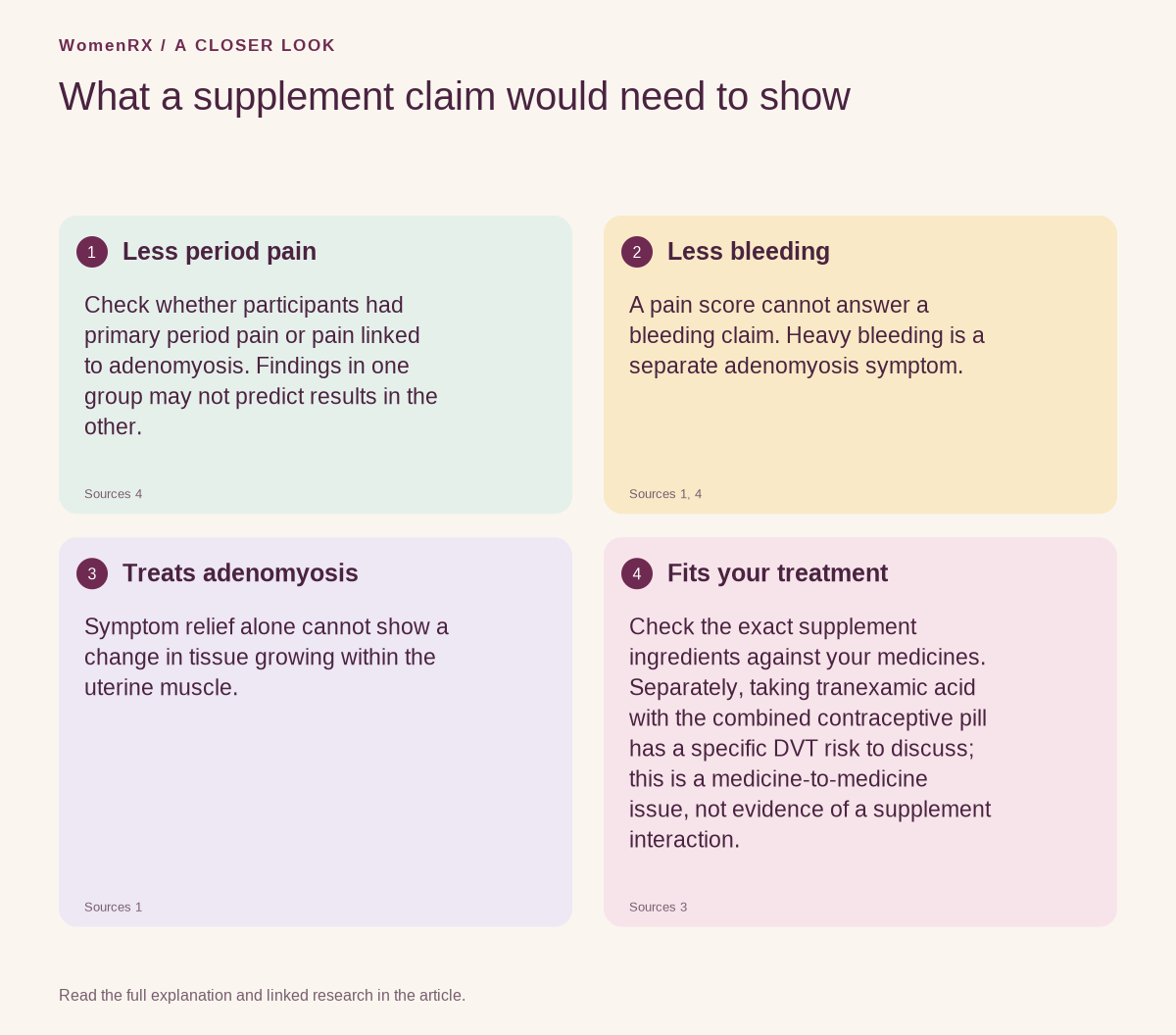
What a supplement claim would need to show
Less period pain: Check whether participants had primary period pain or pain linked to adenomyosis. Findings in one group may not predict results in the other.4
Less bleeding: A pain score cannot answer a bleeding claim. Heavy bleeding is a separate adenomyosis symptom.14
Treats adenomyosis: Symptom relief alone cannot show a change in tissue growing within the uterine muscle.1
Fits your treatment: Check the exact supplement ingredients against your medicines. Separately, taking tranexamic acid with the combined contraceptive pill has a specific DVT risk to discuss; this is a medicine-to-medicine issue, not evidence of a supplement interaction.3
Read the figure as text
Match the claim on a product to the outcome actually measured. These are different questions, not interchangeable signs of treatment success.- Less period pain: Check whether participants had primary period pain or pain linked to adenomyosis. Findings in one group may not predict results in the other.4
- Less bleeding: A pain score cannot answer a bleeding claim. Heavy bleeding is a separate adenomyosis symptom.14
- Treats adenomyosis: Symptom relief alone cannot show a change in tissue growing within the uterine muscle.1
- Fits your treatment: Check the exact supplement ingredients against your medicines. Separately, taking tranexamic acid with the combined contraceptive pill has a specific DVT risk to discuss; this is a medicine-to-medicine issue, not evidence of a supplement interaction.3
More questions, answered
Does a period-pain study tell me whether a supplement could help me get pregnant?
No. A change in pain is not a pregnancy outcome. Research discussed for supplements and dysmenorrhea focuses on period pain, and primary period pain is different from pain caused by adenomyosis. Don’t treat a pain-relief claim as fertility evidence. 4
Sources you can check
- Adenomyosis - NHSAccessed 2026-09-25Return to first citation
- Period pain - NHSAccessed 2026-09-25Return to first citation
- About tranexamic acid - NHSAccessed 2026-09-25Return to first citation
- Disease Burden of Dysmenorrhea: Impact on Life Course Potential.MacGregor B, Allaire C, Bedaiwy MA, Yong PJ, Bougie O. · International journal of women's health · 2023Return to first citation