HPV, Cervical Cancer, and What Prevention Can Do
HPV infection, an abnormal screening result, and cervical cancer are different things, and vaccination and screening help at different points.
Most HPV infections don’t cause problems, but a persistent infection with certain high-risk types can lead to cervical cell changes and, sometimes, cancer. HPV vaccination helps prevent infections from vaccine-covered types; screening looks for HPV or cell changes so precancer can be followed up or treated. Neither an HPV-positive result nor an abnormal screening result is, by itself, a cancer diagnosis. 1 2 6
The pathway from HPV to cancer is not automatic
HPV is a large group of viruses. It’s common, usually has no symptoms, and most infections don’t cause health problems. Some types can cause genital warts; certain high-risk types can affect cells in the cervix. When a high-risk infection persists, it can cause changes that may eventually become cancer. Nearly all cervical cancers are linked to infection with certain HPV types, but an HPV infection does not mean you have cancer, and most infections don’t lead to it. 1 2 6
Three results that mean different things
HPV infection means a test detected HPV, often a high-risk type relevant to cervical screening. It is not a diagnosis of precancer or cancer. There’s no treatment that clears HPV itself; if it causes a problem, such as cervical cell changes, that problem can be assessed and treated. 1
Abnormal screening means a screening test found HPV or cell changes that may need follow-up. Screening is meant to find risk or cell changes before cancer develops, not to confirm cancer. Ask what your particular result found and what follow-up, if any, is recommended. 1 2
Cervical cancer is cancer in the cervix. It is a separate diagnosis, made through further evaluation when needed. Screening aims to prevent cancer by finding changes early, before they become cancer. 2 3
Vaccination and screening do different jobs
HPV vaccination prevents infection from vaccine-covered types and has reduced cervical precancers and cervical cancer in populations studied. It does not cover every HPV type, and it doesn’t replace screening. If you’re unsure whether vaccination still makes sense for you, ask about your age, vaccination history, and current U.S. guidance. 1 4
Screening looks for high-risk HPV and/or cervical cell changes, depending on the test used. Its value is in finding changes that may need follow-up while they can still be addressed before cancer develops. Vaccination lowers risk; screening checks for risk or changes that may still occur. So a history of vaccination doesn’t, on its own, answer whether or when you should be screened. 1 2 4
Condoms can reduce exposure to HPV, but they don’t cover all genital skin, so they can’t prevent every infection. They’re one layer of risk reduction, not a substitute for vaccination or recommended screening. 1
Make follow-up specific to your result
If you receive a screening result, ask what the test found and what follow-up, if any, is recommended for you. In the United States, screening recommendations have not been modified based on HPV vaccination status. Researchers have modeled possible approaches that tailor screening to vaccination status, but those proposals are not current U.S. recommendations. Don’t change a screening plan on your own because you were vaccinated. 5
If you’re discussing screening or a result, useful questions include:
- What exactly did my result detect: high-risk HPV, cell changes, or both?
- What follow-up is recommended for this result? Should I bring my previous results?
- Does my vaccination history affect the plan, or should I follow the same recommendation?
- When should I expect the next step, and who will make sure I receive the result?
Screening is not a substitute for evaluation of symptoms. Unusual vaginal bleeding, changes in discharge, or pain during sex or in the pelvis can have many causes, but if these are new, worsening, or unusual for you, seek medical evaluation even if you’re up to date on screening. 3
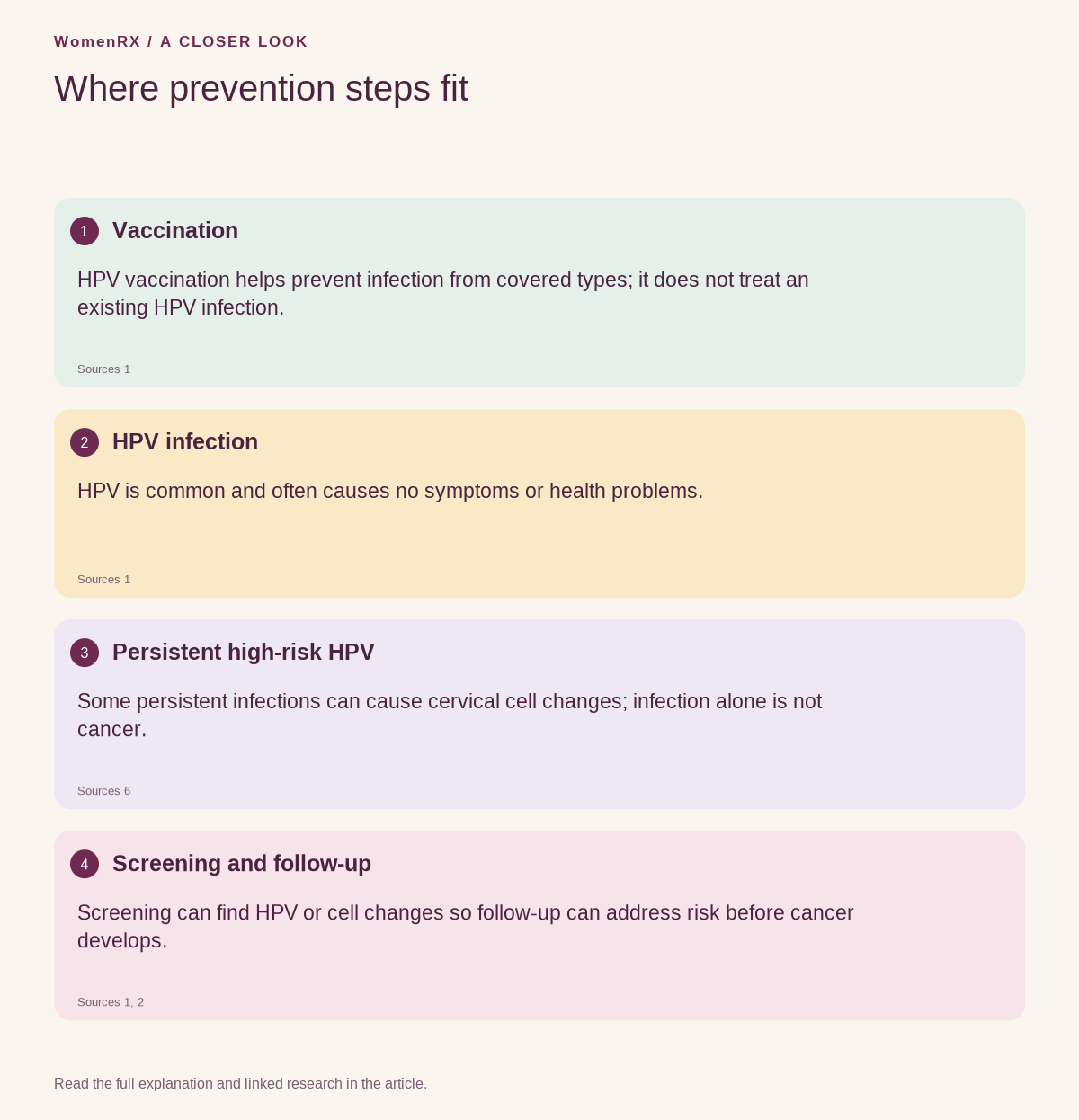
Where prevention steps fit
Vaccination: HPV vaccination helps prevent infection from covered types; it does not treat an existing HPV infection.1
HPV infection: HPV is common and often causes no symptoms or health problems.1
Persistent high-risk HPV: Some persistent infections can cause cervical cell changes; infection alone is not cancer.6
Screening and follow-up: Screening can find HPV or cell changes so follow-up can address risk before cancer develops.12
Read the figure as text
Vaccination helps prevent infection from some HPV types; screening can identify HPV or cell changes for follow-up. Vaccination is prevention, not treatment for an existing infection.- Vaccination: HPV vaccination helps prevent infection from covered types; it does not treat an existing HPV infection.1
- HPV infection: HPV is common and often causes no symptoms or health problems.1
- Persistent high-risk HPV: Some persistent infections can cause cervical cell changes; infection alone is not cancer.6
- Screening and follow-up: Screening can find HPV or cell changes so follow-up can address risk before cancer develops.12
More questions, answered
Does an HPV-positive result mean I have cervical cancer?
No. It means HPV was detected. Screening can also find cervical cell changes, which are not the same as cancer. Ask what follow-up, if any, is recommended for your result. 1 2
Can HPV vaccination replace cervical screening?
No. Vaccination protects against covered HPV types, but not all types. U.S. screening recommendations have not been changed based on vaccination status, so vaccination alone doesn’t determine whether you need screening. 1 5
Sources you can check
- Human papillomavirus (HPV) - NHSAccessed 2026-09-25Return to first citation
- What is cervical cancer? - NHSAccessed 2026-09-25Return to first citation
- Symptoms of cervical cancer - NHSAccessed 2026-09-25Return to first citation
- How practically feasible is tailored screening for cervical cancer based on human papillomavirus vaccination status?: the role of data linkage and registers.Basu P, Lucas E, Elfström KM. · Journal of the National Cancer Institute. Monographs · 2026Return to first citation
- Benefits, harms, and cervical cancer elimination timing of human papillomavirus screening approaches tailored to birth cohort as a proxy for vaccination status in the United States: a comparative modeling study.Simms KT, de Bondt D, Killen J, Sy S, Naslazi E, Regan MC, Burger EA, Kim JJ, Smith MA, de Kok IMCM, Canfell K. · Journal of the National Cancer Institute. Monographs · 2026Return to first citation
- Clinical Validation of the Sansure Human Papillomavirus DNA Diagnostic Kit for Use in Primary Cervical Cancer Screening.Dhillon SK, Latsuzbaia A, Vandenbroeck D, Prétet JL, Tkachenka Y, Lepiller Q, Baraquin A, Jacquot K, Pereira AR, Redzic N, Arbyn M. · Journal of medical virology · 2026Return to first citation