Cervical Dysplasia: What an Abnormal Screen Really Means
An abnormal cervical screening result is a signal to interpret in context, not a diagnosis of cancer.
Cervical dysplasia means abnormal cervical cells; it is not the same as cervical cancer. HPV is linked to many cervical cell changes, but most HPV infections don’t cause problems. Follow-up depends on the exact HPV and cell-test results, your recent screening and biopsy history, and sometimes HPV type. Depending on risk, next steps may range from monitoring to colposcopy, biopsy, or treatment. 1 4 5
Three different things a result can describe
An abnormal screening report can sound like a diagnosis, but screening, HPV infection, and dysplasia are not interchangeable.
An HPV test looks for human papillomavirus. A cervical cell test, often called cytology or a Pap test, looks for changes in cells. Dysplasia describes abnormal cervical cells; a biopsy may further classify those changes. Cervical cancer means cancer has developed in the cervix. Screening aims to identify changes before they become cancer, so an abnormal screen alone does not tell you that you have cancer. 1 2 5
HPV is common, and many infections don’t cause health problems. Some types are associated with cervical precancers and cancer, but an HPV-positive result by itself does not mean you have dysplasia or cancer. HPV can also be present for a long time without causing problems, so a result cannot reliably tell you when it was acquired. 1 2
Why one abnormal result doesn’t determine the next step
Follow-up is based on the estimated chance of having or developing a more serious precancerous change, not just on whether a result is labeled “abnormal.” US risk-based guidance considers the current HPV and cell-test results alongside recent screening results, prior colposcopy or biopsy findings, and treatment history. The same current result can therefore lead to different recommendations for people with different histories. 5
For example, a recent negative HPV test can lower the estimated risk associated with a new abnormal screening result. HPV type can matter too: in an analysis supporting the guidelines, HPV16 raised the risk of serious precancer enough to support colposcopy even when the cell test was normal. HPV18 is treated as a special situation because of its association with invasive cancer. These details help explain why two people with “HPV positive” on their reports may not receive the same recommendation. 4 5
Depending on risk, the guideline options include repeat surveillance at different intervals, colposcopy with biopsy, or treatment. Colposcopy lets a clinician examine the cervix more closely; a biopsy can show whether abnormal cells are present and how advanced they are. Treatment is not the automatic response to every positive HPV test or abnormal cell result. 5
Read the report for the details that guide care
If you have the report, look for the exact HPV result, the cell-test wording, and any mention of a biopsy. Also check whether it lists a specific HPV type, such as HPV16 or HPV18. The recommendation may depend on your prior results, so a previous negative HPV test, biopsy, or treatment is useful context even if it happened at another clinic. 4 5
A practical question is: “What result and history are driving this next step?” You can also ask whether the plan is repeat testing, colposcopy, biopsy, or treatment, and what finding would change that plan. These questions help distinguish monitoring from a procedure without assuming that either means cancer.
Pregnancy and immune status need context
If you’re pregnant, tell the clinician reviewing the result and ask how the proposed timing or procedure applies during pregnancy. The recommendations discussed here do not provide a pregnancy-specific pathway, so they shouldn’t be used to decide whether or when a procedure is appropriate in pregnancy.
HIV or another condition or treatment that affects immunity can also change which management guidance applies. An ASCCP update directs clinicians to separate guidance for people with HIV or immunosuppression; it does not mean that every person with an immune condition has the same result or plan. Make sure the clinician knows about relevant immune conditions and treatments when interpreting your result. 3
The most useful takeaway is that “abnormal” is a starting point, not a final diagnosis. The exact test findings and your history explain why follow-up may mean monitoring for one person and a closer examination for another.
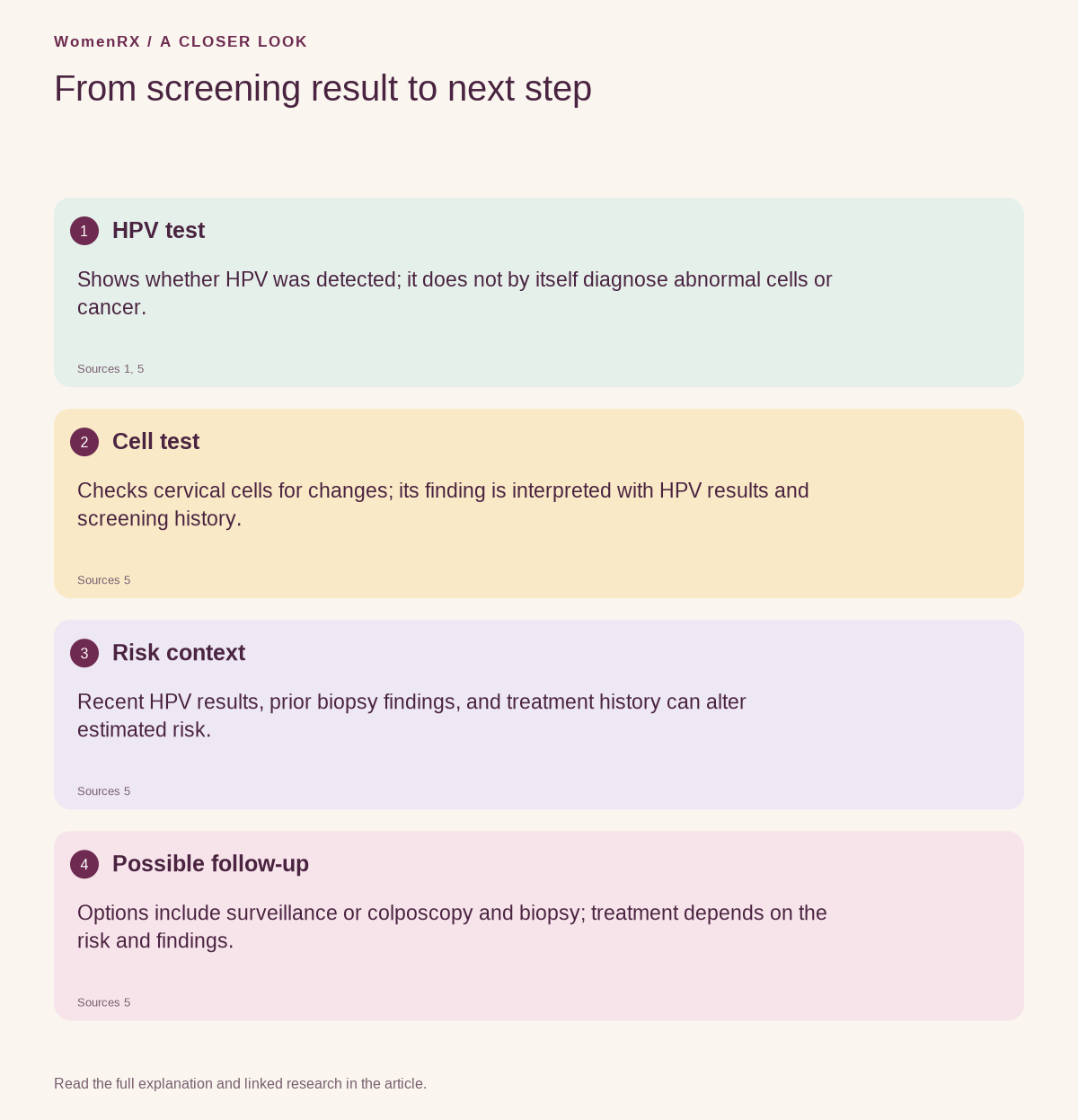
From screening result to next step
HPV test: Shows whether HPV was detected; it does not by itself diagnose abnormal cells or cancer.15
Cell test: Checks cervical cells for changes; its finding is interpreted with HPV results and screening history.5
Risk context: Recent HPV results, prior biopsy findings, and treatment history can alter estimated risk.5
Possible follow-up: Options include surveillance or colposcopy and biopsy; treatment depends on the risk and findings.5
Read the figure as text
A screening result starts an assessment. The exact findings and recent history help determine whether monitoring or closer evaluation is appropriate.- HPV test: Shows whether HPV was detected; it does not by itself diagnose abnormal cells or cancer.15
- Cell test: Checks cervical cells for changes; its finding is interpreted with HPV results and screening history.5
- Risk context: Recent HPV results, prior biopsy findings, and treatment history can alter estimated risk.5
- Possible follow-up: Options include surveillance or colposcopy and biopsy; treatment depends on the risk and findings.5
More questions, answered
Does an HPV-positive result mean I have cervical dysplasia?
No. An HPV test detects the virus; it doesn’t by itself diagnose abnormal cervical cells. Cell testing and, when indicated, biopsy provide different information. 1 5
Does cervical dysplasia mean cervical cancer?
No. Dysplasia refers to abnormal cervical cells, while cancer is a separate diagnosis. Screening looks for cell changes so they can be assessed before they develop into cancer. 2 5
Sources you can check
- Human papillomavirus (HPV) - NHSAccessed 2026-09-25Return to first citation
- What is cervical cancer? - NHSAccessed 2026-09-25Return to first citation
- 2019 ASCCP Risk-Based Management Consensus Guidelines: Updates Through 2023.Perkins RB, Guido RS, Castle PE, Chelmow D, Einstein MH, Garcia F, Huh WK, Kim JJ, Moscicki AB, Nayar R, Saraiya M, Sawaya GF, Wentzensen N, Schiffman M, 2019 ASCCP Risk-Based Mana... · Journal of lower genital tract disease · 2024Return to first citation
- A Study of Partial Human Papillomavirus Genotyping in Support of the 2019 ASCCP Risk-Based Management Consensus Guidelines.Demarco M, Egemen D, Raine-Bennett TR, Cheung LC, Befano B, Poitras NE, Lorey TS, Chen X, Gage JC, Castle PE, Wentzensen N, Perkins RB, Guido RS, Schiffman M. · Journal of lower genital tract disease · 2020Return to first citation
- Risk Estimates Supporting the 2019 ASCCP Risk-Based Management Consensus Guidelines.Egemen D, Cheung LC, Chen X, Demarco M, Perkins RB, Kinney W, Poitras N, Befano B, Locke A, Guido RS, Wiser AL, Gage JC, Katki HA, Wentzensen N, Castle PE, Schiffman M, Lorey TS. · Journal of lower genital tract disease · 2020Return to first citation