Cervical Dysplasia: Understanding Screening and Biopsy Results
An abnormal cervical screening result is a reason to check your risk more closely, not a diagnosis of cancer.
An HPV or Pap result is a screening finding, not a tissue diagnosis. Some results lead to repeat testing; others call for colposcopy, a closer look at the cervix. If a biopsy is taken, its findings help determine whether cell changes can be monitored or need treatment. In the US, the next step depends on the current result and relevant history. 41012
First, find out which result was abnormal
A cervical screening report can describe an HPV test, a Pap test (also called cytology), or both. The HPV test looks for the virus linked to most cervical cancers. A Pap test looks for changes in cells collected from the cervix. A positive HPV result does not mean you have cancer: HPV is common, usually causes no symptoms, and often clears without treatment. Some high-risk HPV types can cause abnormal cell changes, which is why follow-up matters. 124
The exact wording on your report matters. “HPV positive” tells you something different from “abnormal cells,” and a report may include both. 10 If HPV typing is reported, that information can matter too. 7
How a result can lead to a different next step
Think of the screening report as the start of a decision, not a diagnosis that dictates one procedure. These examples show why the branches differ:
- HPV positive, with no abnormal cells reported on the Pap test: Repeat testing rather than immediate colposcopy can be the next step for some people. HPV type and earlier results can change that assessment. In one study that applied US risk-based guidelines to screening records at a center in China, some people with HPV-positive results and normal cytology were assigned follow-up rather than colposcopy. The researchers also highlighted the different risk associated with HPV16 or HPV18. This is an illustration of the distinction, not a US timetable or a recommendation for your particular result. 7
- Abnormal cells reported on the Pap test: The cell finding needs to be considered alongside HPV testing, if available, and earlier results. Follow-up may involve another test or colposcopy; “abnormal Pap” alone does not identify which is appropriate. 4710
- Colposcopy recommended: This means a closer examination is warranted based on the risk assessment. It does not mean a biopsy has already found dysplasia or cancer. If tissue is sampled, its findings inform what happens afterward. 4710
US guidance uses a risk-based approach rather than assigning the same follow-up to everyone with the same broad label. 4711 If the next step or due date isn't clear, contact your clinic and ask for the specific recommendation rather than choosing a repeat-test interval from someone else's result.
Screening raises the question; a biopsy can answer a different one
Screening estimates who needs more evaluation. Colposcopy is a closer examination of the cervix after certain results. If an area needs sampling, a biopsy provides tissue for examination. The biopsy finding, rather than the screening result alone, can identify cervical intraepithelial neoplasia (CIN), a name for cervical cell changes graded CIN1, CIN2, or CIN3. These are findings about cell changes, distinct from a diagnosis of invasive cervical cancer. 1012
This distinction makes a result letter easier to read. An invitation for colposcopy means the screening result calls for a closer look; it does not tell you in advance what a biopsy will show. And not every abnormal screening result calls for colposcopy. US management uses a risk-based approach intended to focus more testing and treatment on people at higher risk of serious precancer or cancer. 467
Why your next step might differ from someone else’s
Your earlier results count. US risk-based management considers the current result alongside screening history. If you've had testing at another office, ask whether those reports are available to the team making your follow-up plan. In a retrospective study of 63,739 patients with an abnormal result across three US health systems, 38.3% had missing or insufficiently documented prior screening history. That doesn't mean your result is more serious; it means a missing record may affect how confidently your risk can be assessed. 57
Your situation counts too. General screening recommendations describe average-risk people and vary by age and test used. They shouldn't be mistaken for a universal follow-up timetable after an abnormal result. If you're pregnant, say so before follow-up is arranged: colposcopy may still be used to assess an abnormal result, but pregnancy changes how clinicians approach biopsy and treatment. A review of pregnancy guidance describes surveillance and reassessment after birth as common approaches when invasive cancer is not suspected, while noting that much of the underlying evidence is limited and retrospective. 49
A weakened immune system can affect routine screening recommendations, but that alone doesn't specify the next step for a particular abnormal result. If it applies to you, ask whether it changes your follow-up plan. 10
A biopsy result can open another decision. If CIN is found, the grade matters. CIN1 is mild and usually goes away without treatment. CIN2 is more abnormal and is typically treated by removing the affected cells, though careful monitoring may be an option for some people. CIN3 is not cancer, but it is a more serious precancer that generally needs treatment; pregnancy can change when treatment happens. That is why a biopsy grade, not simply the word “abnormal” on a screening report, helps explain a recommendation to monitor or treat. 12
For example, a Danish register study compared women with biopsy-diagnosed CIN2 who underwent active surveillance with women who had an immediate excisional procedure before a later birth. That is evidence that surveillance and treatment are distinct management choices in a defined setting, not an instruction to choose either one or to use Denmark's follow-up schedule in the US. Ask what the proposed approach is meant to watch for or treat in your case. 8
What to ask when you receive the result
You don't need to decode every abbreviation yourself. These questions get to the information that actually changes the plan:
- What were my HPV and Pap results, separately? If an HPV type was identified, ask whether it affects the recommendation. 47
- Is this a screening finding or a biopsy diagnosis? If you had a biopsy, ask for its exact wording and grade. 12
- Which earlier results were used? Mention tests or treatment done elsewhere if they don't appear in your record. 57
- What is the recommended next step, and when is it due? Ask whether that means repeat testing, colposcopy, or follow-up after a biopsy, and who will contact you with results. 412
- If I'm pregnant, does that change how biopsy or treatment would be approached? If you have a weakened immune system, ask whether it affects your plan, too. 910
One other distinction: screening is for people without symptoms. If you have bleeding after sex, bleeding between periods or after menopause, a change in vaginal discharge, or pelvic pain, tell a healthcare professional rather than waiting for your next screening test. These symptoms can have many causes and do not, by themselves, mean cervical cancer. 34
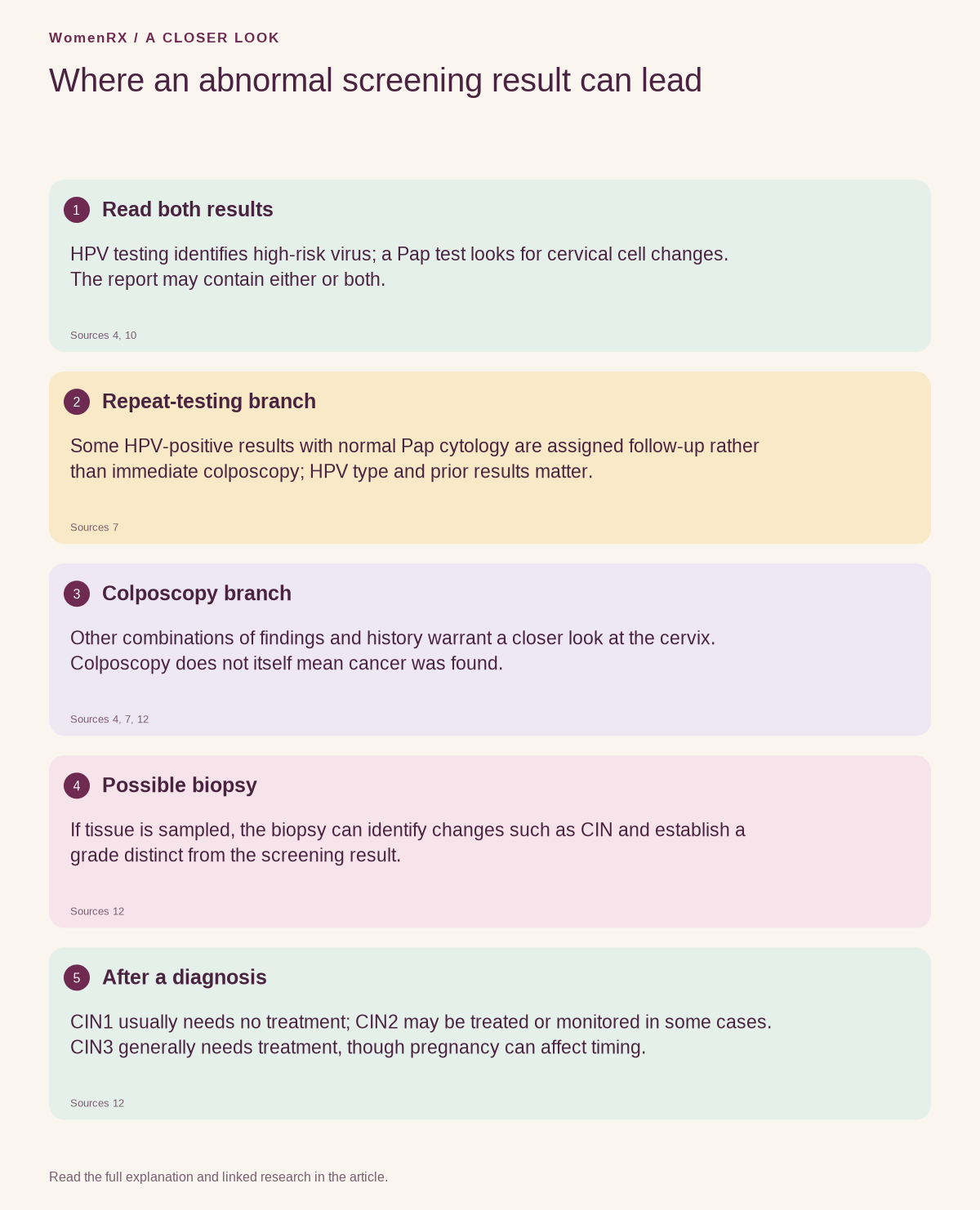
Where an abnormal screening result can lead
Read both results: HPV testing identifies high-risk virus; a Pap test looks for cervical cell changes. The report may contain either or both.410
Repeat-testing branch: Some HPV-positive results with normal Pap cytology are assigned follow-up rather than immediate colposcopy; HPV type and prior results matter.7
Colposcopy branch: Other combinations of findings and history warrant a closer look at the cervix. Colposcopy does not itself mean cancer was found.4712
Possible biopsy: If tissue is sampled, the biopsy can identify changes such as CIN and establish a grade distinct from the screening result.12
After a diagnosis: CIN1 usually needs no treatment; CIN2 may be treated or monitored in some cases. CIN3 generally needs treatment, though pregnancy can affect timing.12
Read the figure as text
From a screening report, the pathway can branch toward repeat testing or colposcopy. A biopsy finding, if there is one, leads to a separate management decision.- Read both results: HPV testing identifies high-risk virus; a Pap test looks for cervical cell changes. The report may contain either or both.410
- Repeat-testing branch: Some HPV-positive results with normal Pap cytology are assigned follow-up rather than immediate colposcopy; HPV type and prior results matter.7
- Colposcopy branch: Other combinations of findings and history warrant a closer look at the cervix. Colposcopy does not itself mean cancer was found.4712
- Possible biopsy: If tissue is sampled, the biopsy can identify changes such as CIN and establish a grade distinct from the screening result.12
- After a diagnosis: CIN1 usually needs no treatment; CIN2 may be treated or monitored in some cases. CIN3 generally needs treatment, though pregnancy can affect timing.12
More questions, answered
Can cervical dysplasia cause symptoms?
Cervical screening is intended for people without symptoms. HPV itself usually causes no symptoms. If you have unusual bleeding, changes in discharge, or pelvic pain, get those symptoms evaluated on their own merits rather than assuming they're explained by an HPV or Pap result. 134
Does the HPV vaccine protect against every HPV type?
No. The HPV vaccine protects against types responsible for many cervical cancers, but it does not protect against every HPV type. 1
Sources you can check
- Human papillomavirus (HPV) - NHSAccessed 2026-09-25Return to first citation
- What is cervical cancer? - NHSAccessed 2026-09-25Return to first citation
- Symptoms of cervical cancer - NHSAccessed 2026-09-25Return to first citation
- Cervical Cancer Screening.Wiser A, Quinlan JD. · American family physician · 2026Return to first citation
- Barriers to the Equitable Implementation of Risk-Based Cervical Cancer Management Guidelines.Clark CR, Lykken JM, Chen PM, Haas JS, Feldman S, Ahn C, Gu CA, Kobrin S, Silver MI, Atlas SJ, Chubak J, Tiro JA. · Journal of general internal medicine · 2026Return to first citation
- A cross-sectional survey examining clinician characteristics, practices, and attitudes associated with adoption of the 2019 American Society for Colposcopy and Cervical Pathology risk-based management consensus guidelines.Vadaparampil ST, Fuzzell LN, Brownstein NC, Fontenot HB, Lake P, Michel A, McIntyre M, Whitmer A, Perkins RB. · Cancer · 2023Return to first citation
- Validation of the indication for colposcopy proposed by the 2019 ASCCP risk-based management consensus guidelines: A single-center study in China.Gui T, Chen Z, Chen F. · PloS one · 2021Return to first citation
- Active surveillance of cervical intraepithelial neoplasia and adverse pregnancy outcomes: A register-based cohort study.Katholm KK, Eriksen LK, Lycke KD, Larsen NL, Sundtoft I, Randrup TH, Hammer A. · Acta obstetricia et gynecologica Scandinavica · 2026Return to first citation
- Approaches to Intraepithelial Cervical Neoplasia Management in Pregnancy: A Narrative Review.Bogheanu DM, Bayati AJSA, Poenaru MO, Olaru OG, Gorecki GP, Boiangiu AG, Hamoud BH, Sima RM, Ples L. · Life (Basel, Switzerland) · 2026Return to first citation
- Cervical Cancer Screening | Pap Smear | HPV | MedlinePlusAccessed 2026-09-25Return to first citation
- Moving forward-the 2019 ASCCP Risk-Based Management Consensus Guidelines for Abnormal Cervical Cancer Screening Tests and Cancer Precursors and beyond: implications and suggestions for laboratories.Nayar R, Chhieng DC, Crothers B, Darragh TM, Davey DD, Eisenhut C, Goulart R, Huang EC, Tabbara SO. · Journal of the American Society of Cytopathology · 2020Return to first citation
- HPV and Pap Test Results: Next Steps after an Abnormal Test - NCIAccessed 2026-09-26Return to first citation