Cervical Screening and HPV Testing: What’s Different?
An HPV test looks for high-risk human papillomavirus; a Pap test looks for changes in cervical cells.
HPV testing and cervical-cell testing look for different things. An HPV test checks a cervical sample for high-risk human papillomavirus, which is linked to cervical cancer; a Pap test, also called cytology, examines cells for changes. Either may be used for screening, or both may be combined. A positive HPV result or an abnormal Pap result isn’t itself a cancer diagnosis. Follow-up can include additional assessment, such as cytology or HPV genotyping, depending on the result. 1 3 4
Two tests, two questions
Cervical screening looks for signs that could lead to cervical cancer before you have symptoms. The name “Pap smear” refers to cytology: a lab examines cervical cells for changes that may need follow-up. An HPV test checks the sample for high-risk types of human papillomavirus, the virus linked to nearly all cervical cancers. 1 4
The distinction matters because the tests can disagree. A person can test positive for high-risk HPV while the cells still look normal. That means the virus was detected, not that cancer was found. In a study of women in Bulgaria with paired results, some samples with negative cytology were HPV-positive; that finding illustrates why the tests aren’t interchangeable, but it isn’t a US population estimate. 5
HPV testing, cytology, or both?
With primary HPV screening, the HPV test is the first test. If it finds a high-risk type, cytology or another risk-assessment step may help determine what follow-up is appropriate. This triage matters because an HPV-positive result alone doesn’t tell whether cervical cells have changed or whether further assessment is needed. HPV genotyping can also help assess risk in HPV-positive results. 3 4
With cytology-first screening, the lab looks for cell changes. Co-testing combines HPV testing and cytology, so the results provide information about both the virus and the cells. In the US, these approaches have included primary HPV testing, cytology alone, and co-testing, though recommendations vary by organization and have changed over time. 4
HPV testing is generally more sensitive for detecting precancerous changes than cytology alone, while cytology can still contribute useful information. A randomized-trial analysis among women aged 50 and older found primary HPV testing detected more CIN2+ lesions than cytology during follow-up; that result is specific to that age group and trial, not a personal prediction. 3 4
What a result can lead to
A negative HPV result means high-risk HPV wasn’t detected in that sample. In some screening approaches, a negative HPV test can support a longer interval before the next screen than cytology alone. The recommended interval isn’t universal; screening recommendations can differ by age, risk factors, and the screening approach used. 2 4
A positive HPV result isn’t a cancer diagnosis. Depending on the result, follow-up may include cytology, HPV genotyping, or further assessment. An abnormal cytology result also isn’t a cancer diagnosis: it means cells looked different. Cytology and other risk information can help determine whether further evaluation is needed. 3 4
If you’ve had an abnormal result before, ask how the current result affects what you’re due for next. Your recommended next step may differ from a routine screening schedule. 4 Screening is designed to look for disease before symptoms, not to explain symptoms you already have. 2
Make the interval question specific
Instead of asking only, “How often do I need a Pap?”, ask which test you’re having and what result would change the timing. A practical set of questions is:
- Is this HPV testing, cytology, or co-testing?
- If HPV is positive, will the sample also get cytology or another triage test?
- Given my age and risk factors, when should I have the next test?
- If I need follow-up, what is the next step and when should it happen?
The useful comparison isn’t simply “which test is better.” HPV testing looks for a likely cause of cervical cell changes; cytology looks for the changes themselves. Knowing which question your test answers makes the result and the next interval easier to understand. 1 4
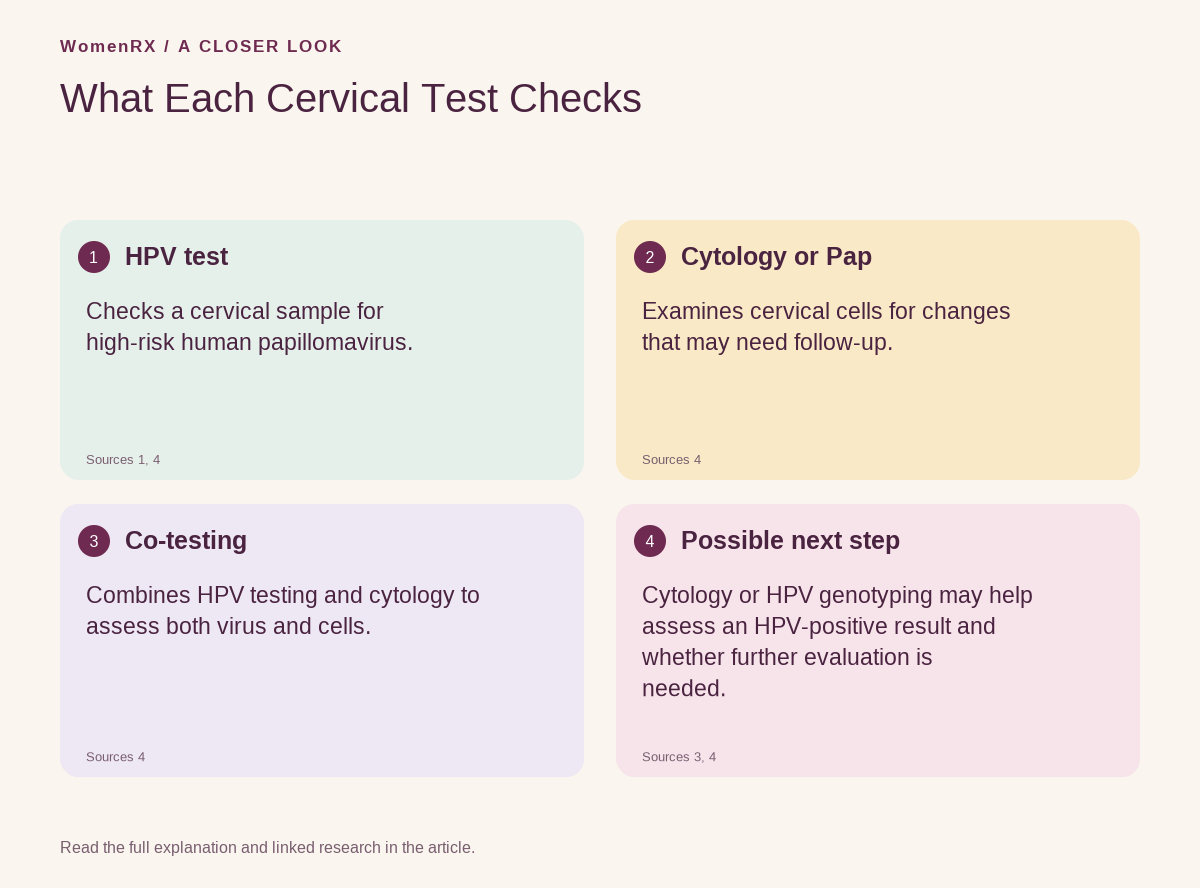
What Each Cervical Test Checks
HPV test: Checks a cervical sample for high-risk human papillomavirus.14
Cytology or Pap: Examines cervical cells for changes that may need follow-up.4
Co-testing: Combines HPV testing and cytology to assess both virus and cells.4
Possible next step: Cytology or HPV genotyping may help assess an HPV-positive result and whether further evaluation is needed.34
Read the figure as text
HPV testing and cytology assess different features of a cervical sample, and positive or abnormal findings can lead to additional assessment.- HPV test: Checks a cervical sample for high-risk human papillomavirus.14
- Cytology or Pap: Examines cervical cells for changes that may need follow-up.4
- Co-testing: Combines HPV testing and cytology to assess both virus and cells.4
- Possible next step: Cytology or HPV genotyping may help assess an HPV-positive result and whether further evaluation is needed.34
More questions, answered
Does a positive HPV test mean I have cervical cancer?
No. The test detects high-risk HPV in the sample, not cancer itself. Follow-up, such as cytology or further assessment, can help determine whether cervical cells have changed and what should happen next. 3 4
Is a Pap test the same as an HPV test?
No. A Pap test examines cervical cells for changes; an HPV test checks for high-risk human papillomavirus. Co-testing combines both. 1 4
Sources you can check
- Human papillomavirus (HPV) - NHSAccessed 2026-09-25Return to first citation
- Health Screening: MedlinePlusAccessed 2026-09-25Return to first citation
- HPV Testing Versus Cytology for Cervical Cancer Screening Among Women 50 Years and Older: Evidence From the HPV FOCAL Randomized Controlled Trial.Alam MS, Smith LW, Gondara L, Cook D, Martin RE, Peacock S, Proctor L, Stuart G, Patrick D, Franco EL, Krajden M, Gottschlich A, Ogilvie GS. · International journal of cancer · 2026Return to first citation
- Implementation and impact of primary HPV testing in cervical cancer screening: Historical perspectives and institutional experience at a large academic medical center.Yoda RA, Huang EC. · Cancer cytopathology · 2026Return to first citation
- Epidemiological Profile of High-Risk HPV in Cervical Samples for Liquid-Based Cytology: Insights from Screening and Symptomatic Cohorts.Curici A, Tsaneva-Damyanova D, Nedelcheva G, Pavelescu LA. · Microorganisms · 2026Return to first citation