Dense Breasts: What the Finding Means for Screening
Dense breast tissue can both raise breast cancer risk and make some cancers harder to see on a mammogram, but it doesn’t automatically mean you need another test.
“Dense breasts” describes how breast tissue looks on a mammogram; it isn’t a cancer diagnosis. Dense tissue can make mammograms less sensitive by obscuring tumors, and it’s also an independent risk factor for breast cancer. Whether to add ultrasound or MRI depends on the broader screening picture and how you weigh finding more cancers against extra callbacks and biopsies. 2 3
A description on your mammogram, not a diagnosis
Breast density is a description of the mix of tissue seen on a mammogram. Reports commonly use the terms heterogeneously dense and extremely dense for the two denser categories. The finding describes the image, not whether cancer is present. 2
Density matters for two different reasons. First, dense tissue is an independent risk factor for breast cancer. Second, it can obscure tumors on a mammogram, making the test less sensitive than it is in breasts with less dense tissue. Those are related screening considerations, but they aren’t the same thing: density can affect visibility and risk without being evidence that you have cancer. 2
What an additional test might change
Ultrasound and MRI have different evidence behind them. In the German study below, adding ultrasound increased cancer detection among women with “critically dense” breasts. In the MRI invitation trial below, interval-cancer risk was lower. Neither result, by itself, shows that extra screening saves lives. Both approaches also led to more false-positive findings. 2 3
The trade-off is visible in a large prospective controlled study in Germany. Among women classified as having “critically dense” breasts, the group offered ultrasound in addition to mammography had 10.7 cancers detected per 1,000 women, compared with 7.2 per 1,000 in the mammography-only group. The ultrasound group also had more recalls (6.6% versus 5.4%) and biopsies (3.2% versus 1.5%). The study was not randomized, focused on the most dense 15-20% of participants, and did not establish long-term benefit. Its results show both sides of the decision, not that every person with dense breasts should have ultrasound. 2
MRI has different evidence. A US Preventive Services Task Force evidence review found one randomized trial of invitations to supplemental MRI for people with dense breasts. The trial reported a lower interval-cancer risk with MRI (relative risk 0.47), alongside more false-positive recalls and biopsy results. It did not provide longer-term evidence about advanced cancer, illness, or deaths. The same review found that the available ultrasound studies reported additional false positives and no difference in interval cancers. 3
How to make the decision personal
A useful discussion is about your overall risk and the likely consequences of another test, not density in isolation. Bring the exact wording of the mammogram report and ask:
- Which density category did my report use, and how does that affect the visibility of my mammogram?
- What other risk information, such as my family history or known inherited risk, changes my screening picture? Some inherited gene changes, including BRCA1 and BRCA2, raise breast cancer risk. 1
- If I add ultrasound or MRI, what is the likely benefit in my situation, and what are the chances of extra imaging or biopsy?
- What evidence supports this option for someone with my level of risk, and what outcomes have not yet been shown?
A reasonable next step is to ask the clinician who ordered your mammogram or the imaging center to explain your report and how your personal risk affects the choice. Supplemental screening is a decision to weigh, not an automatic consequence of a dense-breast finding.
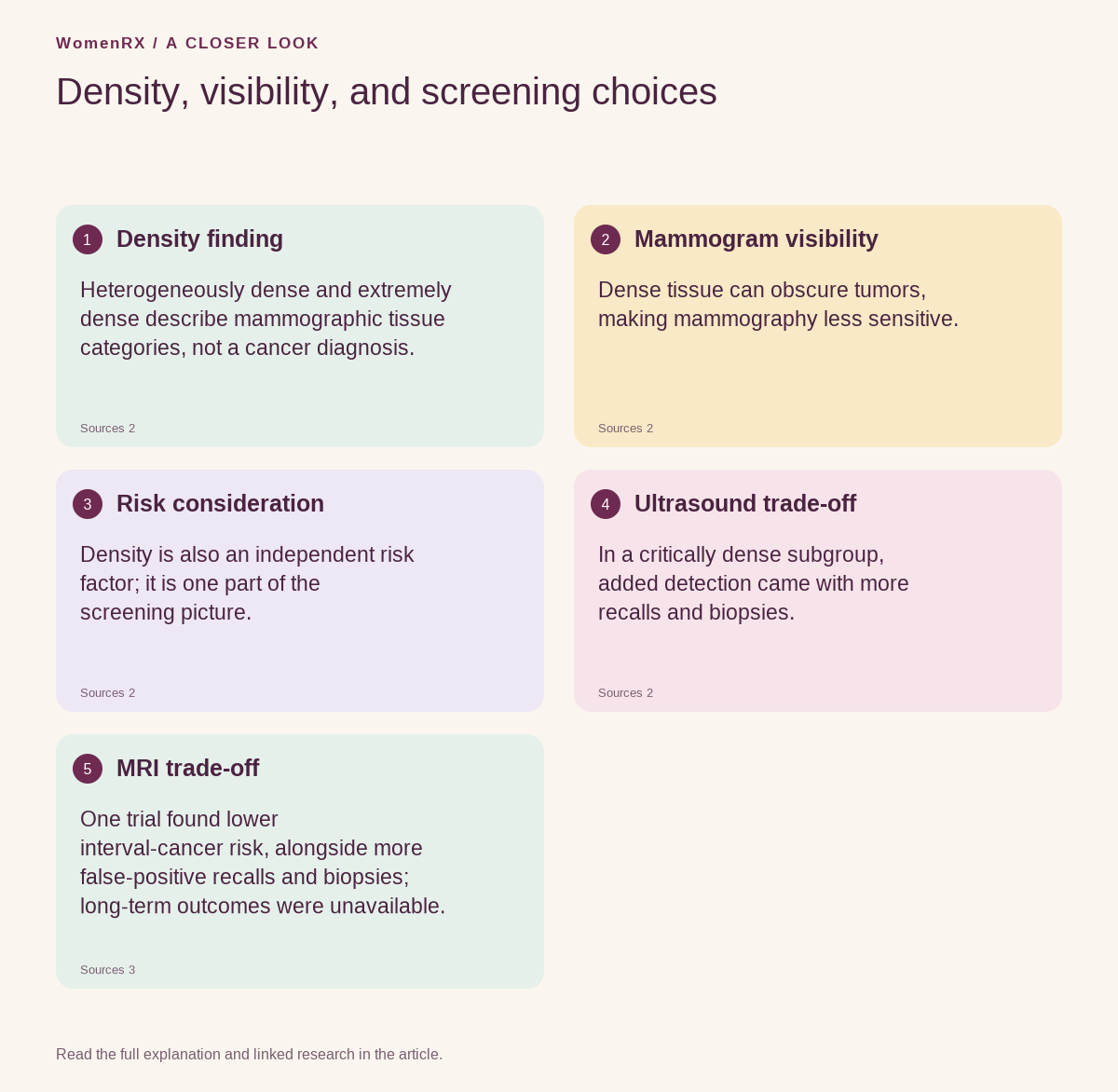
Density, visibility, and screening choices
Density finding: Heterogeneously dense and extremely dense describe mammographic tissue categories, not a cancer diagnosis.2
Mammogram visibility: Dense tissue can obscure tumors, making mammography less sensitive.2
Risk consideration: Density is also an independent risk factor; it is one part of the screening picture.2
Ultrasound trade-off: In a critically dense subgroup, added detection came with more recalls and biopsies.2
MRI trade-off: One trial found lower interval-cancer risk, alongside more false-positive recalls and biopsies; long-term outcomes were unavailable.3
Read the figure as text
These are separate questions: what the mammogram describes, how density affects visibility, and what an added screening test may trade off.- Density finding: Heterogeneously dense and extremely dense describe mammographic tissue categories, not a cancer diagnosis.2
- Mammogram visibility: Dense tissue can obscure tumors, making mammography less sensitive.2
- Risk consideration: Density is also an independent risk factor; it is one part of the screening picture.2
- Ultrasound trade-off: In a critically dense subgroup, added detection came with more recalls and biopsies.2
- MRI trade-off: One trial found lower interval-cancer risk, alongside more false-positive recalls and biopsies; long-term outcomes were unavailable.3
Sources you can check
- Breast Cancer | Breast Cancer Symptoms | MedlinePlusAccessed 2026-09-25Return to first citation
- Supplemental Breast Ultrasound in Mammography Screening for Women with Critically Dense Breasts.Heywang-Köbrunner SH, Elsner SA, Haußmann E, Hacker A, Grieger P, Hadwiger M, Hertlein M, Katalinic A. · Cancers · 2026Return to first citation
- Screening for Breast Cancer: Evidence Report and Systematic Review for the US Preventive Services Task Force.Henderson JT, Webber EM, Weyrich MS, Miller M, Melnikow J. · JAMA · 2024Return to first citation