PMDD Treatment Options: Finding a Plan That Fits
Tracking symptoms across your whole cycle can clarify what needs treating and help you see whether a treatment is helping.
PMDD treatment discussions commonly include SSRI antidepressants and hormonal contraception. Before choosing a plan, chart symptoms across two cycles: symptoms that ease after your period begins may call for a different approach from an ongoing mood condition that gets worse before each period. Keep tracking after treatment starts so you can review what changed, including how symptoms affect daily life. 2 4 6
First, find out what happens between periods
Severe irritability, low mood, or anxiety before a period can make PMDD worth assessing. The pattern matters as much as the symptoms themselves. PMDD symptoms tend to arise before menstruation and ease after it begins. A diagnosis calls for prospective symptom charting across two symptomatic cycles rather than relying on memory alone. 2
Record symptoms as they happen, including days when you feel well. Note bleeding and whether symptoms interfere with work, relationships, sleep, or other parts of your routine. For example, feeling markedly worse before bleeding and then well for the rest of the cycle tells a different story from feeling low most days with an additional premenstrual dip.
That second pattern can be premenstrual exacerbation, or PME, of an ongoing mood disorder. It can resemble PMDD, but treatments that help PMDD may have less or no effect on PME. The distinction can change what your treatment needs to address. Research on PME treatment is still limited. 6
Compare treatments by their evidence and fit
| Approach | What we know | What to discuss |
|---|---|---|
| SSRI antidepressants | A systematic review identified SSRIs as a leading option for adults with PMDD and no current or previous psychiatric comorbidity. Its search was conducted in 2015. 4 | Whether symptoms are confined to part of the cycle or an ongoing mood condition also needs attention. |
| Hormonal contraception | The same review identified oral estrogen-progestin contraceptives as another treatment option for that group. 4 | Whether contraception fits your health needs and preferences, rather than assuming it suits everyone with PMDD. |
| Psychotherapy | In one randomized trial, 48 women were assigned to emotion-focused therapy or a waitlist; 44 completed the study. Several symptom and emotional-regulation scores decreased during the study. Those score decreases alone cannot show whether therapy outperformed the waitlist. 1 | Whether you want support with emotional symptoms, while recognizing that this one small trial cannot establish how therapy compares with medication. |
| Supplements | A review of Vitex trials found positive results but noted that most studies focused on PMS and that preparations, diagnoses, and outcome measures differed. A meta-analysis found no statistically significant overall effect of inositol on its assessed outcomes, though it noted a trend for depressive symptoms in PMDD. 3 5 | The evidence for the specific approach you’re considering, rather than treating all supplements as interchangeable or equivalent to better-supported options. |
This isn’t a ranking for every person. The review supporting SSRIs and oral contraceptives focused specifically on adults without psychiatric comorbidity. If symptoms continue outside the premenstrual phase, that broader picture belongs in the treatment discussion. 4 6
Review change across the whole cycle
Use your chart as a before-and-after comparison, not just a record of the hardest days. Before treatment, identify a few things you hope will change: for example, the intensity of irritability, the number of days low mood disrupts work, or whether you can take part in plans you usually enjoy. Then record those same things during later cycles.
Look at both the premenstrual days and the rest of the month. Did the difficult stretch become less disruptive? Did it shift to different days? Are symptoms still present between periods? Those observations can make a treatment review more useful than trying to recall whether you felt “better overall,” and they may point back to the PMDD-versus-PME distinction. 2 6
Don’t wait on tracking if safety is at stake
Suicidal thoughts deserve attention whenever they occur. In a selected study group of 110 women with prospectively confirmed PMDD, 43 reported current suicidal thoughts in the late premenstrual phase. That figure describes women assessed before participation in clinical trials, not all women with PMDD. 2
If you’re having suicidal thoughts, tell someone you trust and seek prompt help. If you might act on them, get immediate help from emergency services or go to an emergency department. You don’t need to finish two cycles of tracking before getting support.
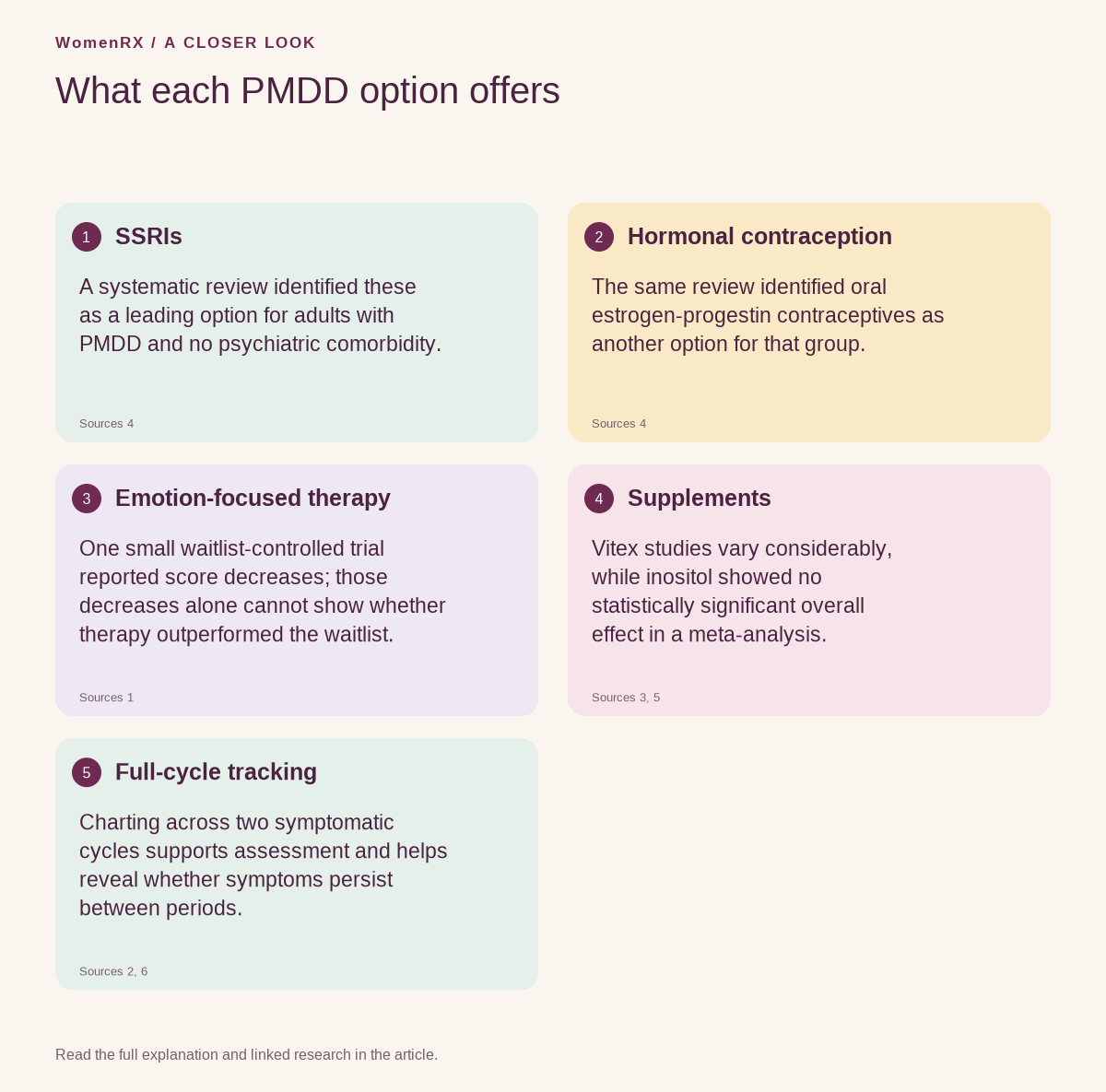
What each PMDD option offers
SSRIs: A systematic review identified these as a leading option for adults with PMDD and no psychiatric comorbidity.4
Hormonal contraception: The same review identified oral estrogen-progestin contraceptives as another option for that group.4
Emotion-focused therapy: One small waitlist-controlled trial reported score decreases; those decreases alone cannot show whether therapy outperformed the waitlist.1
Supplements: Vitex studies vary considerably, while inositol showed no statistically significant overall effect in a meta-analysis.35
Full-cycle tracking: Charting across two symptomatic cycles supports assessment and helps reveal whether symptoms persist between periods.26
Read the figure as text
Compare the evidence behind common treatment discussions, then use full-cycle tracking to check which pattern and changes apply to you.- SSRIs: A systematic review identified these as a leading option for adults with PMDD and no psychiatric comorbidity.4
- Hormonal contraception: The same review identified oral estrogen-progestin contraceptives as another option for that group.4
- Emotion-focused therapy: One small waitlist-controlled trial reported score decreases; those decreases alone cannot show whether therapy outperformed the waitlist.1
- Supplements: Vitex studies vary considerably, while inositol showed no statistically significant overall effect in a meta-analysis.35
- Full-cycle tracking: Charting across two symptomatic cycles supports assessment and helps reveal whether symptoms persist between periods.26
Sources you can check
- Emotion-focused therapy for women with premenstrual dysphoric disorder: a randomized clinical controlled trial.Dehnavi SI, Mortazavi SS, Ramezani MA, Gharraee B, Ashouri A. · BMC psychiatry · 2024Return to first citation
- Prevalence and correlates of current suicidal ideation in women with premenstrual dysphoric disorder.Wikman A, Sacher J, Bixo M, Hirschberg AL, Kopp Kallner H, Epperson CN, Comasco E, Sundström Poromaa I. · BMC women's health · 2022Return to first citation
- Vitex agnus castus for premenstrual syndrome and premenstrual dysphoric disorder: a systematic review.Cerqueira RO, Frey BN, Leclerc E, Brietzke E. · Archives of women's mental health · 2017Return to first citation
- Premenstrual Dysphoric Disorder Without Comorbid Psychiatric Conditions: A Systematic Review of Therapeutic Options.Sepede G, Sarchione F, Matarazzo I, Di Giannantonio M, Salerno RM. · Clinical neuropharmacology · 2016Return to first citation
- A meta-analysis of inositol for depression and anxiety disorders.Mukai T, Kishi T, Matsuda Y, Iwata N. · Human psychopharmacology · 2014Return to first citation
- Premenstrual Exacerbations of Mood Disorders: Findings and Knowledge Gaps.Kuehner C, Nayman S. · Current psychiatry reports · 2021Return to first citation