How Vulvar Varicose Veins Are Assessed After Menopause
A new vulvar bulge needs an examination before anyone can tell whether it’s a varicose vein or another kind of change.
Assessment usually starts with a close look at the vulva and a discussion of where the bulge is, how it has changed, and whether you also have pelvic or leg symptoms. A clinician can often recognize vulvar varicosities on examination; duplex ultrasound may help when the diagnosis or the veins involved need clarification. Menopause alone doesn’t identify the cause. 23
First, establish what the bulge is
A vulvar varicose vein is an enlarged vein in the outer or inner labia. It may look like a bulging vein, but appearance alone isn’t a reliable way to name every lump or patch of color in that area. In a study of women with vulvar varicosities, clinicians could recognize most cases on examination. Other changes, including venous malformations, hematomas and soft-tissue growths, can require a different assessment. That’s why a new or changing vulvar bulge is worth having examined rather than treating it as a vein based on a mirror check. 24
Tell the clinician exactly where you notice it: on one labium or both, near the vaginal opening, or closer to the groin or perineum, the area between the vaginal opening and anus. You can also describe whether you see a distinct bulge or mainly feel pressure or discomfort. Those details help direct the examination. They don’t diagnose the cause on their own.
Why the history reaches beyond the vulva
Vulvar veins connect with veins in the pelvis and legs. Sometimes a vulvar varicosity is part of a wider pattern of pelvic or lower-body vein changes. For example, a clinician may ask about leg varicose veins, persistent pelvic pain, or pain with sex because these can occur alongside pelvic venous disorders. Having one of those symptoms doesn’t prove that a vein is responsible for it. 23
Prior pregnancies are useful history, too. Vulvar varicosities occur during pregnancy, and the study of 101 women with this condition included both pregnant women and a separate group with pelvic and vulvar varicose veins. Those groups were assessed differently. The study doesn’t establish menopause as a cause, nor does it tell us how often a newly noticed vulvar bulge after menopause is a varicose vein. 2
A useful description might be: “I’ve noticed a bulge on the left outer labium for several weeks, and I also have leg varicose veins.” Or: “I feel pelvic pressure, but I can’t see a vein.” These are examples of information to share, not signs that confirm a diagnosis.
What an ultrasound can add
The examination may be enough to identify a vulvar varicosity. If the finding is uncertain, symptoms suggest connected veins elsewhere, or a procedure is being considered, a clinician may use duplex ultrasound. This scan shows vein anatomy and blood flow. In the vulvar-varicosity study, clinicians used it to confirm varicose veins and look for backward flow and connections with pelvic and leg veins. That study describes a specialist-center approach, not a rule that every vulvar bulge needs an extensive pelvic scan. 2
The distinction matters because treatment depends on what the change actually is and, for a varicosity, which veins are involved. A venous malformation, for example, is not simply another name for a varicose vein. 4 If someone suggests compression or a vein procedure before the diagnosis is clear, it’s reasonable to ask what the examination showed and what, if anything, imaging would change.
When bleeding changes the next step
If a visible varicose vein is bleeding, seek urgent medical assessment. General varicose-vein guidance treats bleeding as a reason for urgent help, though it doesn’t set out a separate rule for vulvar veins. 1
Bleeding that seems to come from the vagina is a different question. Any vaginal bleeding after menopause needs assessment, even if it’s a small amount or you aren’t sure it’s blood. If you can’t tell whether blood is coming from a surface change on the vulva or from inside the vagina, say so when you seek care rather than assuming it’s from a vein. 5
For a bulge or discomfort without bleeding, the useful next move is an examination that can identify the change and decide whether ultrasound would answer a specific question. You don’t need to work out the vein anatomy yourself before making that appointment.
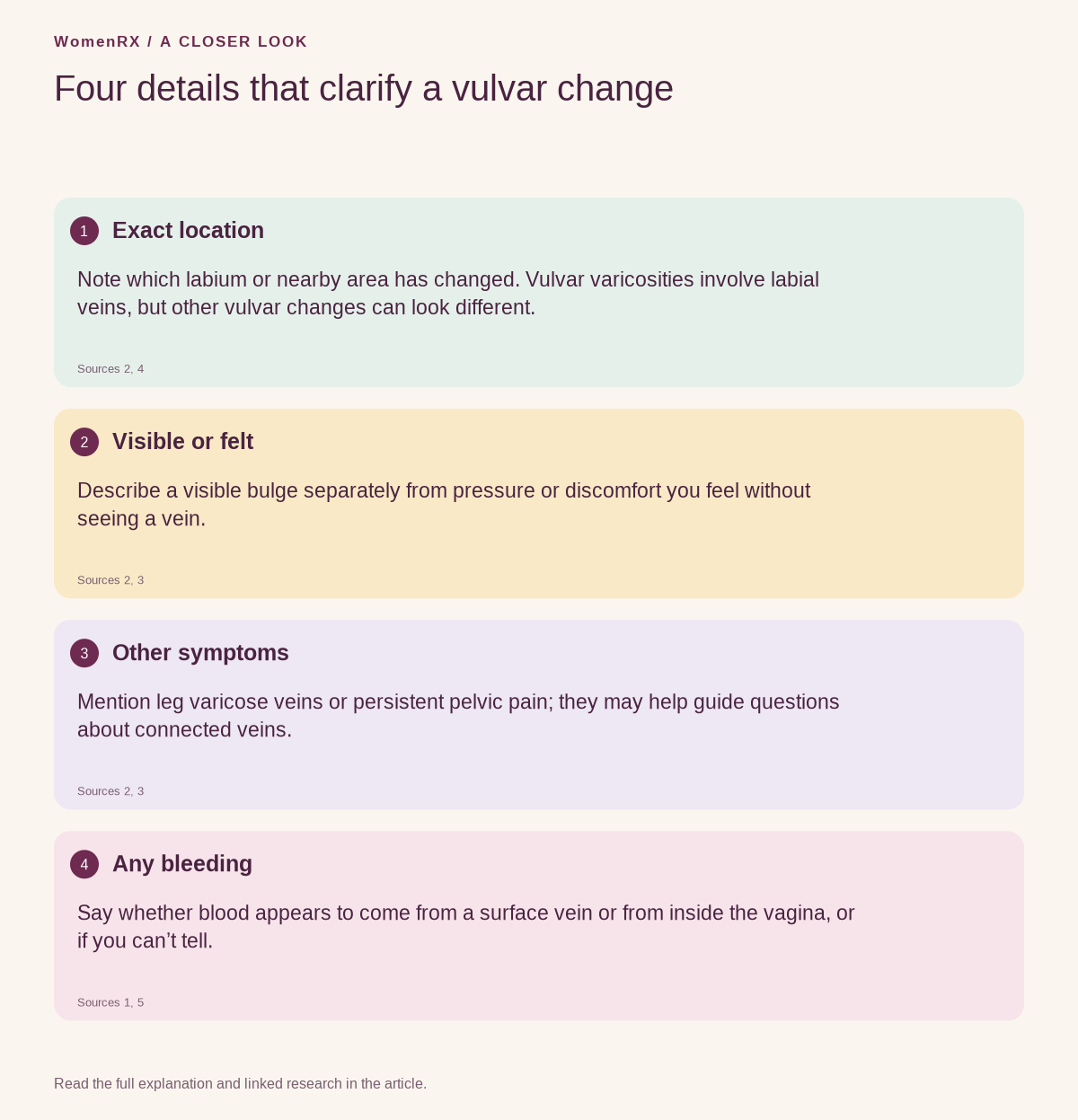
Four details that clarify a vulvar change
Exact location: Note which labium or nearby area has changed. Vulvar varicosities involve labial veins, but other vulvar changes can look different.24
Visible or felt: Describe a visible bulge separately from pressure or discomfort you feel without seeing a vein.23
Other symptoms: Mention leg varicose veins or persistent pelvic pain; they may help guide questions about connected veins.23
Any bleeding: Say whether blood appears to come from a surface vein or from inside the vagina, or if you can’t tell.15
Read the figure as text
These observations help describe what needs examining; they are not a test for varicose veins.- Exact location: Note which labium or nearby area has changed. Vulvar varicosities involve labial veins, but other vulvar changes can look different.24
- Visible or felt: Describe a visible bulge separately from pressure or discomfort you feel without seeing a vein.23
- Other symptoms: Mention leg varicose veins or persistent pelvic pain; they may help guide questions about connected veins.23
- Any bleeding: Say whether blood appears to come from a surface vein or from inside the vagina, or if you can’t tell.15
More questions, answered
Does a history of pregnancy mean this is a vulvar varicose vein?
No. Vulvar varicosities can occur during pregnancy, so that history is useful to mention, but it cannot identify a bulge you notice now. The current finding still needs an examination. 24
Will I need a pelvic scan?
Not necessarily. An examination can identify many vulvar varicosities. Duplex ultrasound can clarify blood flow and connected veins when that information would help establish the diagnosis or plan care. 2
Sources you can check
- Varicose veins - NHSAccessed 2026-09-25Return to first citation
- Vulvar varicosities: diagnosis, treatment, and prevention.Gavrilov SG. · International journal of women's health · 2017Return to first citation
- Pelvic Venous Disorders: An Update in Terminology, Diagnosis, and Treatment.Clark MR, Taylor AC. · Seminars in interventional radiology · 2023Return to first citation
- Management of congenital venous malformations of the vulva.Marrocco-Trischitta MM, Nicodemi EM, Nater C, Stillo F. · Obstetrics and gynecology · 2001Return to first citation
- Postmenopausal bleeding - NHSAccessed 2026-09-25Return to first citation