How to Spot Rosacea Triggers Without Giving Up Everything
A short record of exposures and symptoms can help you find your own patterns without treating every common trigger as a rule.
Rosacea triggers are personal. Sunlight, temperature changes, alcohol, exercise, stress, certain spicy foods, and skin-care practices may worsen symptoms, but a possible trigger isn’t necessarily yours. Note what happened before a flare, what your skin did, and which exposures overlapped. Look for a repeatable pattern before making a narrow change. Trigger adjustments can help alongside treatment, not replace it. 1 2 4
Start with your symptoms, not a forbidden list
If your face burns after dinner, it’s tempting to blame the food. But perhaps you also had a drink, came in from the cold, or tried a new face product. One flare can give you a clue; it usually can’t tell you which of several exposures mattered.
Possible rosacea triggers include sunlight, hot or cold temperatures, alcohol, aerobic exercise, stress, and certain spicy foods. 1 4 Skin-care practices can matter too. 2 None of these needs to become an automatic rule for you. In a German online questionnaire of 777 people with rosacea, 86.3% reported temperature changes as a trigger and 77.7% reported ultraviolet radiation. Those self-reports describe a group, not the cause of any one person’s flare. 6
It also helps to name what you’re trying to understand. Was it brief flushing? Burning or stinging? New bumps and pustules? Rosacea can involve several of these features, and the symptom that bothers you most may shape both the changes you try and the treatment you discuss. 4 5
Keep a small record you can actually use
When symptoms occur, write down three things:
- What happened beforehand: For example, time in the sun, a temperature change, exercise, a particular meal or drink, or a new skin-care product.
- What your skin did: Note flushing, lasting redness, bumps, burning, or stinging, rather than writing only “flare.”
- What else overlapped: If you exercised outdoors on a hot day, both heat and exercise belong in the note.
You don’t need to document every meal or minute. If you happen to notice the suspected exposure without a flare on another occasion, that’s useful context too. The aim is to compare ordinary experiences, not to create a demanding diary or a diagnostic test.
Suppose you flush after a spicy dinner that also included alcohol. Rather than cutting out both, watch for what happens on separate occasions when only one is present. A similar symptom after the same exposure more than once is a stronger personal clue than a single evening, though it still doesn’t prove cause and effect.
Test a narrow change, then judge its value
When one factor looks repeatable, try adjusting that factor without changing everything else at once. That could mean reconsidering one food instead of an entire category, or simplifying one part of your skin-care routine instead of replacing every product. If exercise seems involved, think about whether the conditions around it, such as heat or sun, might also be relevant.
Then ask whether the change made a noticeable difference to the symptom you were tracking. If it didn’t, a lasting restriction may not be worthwhile. Rosacea experts caution that the burden of avoiding triggers can sometimes outweigh the burden of symptoms. Your plan should make life more manageable, not steadily smaller. 4
Where hormonal changes fit
Hormonal changes are one possible factor to consider when looking at someone’s rosacea history. That doesn’t mean every woman’s flares follow her menstrual cycle or change during perimenopause or menopause. If you notice a possible timing pattern, add it to your notes alongside symptoms and other exposures. Look for what repeats rather than assuming hormones explain a particular flare. 4
Don’t ask trigger changes to do a treatment’s job
If flushing, bumps, or discomfort persist, avoiding suspected triggers isn’t the only option. Daily sunscreen, moisturizer, and a mild cleanser are described as maintenance measures. Treatment can then be matched to the symptom: a primary-care review lists topical ivermectin, metronidazole, and azelaic acid for papules and pustules, and alpha-adrenergic medicines for flushing. 5
An assessment is useful if you aren’t sure it’s rosacea. It can resemble acne, and redness may be harder to see on richly pigmented skin. Burning, stinging, dryness, flushing, and sensitivity to products are worth describing even when redness isn’t obvious. If you have rosacea and an eye becomes painful, seek urgent medical attention; eye pain can signal a serious eye problem. 1 3
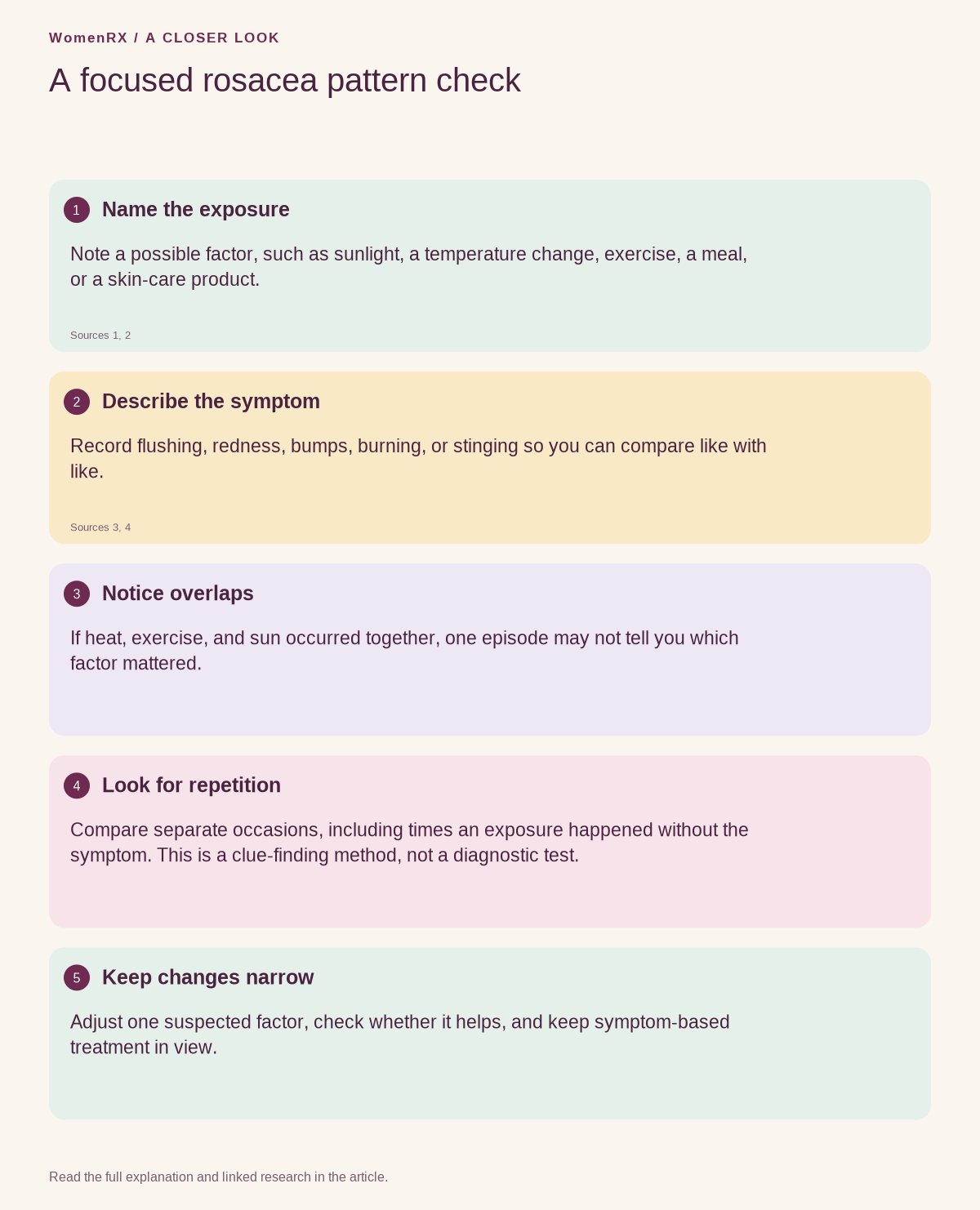
A focused rosacea pattern check
Name the exposure: Note a possible factor, such as sunlight, a temperature change, exercise, a meal, or a skin-care product.12
Describe the symptom: Record flushing, redness, bumps, burning, or stinging so you can compare like with like.34
Notice overlaps: If heat, exercise, and sun occurred together, one episode may not tell you which factor mattered.
Look for repetition: Compare separate occasions, including times an exposure happened without the symptom. This is a clue-finding method, not a diagnostic test.
Keep changes narrow: Adjust one suspected factor, check whether it helps, and keep symptom-based treatment in view.
Read the figure as text
Use these prompts to compare exposures with symptoms before deciding whether a restriction is worth keeping.- Name the exposure: Note a possible factor, such as sunlight, a temperature change, exercise, a meal, or a skin-care product.12
- Describe the symptom: Record flushing, redness, bumps, burning, or stinging so you can compare like with like.34
- Notice overlaps: If heat, exercise, and sun occurred together, one episode may not tell you which factor mattered.
- Look for repetition: Compare separate occasions, including times an exposure happened without the symptom. This is a clue-finding method, not a diagnostic test.
- Keep changes narrow: Adjust one suspected factor, check whether it helps, and keep symptom-based treatment in view.
Sources you can check
- Rosacea - NHSAccessed 2026-09-25Return to first citation
- Environmental and Lifestyle Triggers of Rosacea.Sánchez-Feliciano A, Ershadi S, Barbieri JS. · Cutis · 2026Return to first citation
- Rosacea in Patients with Skin of Color: Diagnosis and Management.Lohani D, Marson JW, Baldwin HE. · American journal of clinical dermatology · 2026Return to first citation
- Exploring New Dimensions in Longitudinal Rosacea Management.Schaller M, Welsh B, Micali G, Tan J, Del Rosso J, Harper J, Dirschka T, Cho S, Almeida LMC, Kon K, Barańska-Rybak W, Dayrit J, Stein Gold L. · Dermatology and therapy · 2026Return to first citation
- Rosacea: Common Questions and Answers.Frazier W, Zemtsov RK, Ge Y. · American family physician · 2024Return to first citation
- A comprehensive epidemiological study of rosacea in Germany.Zierl S, Guertler A, Hildebrand JA, Clanner-Engelshofen BM, French LE, Reinholz M. · European journal of dermatology : EJD · 2021Return to first citation